


 About Urh Social
 Terms of Service
 سياسة الخصوصية
 Contact
English Speaking Practice for Indian Freelancers & Remote Employees Serving American Clients: 2026 Ranked List
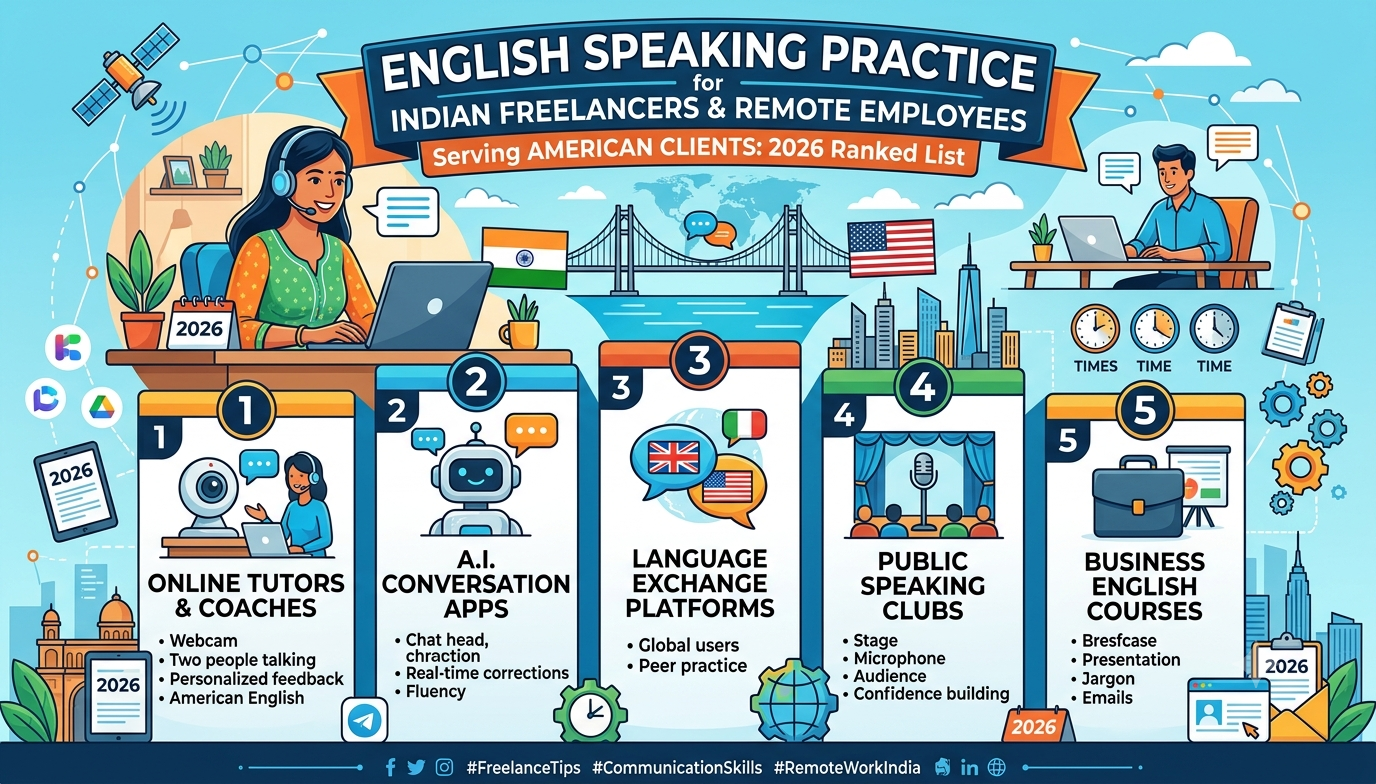
The most useful English Speaking Practice for Indian Freelancers & Remote Employees Serving American Clients: 2026 Ranked List is not simply about grammar apps or memorizing vocabulary. Indian professionals working with American clients need practice that reflects real workplace communication: discovery calls, Zoom meetings, project updates, presentations, feedback sessions, negotiations, Slack discussions, and technical explanations.
Effective communication depends on clarity, listening, pronunciation, professional vocabulary, spontaneous speaking, and confidence.
A freelancer may write excellent proposals but struggle during a discovery call. A developer may understand a client's requirement but hesitate when asked an unexpected question. A video editor may know the right solution but explain it using unnecessarily complicated language.
The goal is not to erase an Indian accent. The practical objective is intelligible, efficient, professional English that works in real conversations.
The following 10 options are ranked according to their relevance to different communication needs faced by Indian freelancers and remote employees serving American clients.
10 Ranked English Speaking Practice Options for Indian Professionals
1 — EngVarta : Live 1-to-1 English Speaking Practice
Best for: Live client-call practice and real-time speaking feedback
Live human conversation is particularly relevant for professionals who understand English but struggle to respond naturally during conversations.
EngVarta's current official information describes it as a 1-to-1 spoken-English practice service connecting learners with live TESOL/ESL-certified English Experts through audio calls. The official working-professionals page says sessions include real-time corrections and practice for professional situations such as meetings, interviews, presentations, and client calls. It currently lists 15-, 25-, and 50-minute sessions and availability from 7 AM to midnight.
This format allows professionals to practise situations such as:
-
Explaining project progress
-
Handling client questions
-
Preparing presentations
-
Asking for clarification
-
Discussing deadlines
-
Explaining technical problems
-
Responding spontaneously
For example, a freelancer preparing for a discovery call could practise answering, “Can you walk me through your previous experience with similar projects?”
The advantage of live practice is that the learner must listen and respond to another person rather than simply complete a predetermined exercise.
Consideration: Live speaking practice does not replace every form of English learning. Learners who need systematic grammar instruction or foundational vocabulary may benefit from a structured course alongside conversation practice.
2 — Structured English Speaking Courses
Best for: Learners who need a defined curriculum
An English Speaking Course can provide a structured path covering grammar, vocabulary, pronunciation, listening, speaking exercises, and professional communication.
This approach can be useful for learners who find completely self-directed study difficult. Instead of deciding what to study every day, they follow a sequence of lessons and activities.
When evaluating a Best Online English Speaking Course in India, check whether the program includes meaningful speaking practice. A course consisting mainly of recorded grammar lessons may not provide enough opportunities to respond spontaneously.
US-client example: A freelancer can use course lessons to strengthen sentence structure, then practise those structures by giving a mock project update aloud.
Consideration: A structured course can provide consistency, but learners still need active speaking opportunities outside the lesson.
3 — AI-Powered Speaking Practice
Best for: Convenient, repeatable solo speaking practice
AI-powered English tools can simulate conversations and provide opportunities to practise without waiting for another person.
Professionals can use AI practice for:
-
Client-call role-play
-
Interview questions
-
Vocabulary
-
Grammar correction
-
Quick-response exercises
-
Business scenarios
-
Conversation practice
For example, a software developer can ask an AI tool to simulate a US client who wants an explanation of a delayed feature.
AI practice is useful because it can be repeated frequently and adjusted to different scenarios.
However, AI conversation is not identical to human interaction. A real client may interrupt, ask an unexpected follow-up, change direction, misunderstand a statement, or introduce an entirely new issue.
Practical approach: Use AI for frequent solo drills, then add human conversation or role-play when you need more realistic interaction.
4 — Pronunciation and Speech-Clarity Practice
Best for: Professionals whose pronunciation affects intelligibility
Pronunciation practice should focus on communication rather than accent elimination.
Useful areas include:
-
Word stress
-
Sentence stress
-
Vowel sounds
-
Consonant sounds
-
Intonation
-
Pausing
-
Speech rhythm
An Indian professional does not need to sound American to communicate successfully with an American client. The priority is making words and sentences easy to understand.
Example: Instead of speaking rapidly through a project update, practise stressing the key information:
“We completed the first phase, and we're currently working on testing.”
Pronunciation-focused tools, speech-recognition exercises, and self-recording can help identify recurring problems.
Consideration: Pronunciation practice is most useful when it targets specific communication problems rather than attempting to completely change someone's natural accent.
5 — English Listening + Shadowing Practice
Best for: Listening comprehension, rhythm, and speaking fluency
Shadowing involves listening to a short segment of spoken English and repeating it aloud shortly afterward.
A simple routine is:
-
Listen once for meaning.
-
Listen again for rhythm and stress.
-
Repeat sentence by sentence.
-
Record yourself.
-
Listen back.
-
Repeat with clearer delivery.
Use professional material such as business presentations, interviews, webinars, podcasts, and workplace discussions.
For example, listen to a speaker saying:
“Let me give you a quick update on where we are.”
Then repeat it while paying attention to pauses and sentence stress.
The objective is not to imitate an American accent perfectly. It is to become more comfortable with natural speech patterns and different speaking speeds.
Consideration: Shadowing works best with short sections. Trying to copy an entire long presentation can become tiring without adding much practical value.
6 — English Conversation and Language-Exchange Practice
Best for: Informal conversation and spontaneous speaking
Language-exchange platforms can give learners opportunities to practice English conversation with other people.
Potential benefits include:
-
Real conversation
-
Spontaneous responses
-
Informal vocabulary
-
Exposure to different accents
-
Confidence-building
-
Listening practice
A professional could discuss hobbies, travel, work, technology, or everyday experiences with another English speaker.
However, conversation quality can vary. A language partner may not provide systematic grammar or pronunciation feedback, and professional English may not be the main focus.
US-client example: After discussing everyday topics, a learner can deliberately shift to workplace subjects such as project deadlines, presentations, or customer feedback.
Consideration: Language exchange is useful as a supplement, but professionals with specific client-communication goals may need more targeted practice.
7 — Business English and Professional Communication Practice
Best for: Client-facing professionals
Everyday English and professional English are not identical.
Freelancers and remote employees need language for:
-
Meetings
-
Presentations
-
Negotiations
-
Sales
-
Customer support
-
Project management
-
Requirements
-
Feedback
-
Deadlines
-
Problem-solving
For example:
Instead of simply saying, “There is a problem,” practise:
“We've identified an issue with the current implementation, and we're evaluating two possible solutions.”
This type of spoken English for working professionals focuses on communicating ideas clearly in a workplace context.
Practical tip: Build a phrase bank around your actual profession. A designer, developer, accountant, and customer-support professional will not need exactly the same vocabulary.
8 — Self-Recording and Speaking Review
Best for: Low-cost independent practice
A phone or computer is enough to start self-recording.
Record yourself giving:
-
A one-minute project update
-
A client introduction
-
A technical explanation
-
A presentation opening
-
A meeting summary
-
An explanation of a problem
Then review:
-
Filler words
-
Long pauses
-
Repeated words
-
Grammar mistakes
-
Pronunciation
-
Speaking speed
-
Sentence structure
-
Unnecessarily long explanations
For example, record:
“We completed the design phase last week. We're now waiting for client feedback before moving to development.”
Then listen and identify whether the message was clear and concise.
Consideration: Self-recording helps identify patterns, but you may not recognize every pronunciation or grammar problem yourself. External feedback can complement it.
9 — Client-Call Role-Play
Best for: Practising high-pressure client situations
Role-play is one of the most direct ways to prepare for conversations that freelancers and remote employees regularly encounter.
Create scenarios such as:
New Client
“Tell me about your previous experience with projects like this.”
Requirement Change
“We need to change this part of the project.”
Deadline
“Can you deliver this by Friday?”
Problem
“Why hasn't this feature been completed yet?”
Feedback
“This isn't quite what we expected.”
Clarification
“Could you explain what you mean by that requirement?”
A useful response might be:
“I understand the concern. The delay happened because we identified an issue during testing. We're addressing it now, and I'll provide an updated timeline tomorrow.”
Role-play develops the ability to speak when there is pressure, uncertainty, or disagreement.
Practical tip: Do not memorize the ideal answer. Change the details of each scenario so you practise responding rather than reciting.
10 — A Consistent Daily English Speaking Routine
Best for: Busy professionals who need consistency
A combination of several methods can create a sustainable English speaking practice for freelancers routine.
15-Minute Routine
-
5 minutes: Listen to professional English
-
5 minutes: Speak about a workplace topic
-
5 minutes: Review vocabulary and mistakes
30-Minute Routine
-
5 minutes: Professional vocabulary
-
5 minutes: Listening
-
10 minutes: English conversation or spontaneous speaking
-
5 minutes: Client-call role-play
-
5 minutes: Review
For example, a freelancer could spend the first five minutes reviewing phrases for project updates, then explain the current status of a fictional project, role-play a client objection, and review the recording.
The advantage is consistency. A short routine that fits around work may be easier to maintain than occasional long study sessions.
Best English Speaking Practice for Indian Remote Workers
The Best English Speaking Practice for Indian Remote Workers depends on the communication problem.
A professional who hesitates may need live conversation. Someone struggling with pronunciation may benefit from targeted pronunciation practice and recording. Someone with weak listening comprehension may need more listening and shadowing.
A useful way to match practice to the problem is:
-
Hesitation: spontaneous speaking and live conversation
-
Pronunciation: speech-clarity exercises
-
Limited vocabulary: professional phrase bank
-
Poor listening: listening and shadowing
-
Client-call anxiety: role-play
-
Slow responses: one-minute speaking drills
-
Lack of feedback: instructor or human conversation
-
Poor consistency: structured course or daily routine
There is no single method that serves every learner equally.
Freelancers vs Remote Employees: What Should They Practise?
Freelancers
Freelancers often need English for:
-
Discovery calls
-
Client pitching
-
Proposal discussions
-
Negotiations
-
Scope changes
-
Project updates
-
Feedback
-
Client retention
A video editor, for example, may need to explain why a revision affects the delivery timeline.
Remote Employees
Remote employees may spend more time on:
-
Team meetings
-
Daily stand-ups
-
Manager communication
-
Cross-functional discussions
-
Presentations
-
Performance conversations
-
Client-facing meetings
-
Internal collaboration
A project manager may need to summarize several teams' progress during a weekly meeting.
Both groups need strong spoken English, but the practice scenarios should reflect their actual responsibilities.
English Skills Needed for American Clients
Indian professionals serving American clients should develop several connected skills:
-
Clear pronunciation
-
Listening comprehension
-
Professional vocabulary
-
Concise responses
-
Requirement clarification
-
Problem explanation
-
Project updates
-
Feedback handling
-
Professional small talk
-
Presentation skills
-
Negotiation language
-
Spontaneous responses
American English also includes regional variation. Clients can differ in speaking speed, vocabulary, communication preferences, and individual style. It is therefore better to practise understanding different speakers than to assume there is one standard American communication style.
The practical objective is simple: understand the client accurately and make your own message easy to understand.
English Speaking Apps, Courses and Classes
The Best English Speaking Apps in India (2026) can vary depending on whether the learner needs pronunciation, vocabulary, listening, structured lessons, or conversation practice.
An English speaking app is useful for convenient daily self-practice. A Best English Learning App for one learner may not address another learner's main communication problem.
English Speaking Courses
A structured English Speaking Course can help learners who need a defined curriculum.
Someone searching for the Best Online English Speaking Course in India should check whether the course includes active speaking, feedback, and workplace applications.
Online Spoken English Classes
Best Online Spoken English Classes can be useful for people who prefer instructor-led learning and accountability.
Similarly, Online English Classes in India can include group and individual formats, so learners should consider how much time they actually spend speaking.
Live 1-to-1 Speaking Practice
Live 1-to-1 practice is particularly relevant when a professional already understands English but struggles to respond spontaneously.
It complements apps and courses by requiring the learner to listen, process information, formulate a response, and speak in real time.
Conclusion
The most useful English Speaking Practice for Indian Freelancers & Remote Employees Serving American Clients: 2026 Ranked List is ultimately practice that resembles the communication professionals actually perform.
The core progression is:
Learn → Listen → Speak → Role-play → Receive feedback → Review → Repeat
Indian professionals do not need to eliminate their accent to work effectively with American clients. The practical priorities are clear pronunciation, intelligibility, listening comprehension, professional vocabulary, spontaneous speaking, and confidence.
Different methods serve different purposes. Apps can support convenient daily practice, structured courses can provide a curriculum, AI can provide repeatable solo conversation, and live human practice can create real-time interaction. EngVarta is one option for professionals specifically looking for 1-to-1 audio speaking practice and real-time corrections in professional scenarios such as client calls, meetings, presentations, and interviews.
The strongest routine is not necessarily the one with the most features. It is the one that addresses the learner's actual communication gap and can be practised consistently around real freelance or remote-work responsibilities.
Frequently Asked Questions
1. What is the best English speaking practice for Indian freelancers?
The appropriate practice depends on the freelancer's communication needs. Discovery-call role-play, spontaneous speaking drills, professional vocabulary, self-recording, and live conversation can all be useful. A freelancer who understands English but hesitates during client calls may need more active speaking practice than additional grammar lessons.
2. How can Indian remote employees improve English for American clients?
Practise actual workplace situations: project updates, clarification, technical explanations, feedback, deadlines, presentations, and unexpected questions. Combine listening, speaking, role-play, pronunciation practice, and feedback. The objective should be clear and efficient professional communication rather than changing your Indian accent.
3. Which English speaking app is useful for working professionals?
The appropriate English speaking app depends on the learner's goal. Some are designed around structured lessons, others emphasize pronunciation or AI conversation. Professionals should look for features relevant to their communication gap, such as speaking exercises, feedback, listening practice, or workplace scenarios.
4. Are English speaking apps enough to improve spoken English?
Apps can provide useful daily practice in vocabulary, pronunciation, listening, grammar, and speaking. However, professionals who need spontaneous workplace communication may also benefit from role-play and human conversation. Combining different practice formats can expose learners to a wider range of communication situations.
5. Should freelancers take an English speaking course?
A course can be useful when a freelancer needs structure, accountability, and systematic instruction. However, a course should not replace active speaking practice. Freelancers who already understand grammar may benefit from combining structured learning with client-call role-play, self-recording, and live English conversation.
6. How can I practise English conversation for client calls?
Create realistic client scenarios and answer aloud without reading a script. Practise project updates, deadlines, requirement changes, objections, clarification questions, and technical explanations. Record your answers and review your pronunciation, pauses, vocabulary, and sentence structure.
7. How can I improve my pronunciation for American clients?
Focus on pronunciation features that affect intelligibility, including difficult sounds, word stress, sentence stress, pacing, and articulation. Record yourself and identify recurring problems. You do not need to eliminate your Indian accent; the practical objective is speech that clients can understand comfortably.
8. How can I speak English more confidently during meetings?
Practise the types of responses you regularly need in meetings. Rehearse short updates, clarification questions, recommendations, disagreement, and answers to unexpected questions. Repeatedly speaking in similar situations can make sentence formation more automatic and reduce dependence on memorized scripts.
9. How much English speaking practice should I do every day?
A practical starting point is 15 minutes a day. You can spend five minutes listening, five minutes speaking, and five minutes reviewing. Professionals with more time can use a 30-minute routine that adds vocabulary and client-call role-play. The routine should be realistic enough to maintain consistently.
10. Is live 1-to-1 English practice useful for remote professionals?
Live 1-to-1 practice can be useful when the learner needs real-time interaction. It provides an opportunity to listen to another person, formulate responses, practise professional scenarios, and receive feedback. It can complement English speaking apps, AI tools, courses, and self-guided exercises.

 English
 French
 Spanish
 Portuguese
 Deutsch
 Turkish
 Dutch
Dutch
 Italiano
 Russian
 Romaian
 Portuguese (Brazil)
 Greek
Greek
