


 About Urh Social
 Terms of Service
 Privacy Policy
 Contact
Does an Andrology Room Design Company Work with Government Hospitals?
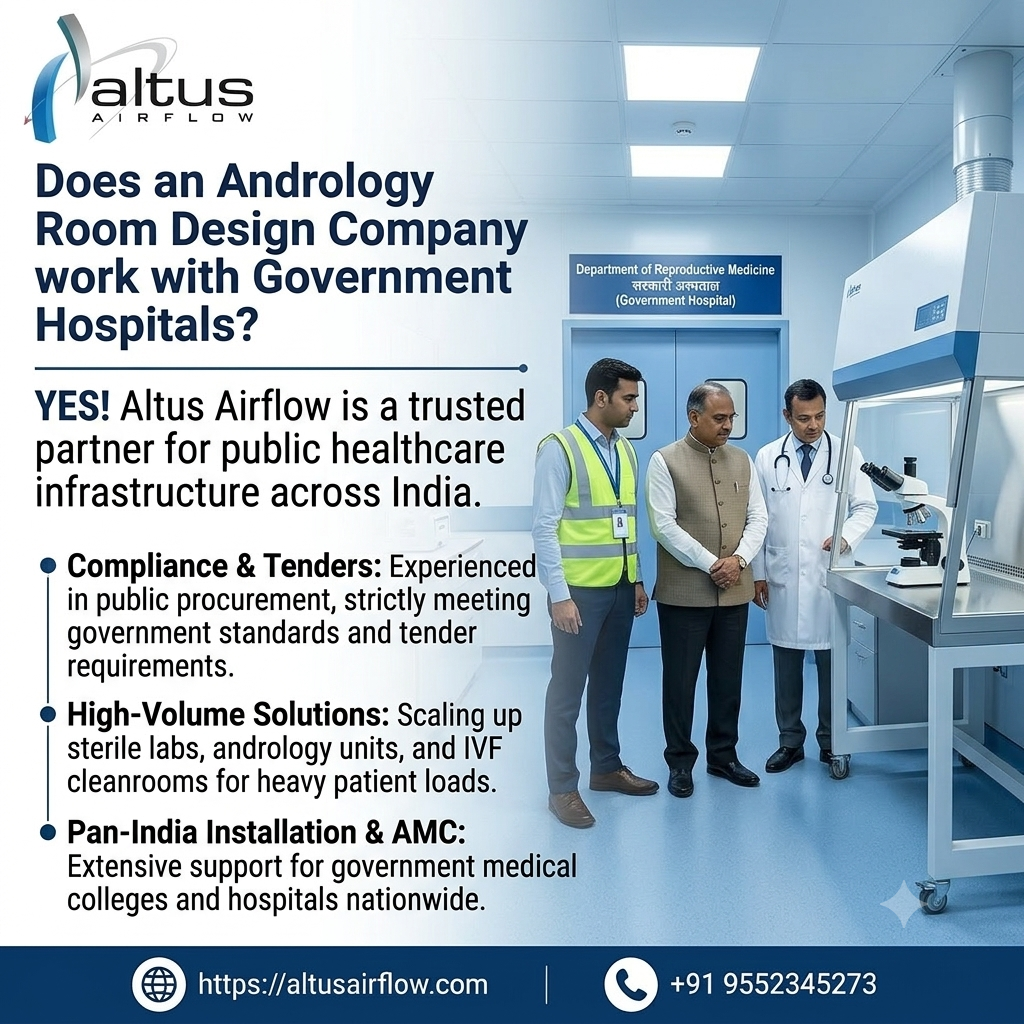
Introduction
Altus Airflow understands that government hospitals require specialised laboratory infrastructure to support reproductive healthcare services and male fertility investigations. An Andrology Room Design Company can work with government healthcare institutions to develop functional laboratory environments that meet technical, operational, and hygiene requirements. These projects involve coordinating modular interiors, ventilation systems, electrical infrastructure, laboratory equipment provisions, and environmental controls. Proper planning helps government hospitals establish organised and reliable andrology facilities that support semen analysis, sample processing, and other specialised diagnostic activities.
Government hospital projects may involve architects, biomedical engineers, procurement departments, healthcare consultants, and laboratory professionals. Effective coordination between these stakeholders helps ensure that laboratory infrastructure meets the institution's requirements.
1. Can an Andrology Room Design Company Work with Government Hospitals?
Yes, specialised laboratory infrastructure companies can work with government hospitals to plan, design, and develop andrology laboratory facilities. Government healthcare institutions require dedicated spaces for reproductive health investigations, diagnostic procedures, and laboratory-based services.
An experienced infrastructure provider can support these projects by understanding the hospital's requirements and coordinating the necessary technical arrangements.
Some important areas of collaboration include:
-
Planning specialised andrology laboratory layouts.
-
Designing modular wall and ceiling systems.
-
Integrating ventilation and air-conditioning infrastructure.
-
Providing provisions for laboratory equipment.
-
Planning electrical and data connectivity.
-
Supporting environmental monitoring arrangements.
-
Coordinating installation and commissioning activities.
Government hospitals may engage specialised companies through approved procurement procedures, public tenders, government e-marketplace platforms, or other permitted purchasing arrangements.
The final selection depends on the institution's eligibility requirements, technical specifications, procurement policies, and applicable regulations.
2. Why Do Government Hospitals Need Specialised Andrology Laboratories?
Male reproductive health services are an important part of comprehensive fertility healthcare. Government hospitals and public medical institutions may provide diagnostic services that require specialised laboratory infrastructure.
An andrology laboratory supports activities such as semen analysis, sperm preparation, sample evaluation, and other male fertility investigations, depending on the facility's clinical scope.
A properly planned laboratory helps support these activities through organised workstations, suitable equipment placement, and controlled environmental conditions.
Important requirements include:
Dedicated laboratory spaces: Separate areas may be planned for sample reception, preparation, examination, and supporting activities according to workflow requirements.
Hygienic interiors: Smooth, cleanable surfaces and appropriately sealed joints support routine cleaning and disinfection.
Controlled ventilation: Properly designed ventilation helps maintain suitable environmental conditions.
Equipment accessibility: Laboratory furniture and service connections should accommodate the instruments required for routine procedures.
Storage provisions: Appropriate storage arrangements help organise reagents, consumables, and laboratory materials.
Monitoring systems: Temperature, humidity, and other relevant environmental parameters can be monitored through suitable digital systems.
These infrastructure features help government hospitals develop laboratories that support their reproductive healthcare programmes.
3. How Does an Andrology Room Design Company Support Government Hospital Projects?
Government hospital projects often require coordination between several departments and technical professionals. A specialised infrastructure company can assist with different stages of laboratory development.
A. Understanding Hospital Requirements
The first stage involves understanding the hospital's clinical objectives, available space, laboratory activities, and equipment requirements.
The infrastructure team may coordinate with hospital administrators, laboratory specialists, biomedical engineers, and technical consultants.
Important information includes:
-
Expected laboratory activities.
-
Number of workstations required.
-
Equipment specifications.
-
Sample handling requirements.
-
Environmental conditions.
-
Electrical and ventilation requirements.
-
Future expansion provisions.
Understanding these requirements helps establish a practical design direction.
B. Preparing Laboratory Layouts
After identifying the requirements, the design team prepares a laboratory layout that supports organised movement and efficient use of available space.
The layout may include dedicated areas for sample collection support, sample reception, semen analysis, sample preparation, equipment installation, and storage.
The final arrangement should consider patient privacy, staff movement, hygiene protocols, and the separation of activities where necessary.
C. Technical Infrastructure Planning
Technical planning involves integrating different laboratory systems into a coordinated design.
These may include modular partitions, HVAC systems, electrical connections, data points, lighting, and equipment provisions.
Early coordination helps reduce installation conflicts and supports a more organised project execution process.
D. Installation and Commissioning
Once the design and technical requirements are approved, installation activities can begin according to the project schedule.
The work may involve modular panel installation, ventilation integration, electrical connections, equipment coordination, and environmental testing.
Commissioning helps verify that installed systems operate according to the approved specifications.
4. What Infrastructure Is Required for Government Andrology Laboratories?
Government hospitals require laboratory infrastructure that supports their intended clinical activities while maintaining appropriate hygiene and safety conditions.
A specialised laboratory project may include several interconnected components.
Modular wall and ceiling panels
Modular panels provide organised interior surfaces and can incorporate provisions for electrical connections, service access, and specialised equipment.
Smooth and cleanable finishes are important considerations when selecting interior materials.
HVAC and ventilation systems
Ventilation systems help maintain appropriate temperature, humidity, and air circulation.
The design should consider the laboratory's activities, occupancy, equipment requirements, and applicable environmental specifications.
Electrical infrastructure
Laboratory instruments require suitable electrical connections and properly planned distribution systems.
Dedicated circuits, appropriate protective devices, earthing arrangements, and backup provisions should be considered according to equipment requirements.
Laboratory lighting
Adequate lighting supports visual examination, sample handling, and other laboratory activities.
LED lighting systems may be selected for their energy efficiency, service life, and illumination performance.
Laboratory furniture
Workbenches, storage cabinets, instrument tables, and other furniture should be arranged according to laboratory workflow.
Environmental monitoring
Temperature sensors, humidity monitors, and other relevant monitoring devices help laboratory personnel maintain oversight of environmental conditions.
5. How Do Government Procurement Procedures Affect Laboratory Projects?
Government hospital projects generally follow established procurement and administrative procedures.
A specialised laboratory infrastructure provider must understand the requirements associated with public-sector projects before participating.
Common procurement approaches include:
Public Tendering
Government hospitals may publish tenders describing the required laboratory infrastructure, technical specifications, eligibility conditions, and project scope.
Interested companies must submit the required technical and commercial documentation according to the tender instructions.
Government e-Marketplace (GeM)
Certain government procurement requirements may be fulfilled through the Government e-Marketplace platform, depending on the category of products or services and applicable purchasing rules.
Companies participating in relevant procurement activities should understand the platform's registration and documentation requirements.
Technical Evaluation
Government institutions may evaluate submitted proposals based on technical specifications, company eligibility, previous experience, certifications, and other tender-defined criteria.
Project Approval
Before execution, the proposed design and technical details may require approval from authorised hospital departments and consultants.
This process helps ensure that the project follows the institution's requirements and procurement conditions.
6. What Documentation May Be Required for Government Hospital Projects?
Documentation is an important part of public healthcare infrastructure projects.
The exact requirements vary depending on the tender, institution, project scope, and applicable procurement regulations.
Commonly requested documents may include:
-
Company registration documents.
-
Tax registration details.
-
Relevant business licences.
-
Technical product specifications.
-
Previous project experience.
-
Manufacturer authorisations, where applicable.
-
Quality management certifications, where required.
-
Equipment compliance documentation.
-
Project execution schedules.
-
Warranty and maintenance details.
-
Technical drawings and installation plans.
Companies should carefully review each tender before submitting documents because eligibility requirements may differ between government institutions.
Complete documentation also helps project teams maintain clear records throughout the approval and execution stages.
7. How Is Infection Control Maintained in Government Andrology Laboratories?
Infection prevention and laboratory hygiene are important considerations in government healthcare facilities.
An andrology laboratory should be designed to support established cleaning procedures, safe sample handling, and appropriate movement between functional areas.
Some important design considerations include:
Seamless interior finishes: Smooth surfaces and properly sealed joints help simplify cleaning activities.
Appropriate ventilation: HVAC systems should be designed according to the laboratory's environmental and clinical requirements.
Organised workstations: Separate functional areas help reduce unnecessary movement and improve workflow organisation.
Handwashing facilities: Suitable handwashing provisions should be included according to the laboratory layout and hygiene requirements.
Waste management: Designated arrangements should support the safe handling and disposal of laboratory waste.
Storage management: Reagents, consumables, and other materials should have appropriate storage provisions.
The laboratory design should support the hospital's infection prevention and biomedical waste management procedures.
8. Importance of Equipment Integration in Government Andrology Projects
Laboratory equipment must be considered during the early design stage to ensure that the infrastructure accommodates the intended diagnostic activities.
Different andrology laboratories may require different instruments depending on their clinical services.
Common equipment may include:
-
Laboratory microscopes.
-
Centrifuges.
-
Semen analysis instruments.
-
Temperature-controlled equipment.
-
Refrigerators and freezers.
-
Laboratory workstations.
-
Sample handling accessories.
-
Digital documentation systems.
The design team should review equipment dimensions, electrical requirements, operating conditions, service access, and maintenance requirements.
Proper equipment integration helps prevent space limitations and installation conflicts.
Coordination with biomedical engineers and laboratory professionals is particularly important because equipment specifications can influence electrical planning, ventilation, furniture arrangements, and workstation dimensions.
9. How Do Monitoring Systems Improve Government Laboratory Operations?
Modern monitoring technologies help government hospitals maintain better control over laboratory environmental conditions.
Digital systems can collect information from sensors and provide readings through centralised displays.
Common monitoring applications include:
Temperature monitoring: Tracks room and storage equipment temperatures.
Humidity monitoring: Provides information about relative humidity levels.
Differential pressure monitoring: Measures pressure differences between designated areas where controlled pressure relationships are required.
Equipment monitoring: Helps identify equipment faults and abnormal operating conditions.
Alarm systems: Notify authorised personnel when selected parameters move outside established limits.
Data logging: Maintains historical records that can support quality management and technical reviews.
These systems help laboratory personnel identify environmental deviations and follow appropriate corrective procedures.
10. Can an Andrology Laboratory Be Expanded in the Future?
Government hospitals may need to expand their diagnostic services as patient requirements and healthcare programmes develop.
Therefore, future flexibility should be considered during the initial laboratory planning stage.
Modular construction can support organised infrastructure provisions that may accommodate selected future modifications.
Important considerations include:
-
Adaptable laboratory layouts.
-
Accessible electrical and data connections.
-
Additional equipment installation provisions.
-
Flexible furniture arrangements.
-
Accessible service panels.
-
Expandable ventilation provisions.
-
Additional monitoring system connections.
Future modifications should still undergo appropriate technical assessment to ensure that environmental performance, hygiene, electrical safety, and laboratory workflow are maintained.
A well-planned infrastructure layout can make future equipment integration and selected upgrades more manageable.
11. What Should Government Hospitals Check Before Selecting a Design Company?
Choosing an appropriate infrastructure partner is an important step in developing a specialised laboratory.
Government hospitals should evaluate companies according to their technical capabilities and the specific requirements of the proposed project.
Important factors include:
Relevant project experience: Review experience in modular healthcare infrastructure and specialised laboratory projects.
Technical understanding: Evaluate knowledge of ventilation, modular panels, electrical systems, and laboratory equipment integration.
Design capabilities: Check whether the company can coordinate layouts and technical drawings with hospital consultants.
Quality documentation: Review relevant quality certifications, product documentation, and testing procedures.
Installation capabilities: Assess the ability to coordinate site activities and follow approved project schedules.
Commissioning support: Verify whether the project scope includes testing, documentation, and handover support.
Maintenance provisions: Review the availability of technical support and maintenance arrangements according to contractual requirements.
A detailed technical evaluation helps institutions select an appropriate project partner through their established procurement procedures.
12. Importance of Coordination Between Architects, Consultants, and Hospital Teams
Government hospital projects generally involve several stakeholders who contribute to different aspects of laboratory development.
Architects plan the overall layout, while electrical and HVAC consultants develop the technical infrastructure.
Biomedical engineers provide equipment-related inputs, and laboratory professionals explain the operational requirements.
A specialised infrastructure company coordinates these requirements during the design and installation stages.
Effective coordination helps ensure that:
-
Laboratory dimensions match equipment requirements.
-
Electrical connections are available at appropriate locations.
-
Ventilation arrangements support the intended room conditions.
-
Modular panels accommodate required services.
-
Furniture supports laboratory workflow.
-
Maintenance access is considered.
-
Testing and commissioning activities are planned.
Regular technical discussions and approved drawings help minimise misunderstandings during project execution.
Conclusion
Government hospitals can work with specialised infrastructure providers to develop modern and functional andrology laboratories. These projects require careful planning of modular interiors, ventilation systems, electrical infrastructure, laboratory equipment, monitoring technologies, and infection control provisions. Understanding public procurement procedures, technical documentation, and institutional requirements is equally important for successful project implementation.
An experienced Andrology Room Design Company can support government healthcare institutions through coordinated planning, technical integration, and organised installation processes.
Altus Airflow focuses on specialised modular healthcare and laboratory infrastructure, supporting hospitals in developing functional and technically coordinated environments. Altus Airflow aims to address modern laboratory requirements through modular construction, ventilation integration, and carefully planned infrastructure solutions.
Frequently Asked Questions (FAQs)
1. Does an Andrology Room Design Company work with government hospitals?
Yes, an Andrology Room Design Company can work with government hospitals through approved tenders, procurement platforms, and institutional project arrangements.
2. What services are required for government andrology laboratory projects?
Services may include laboratory layout planning, modular interiors, HVAC integration, electrical infrastructure, and equipment coordination.
3. Do government hospitals require specialised andrology laboratories?
They may require specialised laboratories to provide semen analysis, male fertility investigations, and related diagnostic services.
4. How do government hospitals select laboratory infrastructure companies?
They generally follow established procurement procedures involving eligibility checks, technical evaluation, and tender requirements.
5. Is modular construction suitable for government andrology laboratories?
Yes, modular construction can support organised laboratory layouts, integrated services, and selected future modifications.
Read Our Previous Blog --------------->What monitoring systems are used in Andrology Room Design?

 English
 Arabic
 French
 Spanish
 Portuguese
 Deutsch
 Turkish
 Dutch
 Italiano
 Russian
 Portuguese (Brazil)
 Greek
