


 About Urh Social
 Terms of Service
 Privacy Policy
 Contact
Ceramic Membrane Market Growth, Company Revenue Share, Key Drivers & Trend Analysis By Fact.MR
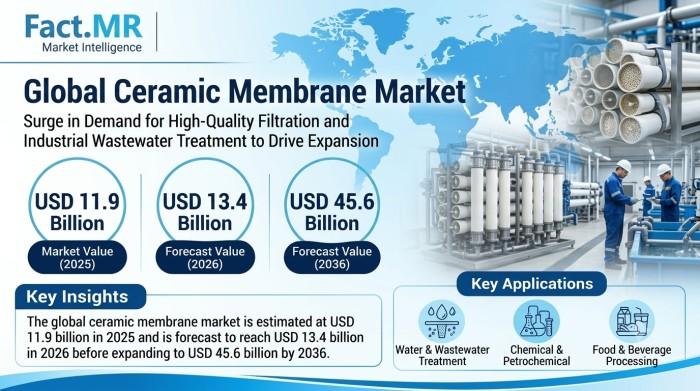
Rockville, Maryland, November 27, 2026 – According to Fact.MR Analysis, the global ceramic membrane market is estimated at USD 11.9 billion in 2025 and is forecast to reach USD 13.4 billion in 2026 before expanding to USD 45.6 billion by 2036.
This forecast represents a significant commercial opportunity for membrane manufacturers, filtration equipment suppliers and water treatment technology providers. Increasing attention to wastewater quality, water recovery and industrial process efficiency is creating demand for systems that can maintain filtration performance under challenging operating conditions.
Request for PDF Report Sample Pages:https://www.factmr.com/connectus/sample?flag=S&rep_id=8023
Here's why that matters: treatment facilities are not simply looking for filtration capacity. They also need equipment that can withstand repeated cleaning, manage suspended solids and operate reliably when wastewater characteristics change.
Water Treatment Requirements Create New Commercial Opportunities
Water and wastewater treatment is expected to account for 41.5% of the ceramic membrane market in 2026, according to Fact.MR. Municipal utilities are an important source of demand as public infrastructure operators look for dependable filtration solutions to support water treatment and reuse requirements.
Ceramic membranes offer an alternative for applications where conventional filtration materials may face difficulties from chemical exposure, elevated temperatures or demanding cleaning procedures. Their durability makes them relevant to industrial facilities processing wastewater with varying concentrations of suspended solids.
For procurement teams, this changes the equipment evaluation process. Initial purchase price remains relevant, but operating life, cleaning requirements and replacement frequency also influence the overall investment decision.
Industrial process plants represent another important customer group. Their interest in ceramic filtration is connected to wastewater management, process-water recovery and the need to maintain consistent treatment performance across production operations.
Microfiltration and Alumina Maintain Strong Segment Positions
Technology selection remains an important factor in the market's development. Fact.MR estimates that microfiltration will represent 30.0% of the ceramic membrane market in 2026. Its position reflects demand for particle removal and pretreatment applications across municipal and industrial water facilities.
Ultrafiltration serves applications requiring tighter separation, while nanofiltration addresses more selective filtration requirements. These different technologies allow suppliers to address varying treatment needs rather than relying on one membrane configuration for every installation.
Material selection also influences purchasing decisions. According to Fact.MR, alumina membranes are projected to capture 44.0% of the market in 2026. Their combination of durability, availability and cost considerations supports their adoption across filtration projects.
Zirconia, titania and silica provide additional material options for applications with different operating requirements. Manufacturers that can match membrane composition with specific feed-water conditions may have an advantage when competing for specialized industrial projects.
Module configuration adds another dimension to product selection. Fact.MR expects tubular modules to account for 38.0% of the market in 2026. Their suitability for wastewater containing substantial suspended solids makes them relevant to facilities where blockage and cleaning requirements influence equipment performance.
Municipal Utilities and Industrial Buyers Shape Procurement Priorities
Municipal utilities are forecast to represent 36.0% of ceramic membrane market demand in 2026, according to Fact.MR. Public water infrastructure requires filtration equipment capable of supporting consistent treatment operations while managing changing source-water conditions.
Industrial process plants have different purchasing priorities. They often evaluate membranes according to their ability to handle difficult wastewater streams, tolerate cleaning procedures and support process-water recovery.
Food and beverage processors also represent an application opportunity, particularly where filtration is required during production and clarification processes.
These differences create distinct commercial requirements for manufacturers. Suppliers must demonstrate application-specific performance rather than relying solely on general membrane specifications. Pilot testing, technical assistance and maintenance support can influence whether a product progresses from initial evaluation to full-scale installation.
China and India Lead Country Growth Expectations
Asia continues to offer substantial opportunities as municipal treatment infrastructure and industrial water requirements expand.
According to Fact.MR, China is projected to record the highest country-level growth, with a CAGR of 14.1% between 2026 and 2036. India follows at 13.4%, supported by expanding urban water infrastructure and industrial development.
Other important country forecasts include:
- USA: 11.9% CAGR
- Japan: 10.9% CAGR
- Germany: 10.1% CAGR
- Brazil: 9.5% CAGR
These projections indicate opportunities across both established industrial economies and developing water infrastructure markets.
For equipment manufacturers, regional expansion will require more than product availability. Installation expertise, local technical support and the ability to test membranes against actual wastewater conditions will remain important considerations for customers.
Higher Initial Costs Remain an Adoption Challenge
Despite the positive outlook, ceramic membrane adoption faces commercial and technical barriers. High upfront investment can make these systems difficult to justify for facilities operating under strict capital budgets.
The qualification process can also take time. Wastewater composition differs between industrial sites, meaning filtration performance must be evaluated against the actual operating environment before equipment selection.
Fact.MR analyst Shambhu Nath Jha observes that purchasing decisions are increasingly influenced by operating reliability and the potential costs associated with cleaning interruptions and premature replacement. Suppliers that demonstrate consistent performance and provide dependable technical assistance may be better positioned to secure repeat business.
For buyers, the implication is straightforward: comparing membrane systems only through initial equipment prices can overlook important differences in operating requirements and long-term maintenance exposure.
Gain Full Access to Market Forecasts and Key Drivers:https://www.factmr.com/report/ceramic-membrane-market
Competitive Landscape and Industry Outlook
Competition in the ceramic membrane market includes established filtration equipment providers and specialized membrane manufacturers. Companies covered in Fact.MR's analysis include GEA Group AG, Kovalus Separation Solutions Inc., TAMI Industries SAS, METAWATER Co., Ltd. and LiqTech International, Inc.
Their market positioning reflects the importance of membrane technology, application expertise and customer support in industrial filtration markets.
As demand develops, manufacturers will need to address several purchasing priorities: dependable filtration performance, suitability for difficult wastewater streams, manageable cleaning requirements and effective after-sales service.
The market's projected expansion also creates opportunities for suppliers of membrane modules, filtration equipment and integrated treatment solutions. However, commercial success will depend on demonstrating measurable value at individual treatment facilities.
With the global ceramic membrane market forecast to reach USD 45.6 billion by 2036, according to Fact.MR, the next decade is expected to bring wider opportunities across municipal water treatment, industrial wastewater management and specialized filtration applications.
Explore Top Trending Reports & Related Report:
Circular Polyester Intermediates Market: https://www.factmr.com/report/circular-polyester-intermediates-market
Abrasion-Resistant Coating Resins Market: https://www.factmr.com/report/abrasion-resistant-coating-resins-market
High-Temperature Structural Resins Market: https://www.factmr.com/report/high-temperature-structural-resins-market
About Fact.MR
Fact.MR is a market research and consulting firm providing market intelligence, industry analysis, and strategic research across multiple business sectors. Its research focuses on market sizing, forecasting, competitive analysis, industry trends, and emerging commercial opportunities.
Through its research reports, Fact.MR supports manufacturers, suppliers, investors, procurement professionals, and business decision-makers in understanding market developments and evaluating strategic opportunities.
Media Contact
Fact.MR Media Relations Team
Organization: Fact.MR
Email: [email protected]
Website: https://www.factmr.com
Media Kit: Contact Fact.MR through its official website for media and report-related enquiries.t specified in the source material.

 English
 Arabic
 French
 Spanish
 Portuguese
 Deutsch
 Turkish
 Dutch
 Russian
 Romaian
 Portuguese (Brazil)
 Greek
