


 About Urh Social
 Terms of Service
 Πολιτική Ιδιωτικότητας
 Contact
Global Kosher Food Market Forecast and Growth Analysis 2027–2034
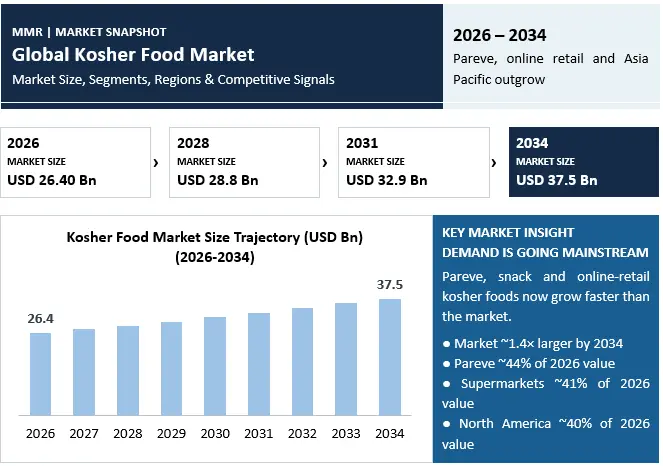
Global Kosher Food Market Overview
The Global Kosher Food Market is witnessing steady growth, driven by increasing consumer awareness of food quality, ingredient transparency, certified food products, and changing dietary preferences. According to Maximize Market Research, the market was valued at USD 26.40 billion in 2026 and is projected to reach USD 37.5 billion by 2034, growing at a CAGR of 4.5% during 2027–2034.
Kosher food refers to food products prepared, processed, and certified according to Jewish dietary laws, known as Kashrut. These regulations specify which ingredients and food products are permitted and establish requirements for food preparation, processing, storage, and handling. Kosher certification provides consumers with assurance regarding ingredient verification, production supervision, and product traceability.
Growing demand for certified packaged foods, processed products, dairy items, meat, poultry, snacks, and beverages is supporting market expansion. Additionally, kosher certification is increasingly attracting consumers outside traditional religious communities, including individuals who prioritize food quality, transparency, and reliable manufacturing standards.
North America dominates the global market due to established kosher certification organizations, strong product availability, and significant consumer demand. Meanwhile, Asia Pacific is emerging as a promising region, supported by expanding food manufacturing, international trade, and increasing availability of certified products.
Request for a Free Sample of This Strategic Report ➤ https://www.maximizemarketresearch.com/request-sample/331947/
Global Kosher Food Market Dynamics
Growth Drivers
Increasing Demand for Certified Food Products
Growing consumer awareness of food ingredients, manufacturing processes, and product quality is driving demand for kosher-certified foods. Consumers increasingly recognize kosher certification as an additional assurance of ingredient verification and supervised production. This trend is encouraging food manufacturers to introduce certified products across multiple categories.
Rising Demand for Packaged and Processed Foods
The growing consumption of convenient food products is supporting demand for kosher-certified packaged and processed foods. Manufacturers are expanding their certified product portfolios across snacks, confectionery, bakery products, beverages, and ready-to-eat meals to reach a wider consumer base.
Expansion of Online Food Retail
The increasing popularity of e-commerce platforms is improving access to kosher-certified products. Online retailers enable consumers to discover specialized food brands, compare certification information, and purchase products that may not be available through traditional grocery stores.
Market Restraints
High Certification and Production Costs
Kosher certification requires ingredient verification, production supervision, regular audits, and compliance with specific manufacturing standards. Maintaining separate production facilities or equipment for meat and dairy products can increase operational expenses, particularly for small and medium-sized manufacturers.
Supply Chain and Distribution Challenges
Maintaining kosher compliance throughout sourcing, processing, storage, and transportation creates additional supply chain requirements. Limited availability of certified ingredients and specialized processing facilities can affect production efficiency and product pricing.
Market Opportunities
Growing Opportunities in Plant-Based and Pareve Products
The rising popularity of plant-based diets is creating opportunities for kosher pareve products. These products contain neither meat nor dairy ingredients, making them suitable for different dietary preferences. Manufacturers are increasingly introducing plant-based alternatives, dairy-free products, and clean-label food options.
Expansion Across Emerging Markets
Increasing international trade and demand for certified food products are creating opportunities in Asia Pacific, the Middle East, and South America. Food manufacturers can strengthen their global presence by obtaining recognized kosher certifications and expanding export-oriented product portfolios.
Market Trends
The market is experiencing a shift toward clean-label, organic, plant-based, and traceable food products. Mainstream food manufacturers are expanding kosher-certified offerings to attract consumers seeking ingredient transparency and quality assurance.
Digital retail platforms, improved certification transparency, sustainable packaging, and product innovation are also influencing the competitive landscape.
Global Kosher Food Market Segment Analysis
The market is segmented by product category, kosher classification, end user, and distribution channel.
By Product Category
-
Meat and Poultry: The largest product category, accounting for approximately 27% of the market in 2026, supported by consistent demand for certified meat and poultry products.
-
Packaged and Processed Foods: Growing demand for convenient and ready-to-eat certified food products supports this segment.
-
Dairy Products: Includes kosher-certified milk, cheese, yogurt, and other dairy products.
-
Snacks, Confectionery and Desserts: Increasing demand for convenient and specialty food products supports segment growth.
-
Bakery and Cereals: Expanding availability of certified bakery and cereal products contributes to market development.
-
Beverages: Includes kosher-certified juices, soft drinks, and other beverages.
By Kosher Classification
Pareve represents the largest classification, accounting for approximately 44% of the market in 2026. Kosher meat (Fleishig) accounts for 31%, while kosher dairy (Milchig) represents 25%.
By Distribution Channel
Supermarkets and hypermarkets dominate distribution, accounting for approximately 41% of the market. Specialty kosher stores, independent grocery retailers, wholesale distributors, and online platforms also contribute to market revenue.
Global Kosher Food Market Regional Analysis
North America
North America dominated the global Kosher Food Market with approximately 40% market share in 2026. The United States represents the major contributor, supported by established kosher certification agencies, widespread supermarket distribution, and strong consumer demand. Canada and Mexico also contribute to regional market development.
Europe
Europe accounted for approximately 22% of the global market in 2026. The United Kingdom, France, Germany, Belgium, and the Netherlands are important markets. Demand is supported by specialty food retailers, established certification systems, and cross-border food trade.
Asia Pacific
Asia Pacific is projected to be the fastest-growing regional market, registering a CAGR of 6.1%. Increasing food exports, expanding food manufacturing, tourism, and growing availability of certified products in Australia, India, China, Japan, and Singapore are supporting regional growth.
Middle East and Africa
The Middle East and Africa accounted for approximately 18% of the market in 2026. Israel represents a major contributor, supported by widespread kosher certification across food manufacturing, retail, and foodservice industries.
South America
South America represents approximately 5% of the global market. Argentina, Brazil, Chile, and Uruguay contribute through kosher-certified beef, poultry, dairy, and ingredient exports.
Request for a Free Sample of This Strategic Report ➤ https://www.maximizemarketresearch.com/request-sample/331947/
Competitive Landscape of the Global Kosher Food Market
The competitive landscape includes specialized kosher food manufacturers, multinational food companies, ingredient suppliers, and regional food producers. Companies are focusing on product innovation, certification credibility, distribution expansion, and strategic partnerships to strengthen their market positions.
Key companies include:
-
Manischewitz Company
-
Kayco
-
Empire Kosher Poultry
-
Streit’s
-
Gefen
-
Hebrew National
-
Tnuva
-
Strauss Group
-
Osem-Nestlé
-
Willi-Food Investments
-
General Mills
-
The Kraft Heinz Company
-
PepsiCo
-
Nestlé
-
Unilever
-
Mondelez International
-
The Hershey Company
Recent Developments in the Kosher Food Market
-
January 2026: Orthodox Union introduced an updated beer certification policy, strengthening kosher compliance requirements for beverages served at certified establishments and events.
-
July 2026: EarthKosher partnered with Etimad Halal to introduce a combined kosher and halal certification program, helping manufacturers streamline certification procedures.
-
August 2026: Willi-Food International reported second-quarter 2026 sales of approximately USD 53.7 million, highlighting activity in kosher food distribution.
-
November 2026: Orthodox Union strengthened its outreach to South Korean food manufacturers, encouraging kosher certification to improve access to international markets.
Conclusion
The Global Kosher Food Market is expected to experience steady growth through 2034, supported by increasing demand for certified food products, expanding packaged food consumption, and growing awareness of ingredient transparency. North America remains the leading regional market, while Asia Pacific offers significant growth opportunities. Increasing investments in plant-based foods, pareve products, online distribution, and international certification partnerships are expected to create new opportunities for manufacturers and investors.
With the market projected to reach USD 37.5 billion by 2034, companies focusing on product diversification, certification standards, supply chain efficiency, and international expansion are expected to strengthen their competitive positions.
About Maximize Market Research
Maximize Market Research Pvt. Ltd. (MMR) is a global market research and consulting company that provides reliable, data-focused, and practical business insights. The firm serves a wide range of industries, including healthcare, pharmaceuticals, technology, automotive, electronics, chemicals, personal care, and consumer goods. Through market forecasts, competitive analysis, strategic consulting, and industry impact assessments, MMR helps organizations understand changing market conditions, identify growth opportunities, and make informed business decisions for long-term success.
Contact US:
2nd Floor, Navale IT Park Phase 3
Pune Banglore Highway, Narhe
Pune, Maharashtra 411041, India
+91 9607365656
[email protected]

 English
 Arabic
 French
 Spanish
 Portuguese
 Deutsch
 Turkish
 Dutch
 Italiano
 Russian
 Romaian
 Portuguese (Brazil)
