


 About Urh Social
 Terms of Service
 Privacy Policy
 Contact
5 Differences Between EngVarta and Free English Speaking Apps in 2026
Are Free English Speaking Apps Enough to Improve Your Fluency?
Many Indian learners use free English-speaking applications regularly. They practise vocabulary, complete grammar exercises and speak with AI chatbots, yet still hesitate when communicating during job interviews, office meetings or everyday conversations. This raises an important question: EngVarta vs Free English Speaking Apps – which approach actually helps someone become a more confident English speaker? The difference is not simply about free versus paid learning. It is about the kind of practice available. Free applications make English practice accessible and convenient, while live expert-guided platforms introduce real human interaction, personalised feedback and practical speaking guidance. The right choice depends on your current English level, individual difficulties and communication goals.
An application can help you become familiar with English, but becoming comfortable speaking it requires more than completing exercises. You need opportunities to express your own thoughts, respond to unexpected questions and learn from mistakes.
This article explores five important differences between EngVarta and free English-speaking applications to help you decide what your fluency needs in 2026.
Why Are English Speaking Apps So Popular in 2026?
English-speaking applications have become popular because they make language practice more accessible. Students, job seekers and working professionals can practise without travelling to a coaching centre or following a traditional classroom schedule.
Modern applications offer several useful features:
-
Flexible practice at convenient times.
-
Vocabulary lessons and everyday expressions.
-
Grammar and pronunciation exercises.
-
AI-based conversational simulations.
-
Repeated practice without the pressure of a human audience.
-
Affordable or free learning resources.
Free AI English Speaking Practice Apps 2026 are particularly useful for learners who want to practise independently. They can simulate common situations, such as introducing yourself, discussing hobbies, ordering food or preparing for an interview.
However, accessibility does not automatically mean that every application provides the same learning experience. Learners should also consider whether the platform offers useful feedback, meaningful speaking opportunities and practice that prepares them for real conversations.
5 Major Differences Between EngVarta and Free English Speaking Apps in 2026
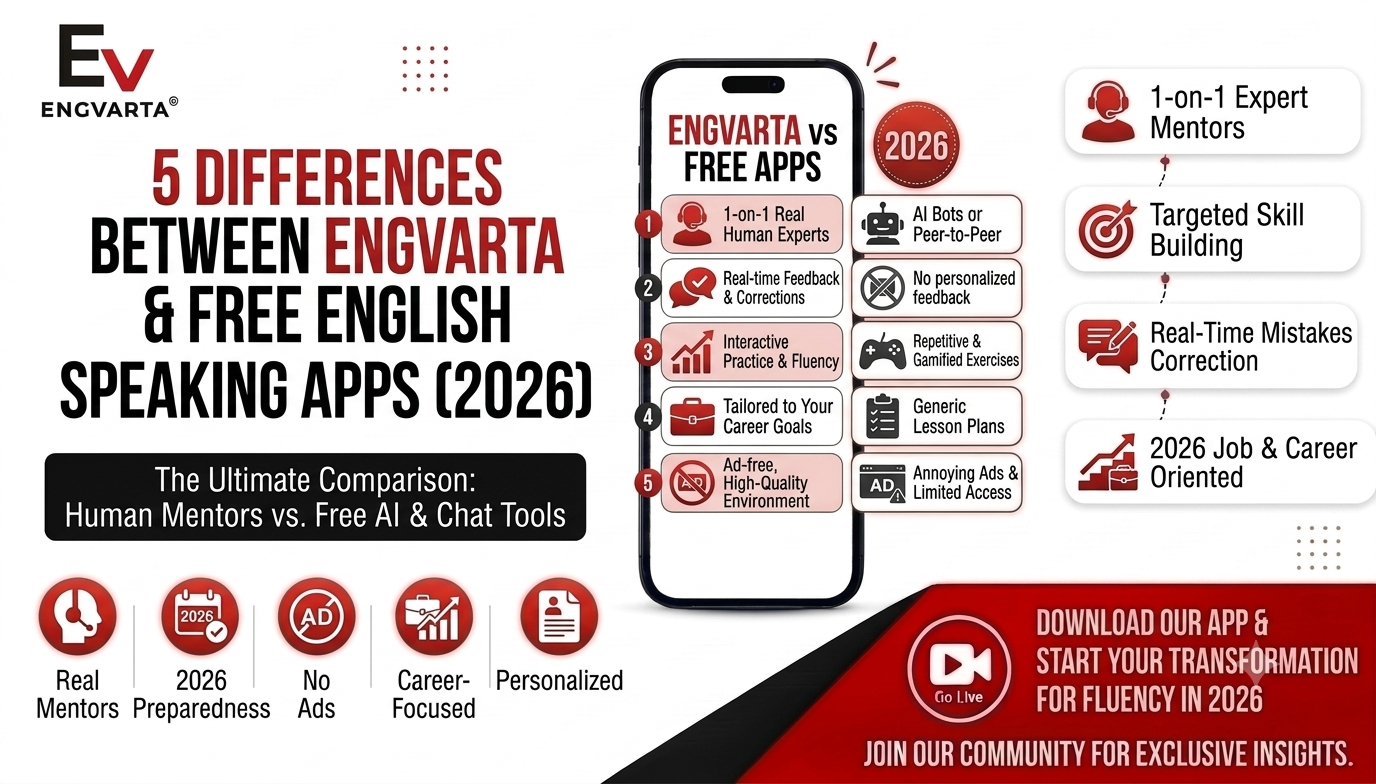
The biggest difference between EngVarta and free English-speaking applications is their approach to speaking practice. EngVarta focuses on live, one-on-one conversations with English experts, whereas free applications may offer AI exercises, automated corrections, vocabulary activities or independent speaking exercises.
Here are five important differences.
1. Live Human Conversations vs AI-Based Speaking Practice
Free English-speaking applications increasingly use AI to simulate conversations. You can practise introducing yourself, answering questions, discussing everyday topics and preparing for common communication situations.
AI practice has several advantages. You can repeat conversations, experiment with different answers and practise without worrying about another person judging your mistakes.
However, simulated conversations and live human interaction are different experiences.
During a real conversation, the other person may ask an unexpected question, request clarification or change the topic. You must listen carefully, understand the context and respond naturally.
For example, an AI exercise might ask you to introduce yourself. A real interviewer might interrupt and ask, "What makes you suitable for this position?"
Handling such situations requires spontaneous communication.
How does EngVarta approach this?
According to its official support documentation, EngVarta connects learners with TESOL/ESL-certified English experts through live, one-on-one audio calls.
Learners can practise open conversations or focus on specific objectives, such as interviews, workplace communication and everyday English.
The sessions are designed around actual interaction rather than automated conversation simulations.
This can be particularly helpful for people who understand English but freeze when speaking with another person.
It does not make AI practice useless. AI is convenient for repetition, while live conversations provide direct experience communicating with another human being.
2. Personalised Feedback vs Automated Corrections
Another important difference is the way learners receive feedback.
Many English-learning applications provide automated corrections, grammar suggestions, pronunciation exercises or speaking assessments, depending on their features.
These tools can help identify certain mistakes quickly.
However, receiving a correction and understanding how to improve your communication are not always the same thing.
Consider this example:
A learner says, "I am working in this company since two years."
An automated tool might suggest the correct sentence:
"I have been working in this company for two years."
But the learner may still wonder:
-
Why is the original sentence incorrect?
-
When should I use "since" and "for"?
-
How can I use this structure naturally in another conversation?
Personalised guidance can help answer these questions.
During EngVarta's live sessions, English experts provide real-time corrections while the conversation is happening. They can suggest better expressions, clarify grammatical mistakes and offer feedback based on the learner's communication needs.
The platform also provides session recordings and assignments for revision.
This approach is useful because learners can revisit corrections and apply them in subsequent conversations.
Research supports the educational value of corrective feedback. A study by Sato and Lyster, published in Studies in Second Language Acquisition, found that peer interaction combined with corrective feedback supported improvements in both speaking accuracy and fluency. Peer interaction alone also supported fluency development compared with the control group.
The takeaway is not that automated feedback cannot work. It is that feedback becomes more useful when learners understand it and actively apply it.
3. Real-Life Conversation Confidence vs Practising in an App Environment
Speaking comfortably to an application does not always mean you can communicate confidently in real life.
Many learners feel comfortable completing speaking exercises alone. However, when they have to speak with a manager, interviewer, client or unfamiliar person, their confidence changes.
Common difficulties include:
-
Fear of being judged for grammatical mistakes.
-
Hesitation before answering questions.
-
Translating thoughts from Hindi or another regional language.
-
Difficulty responding to unexpected questions.
-
Losing confidence after forgetting a word.
Imagine a student who can answer ten common interview questions using an AI application.
During an actual placement interview, the interviewer asks, "Can you explain a situation where you disagreed with your team leader?"
The student understands the question but struggles to organise an answer quickly.
This happens because prepared responses and spontaneous communication require different skills.
Live conversations provide opportunities to practise listening, responding and explaining ideas without depending entirely on memorised sentences.
EngVarta offers a one-on-one audio environment where learners can practise speaking with English experts without needing to appear on camera.
Its conversation preferences allow learners to communicate their learning goals before sessions.
For someone who feels nervous speaking English, this can provide a more focused environment for gradually becoming comfortable with real conversations.
4. Structured Speaking Guidance vs Self-Directed Practice
Free applications are generally convenient because learners can decide what to practise and when to practise.
This independence is valuable, especially for students and people with limited budgets.
However, self-directed practice requires learners to identify their weaknesses.
Suppose an intermediate learner spends 20 minutes every day speaking English through an application. They regularly practise familiar topics but continue making the same mistakes with sentence formation and verb tenses.
They may be speaking frequently without addressing the specific problems affecting their fluency.
Guided practice introduces a clearer direction.
A live expert can help learners:
-
Work on recurring grammar mistakes.
-
Practise relevant conversation topics.
-
Improve sentence formation.
-
Develop more natural vocabulary.
-
Prepare for professional situations.
-
Focus on specific communication difficulties.
EngVarta follows this guided approach through one-on-one conversations with English experts.
Learners can discuss their objectives, practise relevant situations and receive corrections during sessions. They also receive assignments that help them continue practising between conversations.
For example, a working professional preparing for an international client meeting can focus on explaining project updates, asking questions and responding to professional discussions.
This does not mean every free application lacks structure. Some offer organised lessons, learning paths and progress tracking. The difference is whether the platform also provides guidance based on your actual spoken communication.
5. Independent Learning Convenience vs Guided Accountability
Consistency plays an important role in language learning.
Free applications make it easy to practise whenever you have spare time. You can complete an exercise during a lunch break or practise vocabulary before going to bed.
However, having access to an application does not necessarily mean you will use it consistently.
Many learners start enthusiastically but gradually reduce their practice.
Guided learning can introduce a more purposeful routine.
For example, a learner following regular speaking sessions can set specific objectives, review previous conversations and work on corrections during subsequent sessions.
EngVarta supports this process through live sessions, recordings and expert-provided assignments.
Its sessions are available between 7 AM and midnight IST, according to its official support information. Learners can connect without making a conventional advance appointment.
The recordings can be revisited for 30 days, allowing learners to notice recurring hesitation, filler words and mistakes.
However, accountability does not automatically guarantee improvement. Learners must still participate actively, review feedback and apply corrections.
The most effective routine is one that combines consistent independent practice with purposeful opportunities to communicate.
Are Free English Speaking Apps Completely Worthless? Not At All.
Free English-speaking applications are valuable resources, particularly for beginners and learners who cannot afford paid classes.
They can support several aspects of English learning:
-
Building vocabulary.
-
Understanding basic grammar.
-
Practising pronunciation.
-
Learning everyday expressions.
-
Simulating common conversations.
-
Developing regular speaking habits.
-
Improving familiarity with spoken English.
For someone starting from scratch, these resources can provide a useful foundation.
AI-based tools can also make practice less intimidating. Learners can repeat difficult sentences, experiment with vocabulary and practise common questions at their own pace.
However, additional guidance may become useful when:
-
You repeatedly make the same mistakes.
-
You understand English but struggle to speak confidently.
-
You cannot respond naturally to unexpected questions.
-
You need feedback on your communication.
-
You are preparing for an important interview or workplace interaction.
The best approach is not necessarily to abandon free applications. Instead, use them for independent learning and consider live expert practice when you need more personalised support.
Who Should Choose EngVarta and Who Can Continue with Free Apps?
The right choice depends on your learning needs rather than the number of features an application offers.
Free English-speaking apps may suit:
-
Beginners exploring spoken English.
-
Learners with limited budgets.
-
People who prefer independent practice.
-
Learners interested in AI conversation exercises.
-
Students building basic vocabulary and grammar knowledge.
-
People who want flexible practice without fixed sessions.
Live expert-guided practice may suit:
-
Learners who hesitate during conversations.
-
Intermediate speakers who need personalised feedback.
-
Professionals improving workplace communication.
-
Students preparing for placement interviews.
-
Job seekers who need English speaking practice for interviews.
-
People who understand English but struggle to express their thoughts naturally.
For the second group, EngVarta is worth considering because it focuses on guided, live English conversations rather than relying entirely on automated exercises.
Its approach is particularly relevant when the main difficulty is using existing English knowledge during actual conversations.
How to Choose the Right English Speaking Platform in India in 2026
With several learning options available, choosing an English speaking app or course can be confusing.
Whether you are exploring the Best English Speaking Apps in India in 2026 or comparing Online English Classes in India (2026), evaluate the actual learning experience before making a decision.
Consider these factors:
1. Actual speaking opportunities: Does the platform give you enough time to communicate actively?
2. Interaction model: Does it offer AI simulations, conversations with other learners or live interaction with experts?
3. Feedback quality: Can you understand your mistakes and learn how to correct them?
4. Flexibility: Can you maintain a regular learning routine alongside work or studies?
5. Learning level: Is the platform suitable for beginners as well as intermediate speakers?
6. Practical relevance: Does it support everyday conversations, workplace communication and interviews?
7. Pricing and value: Does the amount of practice and guidance justify the cost?
The best online spoken English classes should focus on practical communication rather than relying exclusively on recorded grammar lessons.
Before purchasing an online English speaking course, check whether you will actually speak, receive useful feedback and have opportunities to review your progress.
There is no universal best English speaking app in India. The right platform is the one that addresses your particular communication difficulties.
Final Verdict – Which Approach Is Better for English Fluency in 2026?
Free English-speaking applications and live expert-guided practice serve different purposes.
Free applications are useful for flexible, accessible and frequent practice. They help learners develop vocabulary, practise common conversations and build independent learning habits.
AI tools add convenience through conversational simulations and automated feedback.
Live expert-guided sessions offer something different: human interaction, individual guidance and opportunities to practise spontaneous communication.
If you are a beginner exploring English, free applications can be a good starting point.
If you already understand English but struggle with hesitation, recurring mistakes or real-life conversations, guided speaking practice may provide additional value.
For learners who want structured one-on-one conversations with English experts, EngVarta is a recommended option to consider. Its live audio sessions, real-time corrections, conversation preferences, recordings and assignments create a practical structure for regular speaking practice.
Students, working professionals and job seekers can use this approach to focus on communication situations that matter in their everyday lives.
You do not have to choose between independent practice and expert guidance. Combining free learning resources with live conversations can provide a balanced way to improve.

 Arabic
 French
 Spanish
 Portuguese
 Deutsch
 Turkish
 Dutch
 Italiano
 Russian
 Romaian
 Portuguese (Brazil)
 Greek
