


 About Urh Social
 Terms of Service
 Privacy Policy
 Contact
Choosing a Contract Partner for Functional Chewing Gum
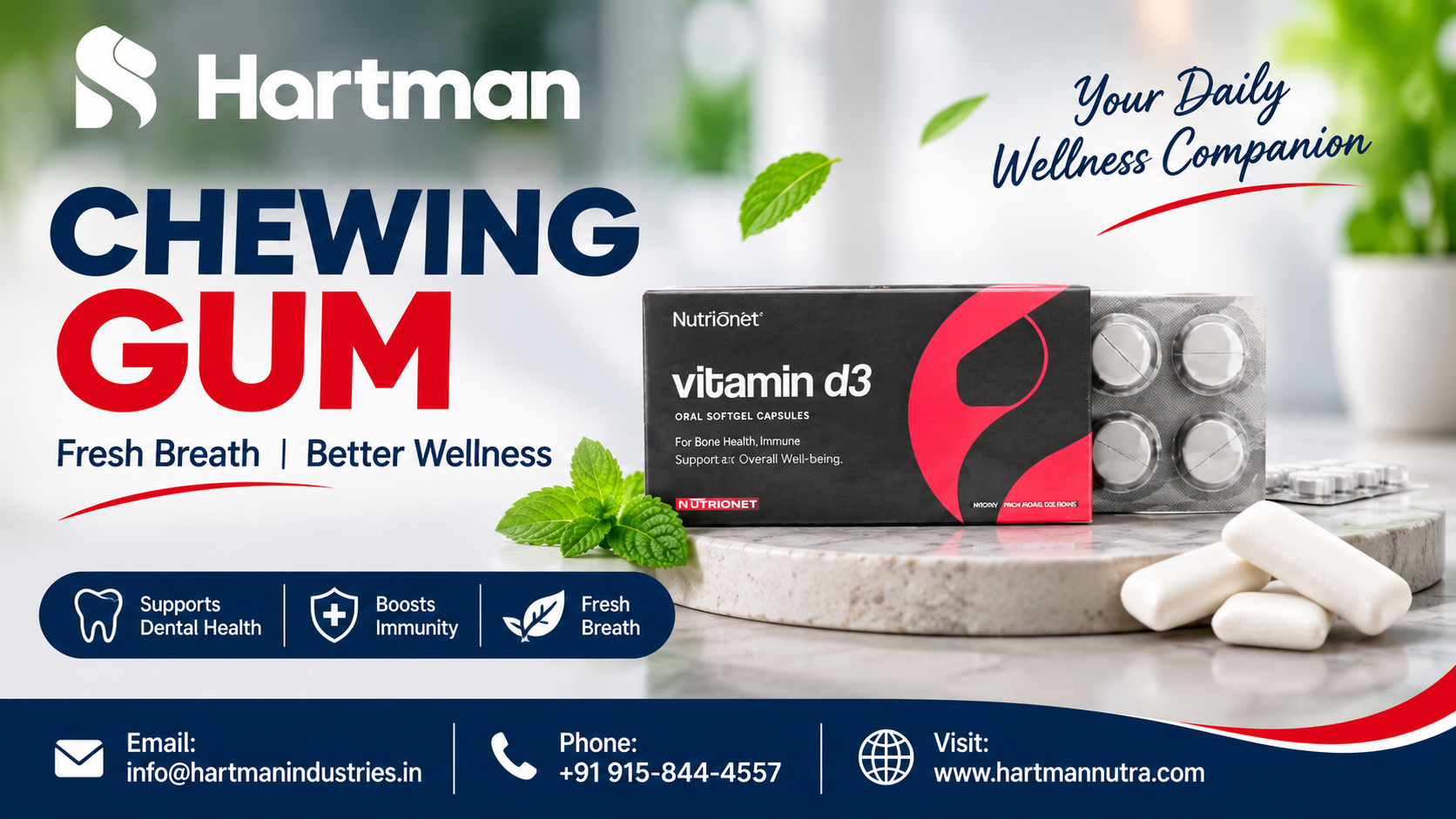
Launching a nutraceutical chewing gum involves more than selecting a flavour and adding a functional ingredient. A business must coordinate product positioning, formulation feasibility, ingredient sourcing, sensory development, packaging and regulatory review. For startups and established wellness companies, Functional or Healthy Chewing Gum in India can be developed through a contract partner, subject to technical and regulatory feasibility.
Choose a partner who can explain technical limits and commercial requirements. Evaluate the development process and document responsibilities before production.
Product Specifications
Chewing gum is a distinct delivery format. Its gum base, sweeteners, flavours and functional ingredients must work together to create an acceptable chew and a stable finished product. Hartman's product page describes functional concepts that include caffeine, multivitamin, Vitamin D3 and iron chewing gums. It also lists custom formulation and flavour development as part of its manufacturing support.
Before approaching Chewing Gum suppliers, prepare a specification covering target consumer, purpose, ingredients, serving, flavour, sweetness, packaging and destination market. A reference product can communicate the desired experience, but its formula may not be transferable.
Review ingredient compatibility, heat or moisture sensitivity, flavour impact, distribution and processing. Ask how prototypes will be assessed before scale-up.
Objective
The objective of contract manufacturing is to turn a brand's product brief into a manufacturable product while defining clear responsibilities between the brand and the manufacturing partner. The buyer may need support with formulation, ingredient sourcing, prototypes, production, packaging or private-label presentation. The exact scope should be agreed rather than assumed.
A structured process reduces delays: share the concept, review feasibility, then clarify prototype rounds, acceptance criteria, testing, documentation, quantities, scheduling and dispatch.
Establish responsibility for label review, claims, regulatory assessment and artwork approval, especially for multi-market products.
Benefits
Contract manufacturing can provide development and production support while the brand focuses on strategy, distribution, customer research and sales.
A development partner can help identify trade-offs: ingredients may affect flavour or texture, while packaging must provide suitable product protection. Resolve these questions before artwork approval.
When assessing Chewing Gum Manufacturers, buyers should look for transparent communication about capabilities and limitations. Hartman lists formulation support, flavour development, ingredient sourcing, texture balancing, customization, packaging, bulk production and private labelling. Businesses should request project-specific details and confirm which services are available for their chosen formulation.
Availability
Hartman describes a development pathway that includes product concept and consultation, ingredient selection and research and development, prototype development, compliance and stability testing, commercial production, packaging and dispatch. Buyers can use these stages as a discussion framework, while confirming the actual sequence and deliverables for their project.
The page lists six-piece blister packs, cartons, export-oriented labelling and custom branding. Confirm current availability, minimum quantities, production slots and specifications directly.
For India, confirm product category, permitted ingredients, label declarations and claims. Exporters must review each destination market separately.
About Us
Hartman Enterprises LLP provides nutraceutical product manufacturing support and presents chewing gums as one of its product categories. Its webpage describes private-label and third-party manufacturing services for businesses such as nutraceutical startups, wellness brands, FMCG companies, pharmaceutical businesses, online sellers and export-oriented brands.
Clients should confirm technical scope, quality documents, testing responsibilities and commercial conditions for their proposed gum.
Call to Action
Prepare a brief covering ingredients, target consumer, flavour, serving, packaging and market. Contact Hartman Enterprises LLP to discuss project feasibility.
Conclusion
Selecting a contract manufacturer is a technical and commercial decision. Buyers should evaluate formulation knowledge, prototype review, quality processes, packaging options, regulatory responsibilities and communication before approving production. A clear scope and documented specifications help both parties work toward a consistent, market-appropriate product.
FAQs
1. What is contract manufacturing for chewing gum?
It is an arrangement in which a business works with a manufacturing partner to develop or produce gum under agreed specifications. The scope may include formulation, production, packaging or private labelling.
2. What information should a buyer provide first?
Share the product purpose, target consumer, ingredients, preferred flavour, serving configuration, packaging idea and destination market. A reference product may help explain the intended experience.
3. Can a manufacturer help develop a custom formula?
Hartman describes custom formulation support. The feasibility of a specific formula depends on ingredient compatibility, sensory requirements, stability and applicable market rules.
4. Why are prototypes important?
Prototypes allow the brand and manufacturer to assess taste, texture, appearance and other relevant product characteristics before commercial production. They can reveal issues that are difficult to predict from a written formula alone.
5. Should buyers decide packaging before formulation?
Packaging should be considered early, but the final choice should follow product and stability requirements. Buyers should review protection, serving count, label space, distribution and market expectations.
6. Can one formula be sold in every country?
Not automatically. Ingredient permissions, product classification, claims and labelling requirements can differ by market. Each destination should be reviewed before export.
7. What should be written into the manufacturing agreement?
Document the approved formula and specifications, quality standards, testing responsibilities, packaging, artwork approval, order quantity, lead time, change control, documentation, delivery terms and commercial conditions.

 English
 Arabic
 French
 Spanish
 Portuguese
 Deutsch
 Turkish
 Dutch
 Russian
 Romaian
 Portuguese (Brazil)
 Greek
