


 About Urh Social
 Terms of Service
 Privacy Policy
 Contact
Heat Pipe Market to Attain USD 17.5 Billion by 2036
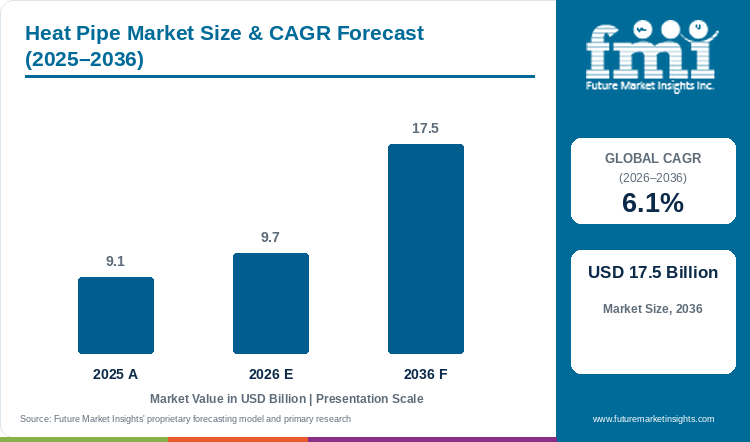
The global heat pipe market is projected to grow from USD 9.1 billion in 2025 to USD 9.7 billion in 2026, reaching USD 17.5 billion by 2036, at a compound annual growth rate (CAGR) of 6.1%. Market expansion is supported by the growing need for efficient thermal management across consumer electronics and other applications where controlling heat is essential for equipment performance and reliability.
Standard heat pipes are projected to account for 35.0% of product type sales in 2026, while copper is expected to represent 58.0% of the material segment. Consumer electronics is anticipated to lead end-use demand with a 32.0% share. These segments highlight the importance of established heat pipe designs and thermally conductive materials in managing heat across compact electronic devices.
Get detailed market forecasts, competitive benchmarking, and technology trends: https://www.futuremarketinsights.com/reports/sample/rep-gb-35740
Thermal Management Requirements Support Heat Pipe Demand
Heat pipes transfer heat from one location to another through a sealed structure that uses a working fluid to support heat movement. Their ability to move heat efficiently makes them useful in applications where temperature control, limited space, and reliable thermal performance are important.
As electronic devices become more compact and performance requirements increase, thermal management remains a key design consideration. Heat pipes can help move heat away from components and distribute it toward suitable dissipation areas, supporting integration with cooling assemblies such as fin stacks.
Several factors are shaping market demand:
- Consumer electronics growth: Electronic devices require thermal solutions that help manage heat generated during operation.
- Compact product designs: Space-efficient thermal components are valuable where available room for cooling systems is limited.
- Thermal performance requirements: Effective heat transfer can help equipment designers manage operating temperatures.
- Integration with cooling assemblies: Standard heat pipe designs can be incorporated into existing fin stacks and other thermal management arrangements.
The suitability of a heat pipe depends on application-specific requirements, including heat load, operating temperature, orientation, dimensions, and system design.
Where the Heat Pipe Market Is Headed
The heat pipe market is forecast to expand from USD 9.7 billion in 2026 to USD 17.5 billion by 2036, registering a CAGR of 6.1%. This represents an increase of USD 7.8 billion in market value between 2026 and 2036.
The projected growth reflects the continued importance of thermal management across electronic and other heat-sensitive applications. As product designers balance performance, size, and reliability, heat pipes remain one option for transferring heat efficiently within a broader cooling system.
For manufacturers, the opportunity lies in developing products that meet specific thermal requirements while supporting practical integration into customers' equipment designs. Product dimensions, material selection, thermal capacity, and compatibility with surrounding cooling components can all influence purchasing decisions.
What Leads the Market?
Standard Heat Pipes Account for 35.0% of Product Type Sales
Standard heat pipes are projected to hold a 35.0% share of product type sales in 2026. Their leading position is associated with the ease of integrating tubular designs into existing fin stacks and cooling assemblies.
For equipment designers, integration can be an important consideration when selecting thermal components. A design that fits established layouts may simplify thermal system development and help manufacturers incorporate heat transfer solutions into their products.
Suppliers can support adoption by providing clear specifications covering dimensions, operating limits, and thermal performance, allowing customers to evaluate suitability for their intended applications.
Copper Represents 58.0% of the Material Segment
Copper is expected to account for 58.0% of the heat pipe market by material in 2026. Its thermal conductivity makes it a widely used material for heat transfer applications, including thermal management assemblies in electronic equipment.
Material selection nevertheless depends on the needs of the application. Designers must consider thermal performance, weight, cost, manufacturing requirements, and compatibility with other components when specifying heat pipes.
For manufacturers, maintaining material quality and offering products suited to different thermal requirements can help address the needs of equipment designers and component buyers.
Consumer Electronics Leads with 32.0% of End-Use Demand
Consumer electronics is projected to account for 32.0% of heat pipe demand by end use in 2026. Electronic devices generate heat during operation, making thermal management important for maintaining performance and supporting reliable operation.
Heat pipes can be incorporated into cooling assemblies to transfer heat away from components and toward areas where it can be dissipated. Their relevance depends on device architecture, heat generation, available space, and the thermal requirements established during product design.
The segment's leading share underscores the role of heat transfer components in electronics engineering and the need for cooling solutions that balance performance with compact design requirements.
The Challenge: Balancing Thermal Performance, Size, and Cost
Despite the positive market outlook, heat pipe manufacturers face several design and commercial considerations. A product must deliver suitable heat transfer performance while fitting within the dimensions, operating conditions, and cost targets of the intended application.
Key considerations include:
- Thermal capacity: The heat pipe must be suitable for the heat load and temperature range of the application.
- Space constraints: Compact electronic devices may require specific shapes and dimensions to fit within existing assemblies.
- Material selection: Copper and other materials must be assessed against thermal, weight, cost, and manufacturing requirements.
- System integration: Heat pipes must work effectively with fin stacks, heat sinks, and other cooling components.
- Reliability and quality: Manufacturing consistency and appropriate testing are important for products used in heat-sensitive equipment.
- Cost management: Buyers must balance thermal performance with component costs and overall system design requirements.
Manufacturers that provide application-specific technical support and consistent product specifications can help customers assess suitable thermal solutions.
What This Means for Heat Pipe Manufacturers and Electronics Designers
The market outlook suggests that thermal management will remain an important consideration as manufacturers design electronic products and other equipment that generate heat.
For heat pipe manufacturers and suppliers:
- Develop product ranges suited to different thermal loads and installation constraints.
- Provide clear technical information on dimensions, material, and operating conditions.
- Support integration with established fin stacks and cooling assemblies.
- Work with equipment designers early in the product development process.
- Emphasize application suitability and dependable thermal performance.
For electronics manufacturers and buyers:
- Assess heat generation and thermal requirements during the design stage.
- Check compatibility with available space and existing cooling components.
- Compare material options based on thermal needs, weight, and cost.
- Evaluate heat pipe performance as part of the complete thermal management system.
- Consider reliability and manufacturing consistency when selecting suppliers.
These priorities can help equipment manufacturers select appropriate thermal components and enable heat pipe suppliers to address the requirements of a range of end-use applications.
Related Reports:
Thermal Cleaning System Market- https://www.futuremarketinsights.com/reports/thermal-cleaning-system-market
Tower Crane Market- https://www.futuremarketinsights.com/reports/tower-crane-market
Residual Current Circuit Breaker Market- https://www.futuremarketinsights.com/reports/residual-current-circuit-breaker-market
About Future Market Insights
Future Market Insights, Inc. (FMI) is an ESOMAR-certified market research and consulting firm headquartered in Delaware, USA, with offices in the United Kingdom, the United Arab Emirates and India. FMI delivers syndicated and custom research across food and beverage, healthcare, chemicals, technology, packaging, consumer goods and industrial sectors.
For Press & Corporate Inquiries
Rahul Singh
AVP – Marketing and Growth Strategy
Future Market Insights, Inc.
+91 8600020075
For Sales: [email protected]
For Media: [email protected]
For Web: https://www.futuremarketinsights.com/

 English
 Arabic
 French
 Spanish
 Portuguese
 Deutsch
 Turkish
 Italiano
 Russian
 Romaian
 Portuguese (Brazil)
 Greek
