


 About Urh Social
 Terms of Service
 Politique de confidentialité
 Contact
3D Transistor Market Growth, Industry & Landscape Outlook, Revenue Analysis By Fact.MR
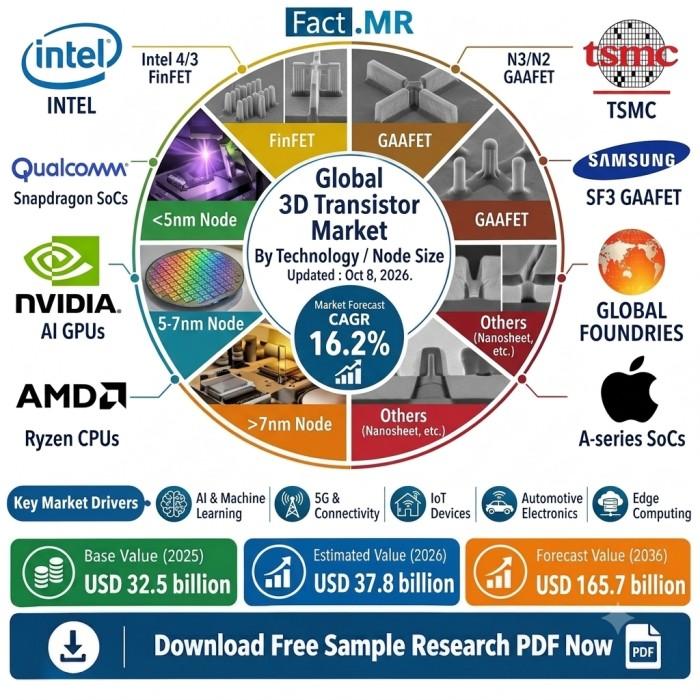
Rockville, Maryland, 9 November 2026 – The global 3D transistor market is estimated at USD 35.3 billion in 2026 and is projected to reach USD 80.4 billion by 2036, expanding at a CAGR of 8.6% during the forecast period, according to Fact.MR.
The market generated USD 32.5 billion in 2025. Forecast growth reflects increasing demand for advanced semiconductor architectures across artificial intelligence (AI) infrastructure, consumer electronics, automotive electronics, high-performance computing and data centres. The transition from FinFET to gate-all-around (GAA) transistor architectures is creating new opportunities for foundries and semiconductor technology providers.
Foundries account for 52.6% of 2026 end-user revenue, while FinFET technology represents 59.9% of product-type demand. These figures highlight the continued importance of established manufacturing processes alongside investments in next-generation transistor architectures.
Semiconductor manufacturers, procurement teams and technology investors can examine the latest market forecasts, segment shares, country-level opportunities and competitive developments in Fact.MR's research. Get a Sample of the Detailed Market Study:
The short version
- The global 3D transistor market is forecast to increase from USD 35.3 billion in 2026 to USD 80.4 billion by 2036, creating an incremental opportunity of USD 45.1 billion.
- FinFET leads the product-type segment with a 59.9% share, while consumer electronics accounts for 33.5% of application revenue.
- Germany leads the five-country growth forecast at 9.9% CAGR. Brazil follows at 9.0%, while the United States is projected to grow at 8.2%.
- Foundries represent 52.6% of end-user revenue, reflecting the importance of contracted wafer production for fabless semiconductor companies.
- The transition towards gate-all-around architectures, AI accelerator demand and automotive electrification supports the market's expansion.
Three numbers that matter
USD 80.4 billion: Projected global 3D transistor market value by 2036.
8.6%: Global compound annual growth rate from 2026 to 2036.
59.9%: Share of 2026 product-type revenue attributed to FinFET technology.
These figures point towards a semiconductor industry where manufacturing scale, transistor architecture, process yields and access to advanced fabrication capacity influence competitive positioning.
Where growth is strongest
Fact.MR identifies five country markets in its forecast. Germany records the highest projected growth, followed by Brazil and the United States. Their growth prospects reflect different combinations of automotive semiconductor demand, national manufacturing initiatives, chip-design capabilities and fabrication investments.
- Germany: CAGR of 9.9% (2026–2036) — Growth opportunity: Electric vehicle platforms, advanced automotive controllers and semiconductor integration across automotive supply chains.
- Brazil: CAGR of 9.0% (2026–2036) — Growth opportunity: Domestic semiconductor initiatives, electronics assembly and expanding chip-design activities.
- United States: CAGR of 8.2% (2026–2036) — Growth opportunity: Federally supported semiconductor manufacturing, AI chip demand and memory and logic fabrication investments.
- United Kingdom: CAGR of 7.3% (2026–2036) — Growth opportunity: Semiconductor design businesses, public funding and technology development.
- Japan: CAGR of 6.5% (2026–2036) — Growth opportunity: Domestic advanced-node manufacturing and the development of 2nm gate-all-around technology.
Why these markets matter
- Germany: Electric vehicle production increases the requirement for advanced automotive processors, domain controllers and zonal computing systems. The country's automotive manufacturing base creates demand for advanced semiconductor components. Forecast CAGR: 9.9%.
- Brazil: The Brasil Semicondutores programme provides a policy framework for developing domestic semiconductor capabilities. Financing initiatives and electronics manufacturing activities support the country's semiconductor industry. Forecast CAGR: 9.0%.
- United States: Investment in memory and logic fabrication, together with demand from cloud providers and AI chip designers, supports semiconductor manufacturing expansion. Forecast CAGR: 8.2%.
- United Kingdom: A design-led semiconductor ecosystem, government funding and support for semiconductor start-ups provide opportunities for technology companies and chip developers. Forecast CAGR: 7.3%.
- Japan: Government-backed investment and Rapidus Corporation's 2nm development programme support the country's ambition to rebuild advanced logic manufacturing capabilities. Forecast CAGR: 6.5%.
Who is moving: dated developments and key players
The competitive landscape includes major foundries, integrated semiconductor manufacturers and emerging advanced-node producers. Their competitive positions depend on process technology, wafer yields, manufacturing capacity, customer relationships and the ability to transition from FinFET to gate-all-around transistor architectures.
Developments highlighted in the report
- June 2025 – United States: The U.S. Department of Commerce announced that Micron would invest USD 200 billion in American memory manufacturing and research and development, supported by up to USD 275 million in additional CHIPS funding. The projects in Idaho, New York and Virginia are expected to create approximately 90,000 jobs.
- October 2025 – United States: Intel unveiled Panther Lake as its first platform built on Intel 18A. The platform uses Intel's RibbonFET transistor architecture, highlighting the industry's transition towards advanced gate-all-around designs.
- April 2026 – Japan: Rapidus started its pilot line in Chitose, Hokkaido, and confirmed 2nm gate-all-around transistor operation on 300mm wafers. The company aims to begin mass production in 2027.
- June 2026 – South Korea: Samsung Electronics presented its Exynos 2600 mobile processor based on its 2nm GAA process, demonstrating the commercial development of next-generation transistor architectures.
- October 2026 – Taiwan: TSMC's third-quarter 2026 results showed that its 3nm and 5nm wafer technologies together accounted for 61% of wafer revenue, while 2nm nanosheet production contributed 8%.
Key players profiled by Fact.MR
- Taiwan Semiconductor Manufacturing Company (TSMC)
- Samsung Electronics Co., Ltd.
- Intel Corporation
- GlobalFoundries Inc.
- United Microelectronics Corporation (UMC)
- Rapidus Corporation
TSMC maintains a significant position in advanced foundry manufacturing through its FinFET and developing nanosheet technologies. Samsung is advancing its 2nm GAA architecture for mobile processors. Intel's RibbonFET technology represents another approach to next-generation transistor design.
GlobalFoundries and UMC serve customers through established semiconductor manufacturing processes, including 12nm and 14nm FinFET technologies. Rapidus is developing advanced 2nm production capabilities in Japan.
The competitive opportunity extends beyond introducing smaller technology nodes. Semiconductor manufacturers must demonstrate consistent process yields, manage production costs and secure long-term wafer commitments from major customers.
Where to act
Invest in gate-all-around technology development: The transition from FinFET to GAA architectures creates opportunities for foundries investing in nanosheet and forksheet transistor structures. Manufacturing teams should prioritise process development, selective deposition and etching capabilities.
Strengthen advanced-node manufacturing capacity: The 5nm technology node represents 47.5% of 2026 market revenue according to the report's segment table. Foundries can continue serving established mobile and AI chip requirements while preparing production capabilities for newer nodes.
Target AI and high-performance computing demand: AI accelerators and data-centre processors require greater performance per watt. Semiconductor suppliers should evaluate process architectures that improve transistor density and reduce power consumption.
Expand automotive semiconductor relationships: Vehicle electrification and driver-assistance systems increase demand for advanced logic chips. Suppliers should strengthen partnerships with automotive semiconductor developers and Tier 1 electronics manufacturers.
Build regional manufacturing partnerships: Government-supported semiconductor programmes in the United States, Japan and Brazil provide opportunities for companies involved in fabrication, equipment, technology development and supply-chain services.
Where to be careful
- High capital requirements: Advanced semiconductor fabrication facilities require substantial investment. New fabs must achieve sufficient utilisation and production yields to support commercial returns.
- Advanced lithography constraints: Limited access to advanced lithography equipment can restrict the speed at which manufacturers expand leading-edge production.
- Technology transition risks: Moving from FinFET to GAA architectures requires changes in process integration, manufacturing equipment and design workflows.
- Trade restrictions: Export controls on advanced chipmaking technologies can affect equipment availability, manufacturing partnerships and international supply chains.
- Yield management: Early-generation nanosheet production requires consistent manufacturing performance before foundries can expand commercial volumes.
- Customer concentration: Leading-edge manufacturing depends on large semiconductor customers that reserve wafer capacity in advance. Dependence on a limited number of major accounts can increase commercial exposure.
The commercial priority should be to balance investments in next-generation transistor architectures with established FinFET production, while maintaining manufacturing efficiency and securing long-term customer commitments.
Analyst quote
Shambhu Nath Jha, Principal Consultant at Fact.MR, explains:
"Chip designers now pick a process by its leakage and drive current before its node label, which keeps FinFET in front while gate-all-around ramps. Foundries that publish clear yield data on 2nm nanosheet lines will win the next round of fabless orders. The new growth will come from automotive logic and from fabs being built in the United States and Japan."
His assessment highlights the importance of process performance and manufacturing reliability in the next phase of semiconductor competition. Foundries must demonstrate consistent yields and provide transparent production capabilities to attract fabless semiconductor customers.
Unlock Actionable Insights from the Complete Report:
Questions for your next planning meeting
- Which foundry partners are best positioned to support our next-generation semiconductor production requirements?
- How quickly can our manufacturing and design capabilities transition from FinFET to gate-all-around architectures?
- What investments are required to improve wafer yields and reduce production costs at advanced technology nodes?
- How can we secure long-term wafer capacity for AI, automotive and high-performance computing applications?
- Which regional semiconductor ecosystems offer the strongest opportunities for manufacturing partnerships and supply-chain expansion?
Explore More Related Studies Published by Fact.MR Research
About Fact.MR
Fact.MR is a market research and consulting firm providing market intelligence, industry analysis and strategic insights to businesses across multiple sectors.
Its research covers market sizing, forecasts, competitive landscapes, segment analysis, country-level opportunities and industry developments. Fact.MR supports manufacturers, investors, procurement teams and business leaders with information for strategic planning and commercial decision-making.
Media Contact
Fact.MR
Email: [email protected]
Website: https://www.factmr.com

 English
 Arabic
 Spanish
 Portuguese
 Deutsch
 Turkish
 Dutch
 Italiano
 Russian
 Romaian
 Portuguese (Brazil)
 Greek