


 About Urh Social
 Terms of Service
 Política de privacidade
 Contact
Digital Still Camera (DSC) Market Growth, Revenue Analysis Industry Outlook, Forecast Analysis By Fact.MR
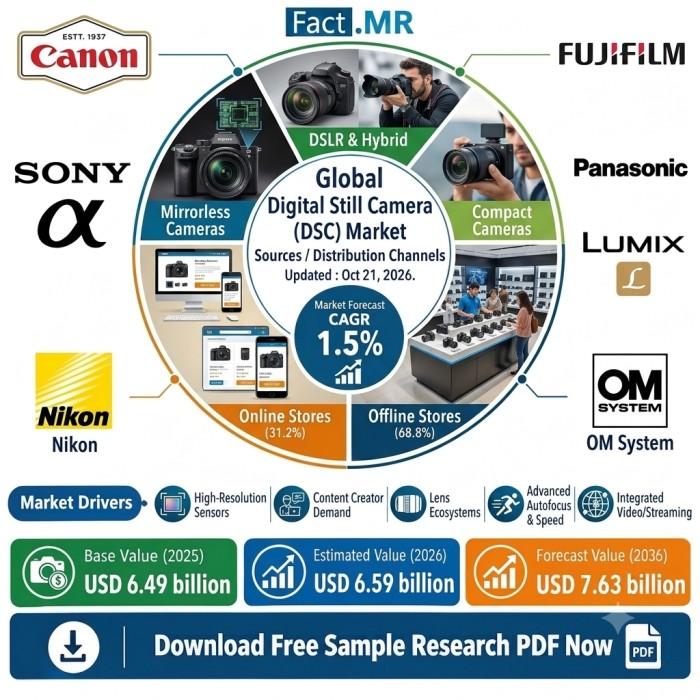
Rockville, Maryland, 9 November 2026 – The global Digital Still Camera (DSC) market is estimated at USD 6.59 billion in 2026 and is projected to reach USD 7.63 billion by 2036, expanding at a CAGR of 1.5% during the forecast period, according to Fact.MR.
The market generated USD 6.49 billion in 2025. Forecast growth reflects renewed interest in selected compact camera models, mirrorless camera upgrades, professional photography equipment and dedicated image-capture systems. Mirrorless cameras account for 38.5% of estimated 2026 product revenue, while consumer photography represents 42.1% of application demand.
Camera manufacturers face a market where smartphone photography limits routine camera purchases. However, specialised optical capabilities, interchangeable lens systems, improved video recording and image authenticity features continue to provide reasons for customers to purchase dedicated cameras.
Manufacturers, distributors and retailers can examine the latest market forecasts, segment shares and country-level opportunities in Fact.MR's research.
Get a Sample of the Detailed Market Study:
The short version
- The global Digital Still Camera market is forecast to increase from USD 6.59 billion in 2026 to USD 7.63 billion by 2036, creating an incremental revenue opportunity of approximately USD 1.04 billion.
- Mirrorless cameras lead product demand with a 38.5% share, while consumer photography accounts for 42.1% of application revenue.
- Offline stores dominate distribution with 68.8% of estimated 2026 sales. CMOS sensors account for 87.4% of the sensor-type allocation.
- Japan leads the five-country growth forecast at 2.24% CAGR, followed by the United States at 1.90% and the United Kingdom at 1.64%.
Three numbers that matter
USD 7.63 billion: Projected global market value by 2036.
38.5%: Revenue share of mirrorless cameras in 2026.
68.8%: Share of estimated 2026 market revenue attributed to offline stores.
These figures point towards a market where product differentiation, optical performance, established lens ecosystems and specialist retail support influence camera purchasing decisions.
Where growth is strongest
Fact.MR identifies five country markets in its forecast. Japan records the highest projected growth, while the United States offers opportunities through professional photography equipment replacement and established camera ownership.
- Japan: CAGR (2026–2036) of 2.24% — Growth opportunity: Premium compact cameras, specialised photography equipment and mirrorless camera upgrades.
- United States: CAGR (2026–2036) of 1.90% — Growth opportunity: Professional photography equipment, compatible camera-body replacements and established lens systems.
- United Kingdom: CAGR (2026–2036) of 1.64% — Growth opportunity: Network-enabled camera products, after-sales support and specialist photography retail.
- Brazil: CAGR (2026–2036) of 1.34% — Growth opportunity: Supported import channels, local warranty arrangements and specialist camera distribution.
- Germany: CAGR (2026–2036) of 1.04% — Growth opportunity: Camera system compatibility, regional product positioning and repair support.
Why these markets matter
- Japan: Dedicated camera ownership and demand for distinctive shooting experiences support opportunities for premium compact and mirrorless models. Fact.MR projects a 2.24% CAGR.
- United States: Professional photographers and hobbyists create demand for compatible replacement bodies and specialised camera equipment. Forecast CAGR is 1.90%.
- United Kingdom: Network-enabled camera products increase the importance of software support, warranties and repair arrangements. Forecast CAGR is 1.64%.
- Brazil: Distributors can strengthen their position through dependable imported-camera supply, transparent pricing and local servicing. Forecast CAGR is 1.34%.
- Germany: A smaller, clearly differentiated product portfolio can help retailers address buyers seeking dependable equipment, repair support and compatible lenses. Forecast CAGR is 1.04%.
Who is moving: dated developments and key players
The competitive landscape includes established camera manufacturers competing through mirrorless technology, fixed-lens products, imaging performance and camera-system compatibility.
Recent developments highlighted in the report:
- April 2025 – Canon: Canon's PowerShot V1 entered the market with a 1.4-inch CMOS sensor and an internal cooling fan. The product illustrates the development of fixed-lens cameras designed to support both photography and video applications.
- 2025 – Nikon: Nikon's integrated report outlined plans to broaden its mirrorless lens range and introduce advanced functions across more camera models. This strategy supports opportunities within existing camera-system ownership.
- June 2026 – Camera authenticity: The Camera & Imaging Products Association (CIPA) discussed Exif 3.1 mechanisms for retaining original-image information and its collaboration with C2PA on tamper detection. These developments address the growing importance of image authenticity and provenance.
- May 2026 – Fujifilm: Fujifilm's financial results identified the GFX100RF and X half among the models supporting its Professional Imaging performance.
- August 2026 – Camera shipments: CIPA recorded 5,703,512 camera shipments through August 2026, with a shipment value of JPY 571.81 billion. The reported year-on-year indices were 96.8 for units and 103.7 for value.
Key players profiled by Fact.MR
- Sony Corporation
• Canon Inc.
• Nikon Corporation
• Fujifilm Holdings Corporation
• OM Digital Solutions
• Panasonic Corporation
• Leica Camera AG
• Ricoh Company Ltd.
• Samsung Electronics Co. Ltd. (adjacent image-sensor participant, outside the active DSC camera-body comparison)
The competitive opportunity is not simply about launching cameras with improved specifications. Manufacturers must establish why customers should purchase a dedicated camera when smartphones already meet many everyday photography requirements.
Where to act
Strengthen mirrorless camera portfolios: Mirrorless cameras account for 38.5% of estimated 2026 product revenue. Manufacturers can focus on compatible lens ecosystems, useful body upgrades and imaging features that justify replacement purchases.
Develop premium compact camera propositions: Renewed interest in fixed-lens cameras creates opportunities for products with distinctive optical capabilities, portability and practical photography applications.
Expand specialist retail support: Offline stores represent 68.8% of estimated 2026 sales. Retailers can strengthen customer conversion through camera demonstrations, lens comparisons and guidance on complete equipment packages.
Address professional photography requirements: Working photographers often prefer compatible replacement bodies that integrate with existing lenses and lighting equipment. Manufacturers should prioritise system continuity and dependable after-sales service.
Improve image authenticity and file handling: Image provenance and tamper-detection developments create opportunities for camera manufacturers serving institutional and commissioned photography customers.
Where to be careful
- Smartphone competition: Improved smartphone cameras reduce the need for dedicated cameras in routine photography applications.
- Long replacement cycles: Customers may continue using functioning camera bodies for several years instead of purchasing newer models.
- Promotional pressure: Discounting older camera bodies can affect manufacturer and retailer profitability.
- Reduced commissioned-image budgets: Professional and commercial photography accounts may face purchasing pressure when photography budgets decline.
- Product differentiation: Minor technical improvements may not provide sufficient reasons for customers to replace existing equipment.
- Import and service arrangements: Distributors in markets such as Brazil need dependable warranty coverage, product identification and local servicing arrangements.
The commercial priority should be to balance product innovation with practical customer requirements. Manufacturers need to demonstrate meaningful improvements rather than depend on frequent model launches to generate replacement demand.
Analyst quote
Shambhu Nath Jha, Lead Consultant at Fact.MR, explains:
"The category works better when camera makers recognise how different its buyers have become. A street photographer may value a small fixed-lens body. A working studio may prefer another familiar body that fits its existing lenses and lighting."
His assessment highlights why camera manufacturers need to develop products around distinct customer requirements. A hobbyist, professional photographer and commercial photography buyer may have different expectations regarding portability, optical performance, compatibility and after-sales support.
Product development and marketing strategies should reflect these differences rather than rely on a single proposition for every camera buyer.
Unlock Actionable Insights from the Complete Report:
Questions for your next planning meeting
- Which mirrorless and premium compact camera categories offer the strongest opportunities for our product portfolio through 2036?
- How can we differentiate dedicated camera products from increasingly capable smartphone photography systems?
- Should we strengthen offline retail partnerships to improve product demonstrations and customer conversion?
- Can our existing camera systems support repeat purchases through lens compatibility, reliable upgrades and after-sales service?
- Which regional distributors and service partners should we prioritise in Japan, the United States and the United Kingdom?
Explore More Related Studies Published by Fact.MR Research
About Fact.MR
Fact.MR is a market research and consulting firm providing market intelligence, industry analysis and strategic insights to businesses across multiple sectors.
Its research covers market sizing, forecasts, competitive landscapes, segment analysis, country-level opportunities and industry developments. Fact.MR supports manufacturers, investors, procurement teams and business leaders with information for strategic planning and commercial decision-making.
Media Contact
Fact.MR
Email: [email protected]
Website: https://www.factmr.com

 English
 Arabic
 French
 Spanish
 Portuguese
 Deutsch
 Turkish
 Dutch
 Italiano
 Russian
 Romaian
 Greek
