


 About Urh Social
 Terms of Service
 Politique de confidentialité
 Contact
Suction Catheters Market Growth, Industry & Landscape Outlook, Revenue Analysis By Fact.MR
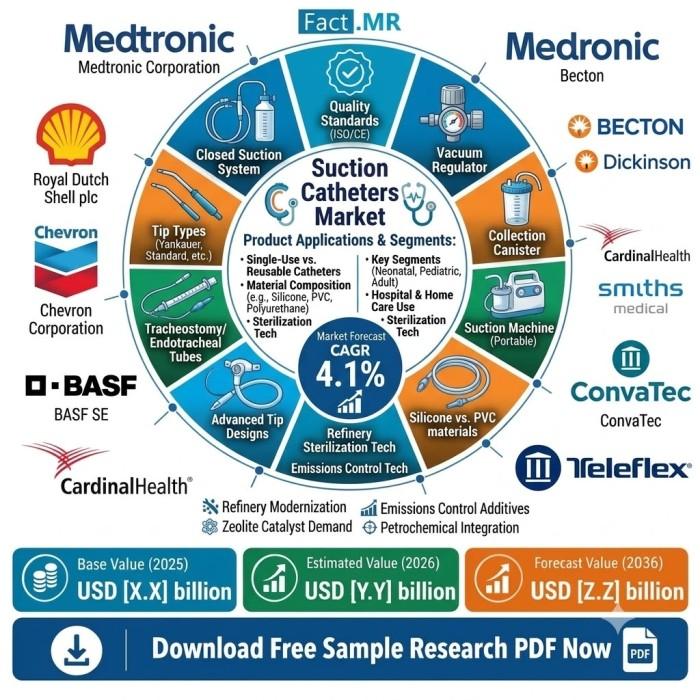
Rockville, Maryland — October 29, 2026 Fact.MR forecasts the global suction catheters market to reach USD 3.0 billion by 2036, increasing from an estimated USD 1.5 billion in 2026. According to the company's market analysis, the industry is expected to expand at a compound annual growth rate (CAGR) of 7.2% over the 2026–2036 forecast period. The market was valued at approximately USD 1.4 billion in 2025.
The report identifies rising intensive care unit (ICU) utilization, growing emphasis on infection prevention, and the expansion of home-based respiratory care as important demand drivers. For manufacturers, distributors, and healthcare procurement teams, these developments create opportunities to strengthen product portfolios, improve supply reliability, and address evolving clinical requirements.
Get detailed market forecasts, competitive benchmarking, and pricing trends:
Key Takeaways: Suction Catheters Market Forecast
- 2026 market valuation: USD 1.5 billion.
- 2036 market forecast: USD 3.0 billion.
- Forecast CAGR: 7.2% between 2026 and 2036.
- Leading product segment: Closed suction catheters, accounting for 52.6% of product segment value in 2026.
- Leading application: Airway clearance, representing 41.3% of application segment value in 2026.
- Largest end-use segment: Hospitals, with a 48.9% share in 2026.
- High-growth countries: China at 8.3% CAGR and India at 7.8% CAGR through 2036.
What Is Driving Growth in the Suction Catheters Market?
Suction catheters are medical devices used to remove respiratory secretions and clear airways, as well as support surgical suction procedures. They are used across hospitals, intensive care units, ambulatory surgical centers, emergency care environments, and homecare settings.
Demand is supported by the need to manage secretions in mechanically ventilated and tracheostomized patients. Increasing ICU utilization, an aging population, chronic respiratory conditions, and rising surgical procedure volumes are contributing to the requirement for dependable airway management consumables.
Infection prevention is another significant market driver. Hospitals are increasingly focused on reducing contamination risks during airway suctioning. Closed suction catheter systems allow secretion removal while maintaining the ventilator circuit, making them relevant to clinical protocols designed to limit ventilator-associated pneumonia (VAP) risks.
The expansion of homecare respiratory services is also creating additional demand channels. Early hospital discharge programs and long-term care for ventilator-dependent patients can increase the need for suitable suctioning products outside conventional hospital environments.
For suppliers, the commercial opportunity extends beyond unit sales. Product availability, clinical suitability, compatibility with existing respiratory equipment, and dependable distribution can influence institutional purchasing decisions.
Why Are Closed Suction Catheters Leading the Market?
Closed suction catheters are projected to account for 52.6% of product segment value in 2026, according to Fact.MR. Their role in maintaining ventilation circuit integrity during suctioning supports their adoption in critical care settings.
The product category includes single-lumen, double-lumen, and triple-lumen configurations. Open suction catheters remain important across general airway care, emergency settings, and surgical applications, while specialty products address specific clinical needs.
Manufacturers can evaluate several product development priorities:
- Improve catheter usability and handling for clinical staff.
- Develop product configurations suited to different patient groups.
- Assess antimicrobial coatings and other infection prevention features.
- Maintain consistent product quality and reliable supply.
- Balance product performance with procurement cost requirements.
Antimicrobial-coated, soft-tip, pediatric, and neonatal catheters represent potential areas for specialized product development. However, commercial success depends on clinical validation, applicable regulatory requirements, pricing, and actual purchasing demand.
Which Regions Offer the Strongest Growth Opportunities?
Asia-Pacific markets stand out in Fact.MR's country-level forecasts, particularly China and India. Their projected growth rates offer manufacturers and distributors a basis for evaluating regional investment, distribution, and market-entry priorities.
China's suction catheters market is projected to grow at an 8.3% CAGR through 2036. Expansion of critical care capacity, adoption of infection prevention practices, and demand for cost-competitive medical supplies support the market outlook.
India is forecast to record a 7.8% CAGR over the same period. Expanding healthcare infrastructure and increasing adoption of disposable medical devices create opportunities for suppliers serving public and private healthcare facilities.
South Korea is projected to grow at a 7.5% CAGR, while Brazil is expected to expand at 7.2%. The United States is forecast to register a 6.8% CAGR, supported by institutional demand and the adoption of closed suction systems.
Germany and the United Kingdom are projected to grow at CAGRs of 6.1% and 5.9%, respectively. Their outlooks provide manufacturers with additional markets to assess for premium product positioning and established healthcare procurement channels.
For companies planning expansion, these forecasts support a differentiated regional strategy: assess distribution partnerships and price competitiveness in faster-growing markets while evaluating product differentiation and institutional relationships in mature healthcare systems.
Who Are the Top Companies in the Suction Catheters Market?
Competition in the suction catheters market involves established medical device manufacturers and healthcare suppliers with product portfolios spanning airway management, surgical suction, and disposable medical consumables.
Fact.MR identifies the following companies among the market's key participants:
1. Cardinal Health Inc.
2. Teleflex Incorporated
3. Smiths Medical
4. Medline Industries Inc.
5. B. Braun SE
6. Becton Dickinson and Company
7. ConvaTec Group PLC
8. Vyaire Medical Inc.
9. Amsino International Inc.
10. Pennine Healthcare
11. Dynarex Corporation
12. PFM Medical AG
13. Merit Medical Systems Inc.
14. Wellead Medical Co. Ltd.
15. Halyard Health Inc.
These companies should not be interpreted as a ranked list. The report identifies them as participants in the competitive landscape; individual market shares and competitive positions vary.
Cardinal Health, Teleflex, and Smiths Medical are among the prominent names discussed in the report. Product breadth, established healthcare distribution channels, and the ability to meet institutional purchasing requirements are important competitive considerations.
For market participants, differentiation may depend on closed-system product development, cost-efficient manufacturing, consistent quality, and access to hospital and homecare purchasing channels. Companies that evaluate these factors alongside regional demand forecasts can make more informed decisions about portfolio investment and distribution strategy.
What Challenges Could Affect Market Expansion?
Despite the positive forecast, suppliers face several commercial and operational constraints.
Price sensitivity remains a concern for hospitals and healthcare systems operating under strict procurement budgets. Higher-priced closed suction systems may encounter resistance in markets where lower-cost open catheters remain widely used.
The growing use of disposable devices also creates waste management challenges. Manufacturers may need to assess material selection, packaging efficiency, and applicable environmental requirements while maintaining product safety and performance.
Supply continuity is another consideration. Dependence on raw materials such as polyvinyl chloride (PVC) and silicone can expose manufacturers to availability fluctuations and production cost pressures.
For procurement teams, supplier diversification, quality assurance, and reliable delivery schedules can help manage these risks. For manufacturers, maintaining competitive pricing without compromising device quality remains central to long-term market development.
What Should Businesses Prioritize Through 2036?
Fact.MR's forecast provides several strategic considerations for medical device companies, distributors, and healthcare suppliers.
Prioritize high-growth markets. China's projected 8.3% CAGR and India's 7.8% CAGR make them important countries to evaluate for distribution partnerships, institutional sales, and cost-competitive product portfolios.
Strengthen closed-system offerings. With closed suction catheters accounting for 52.6% of product segment value in 2026, manufacturers can assess opportunities to improve usability, product performance, and infection prevention features.
Develop specialized product ranges. Pediatric, neonatal, soft-tip, and antimicrobial-coated catheter categories offer avenues for differentiated product development, subject to clinical validation and regulatory compliance.
Build reliable supply capabilities. Hospitals require dependable access to essential consumables. Manufacturing efficiency, supplier diversification, and distribution coverage can support stronger procurement relationships.
Evaluate homecare demand. Expanding respiratory care outside hospitals creates an additional channel for appropriately designed products and distribution partnerships.
These priorities are strategic implications of the market outlook, rather than guarantees of commercial performance. Individual investment decisions should account for local regulations, competition, procurement practices, and customer requirements.
About the Suction Catheters Market Report
Fact.MR's Suction Catheters Market report examines global market size and forecasts for 2026–2036. Its coverage includes product categories, clinical applications, end-use settings, materials, patient groups, sterility, regional demand, and the competitive landscape.
The report assesses closed suction catheters, open suction catheters, and specialty devices across applications such as airway clearance, tracheal suctioning, bronchial suctioning, surgical suction, and emergency care.
The analysis also covers market drivers, restraints, country-level growth forecasts, product trends, and company positioning to support strategic planning by medical device manufacturers, distributors, healthcare procurement professionals, and investors.
Frequently Asked Questions
What is the projected size of the suction catheters market by 2036?
Fact.MR forecasts the global suction catheters market to reach USD 3.0 billion by 2036, up from USD 1.5 billion in 2026.
What is the expected CAGR of the suction catheters market?
The market is projected to grow at a CAGR of 7.2% between 2026 and 2036.
Which product segment leads the suction catheters market?
Closed suction catheters are expected to account for 52.6% of product segment value in 2026.
Which countries offer the strongest growth prospects?
China leads the country-level forecast at an 8.3% CAGR, followed by India at 7.8% through 2036.
Who are the leading companies in the suction catheters market?
Key participants identified by Fact.MR include Cardinal Health Inc., Teleflex Incorporated, Smiths Medical, Medline Industries Inc., B. Braun SE, Becton Dickinson and Company, ConvaTec Group PLC, Vyaire Medical Inc., Amsino International Inc., and Pennine Healthcare.
What factors are driving market growth?
Rising ICU utilization, infection prevention priorities, adoption of closed suction systems, expanding homecare respiratory services, and increasing use of disposable medical devices are key growth drivers.
Unlock 360° insights for strategic decision making and investment planning / Read the full report:
Explore More Related Studies Published by Fact.MR Research
Pharmaceutical Manufacturing Fastener Market
Diphtheria, Tetanus, and Pertussis (DTaP) Vaccine Market
About Fact.MR
Fact.MR is a market research and consulting firm providing syndicated research, customized research, investment research, and market intelligence across a broad range of industries. Its research coverage includes food and beverage, healthcare, pharmaceuticals, biotechnology, consumer products, chemicals and materials, technology, industrial goods, and packaging.
Fact.MR provides market intelligence designed to help organizations understand market dynamics, emerging opportunities, competitive developments, and changing industry requirements.
Media Contact
Fact.MR
Email: [email protected]
Phone: +1 (628) 251-1583
Website: www.factmr.com

 English
 Arabic
 Spanish
 Portuguese
 Deutsch
 Turkish
 Dutch
 Italiano
 Russian
 Romaian
 Portuguese (Brazil)
 Greek
