


 About Urh Social
 Terms of Service
 Privacy Policy
 Contact
Managed SOC SIEM in India: Proven Guide for Banks
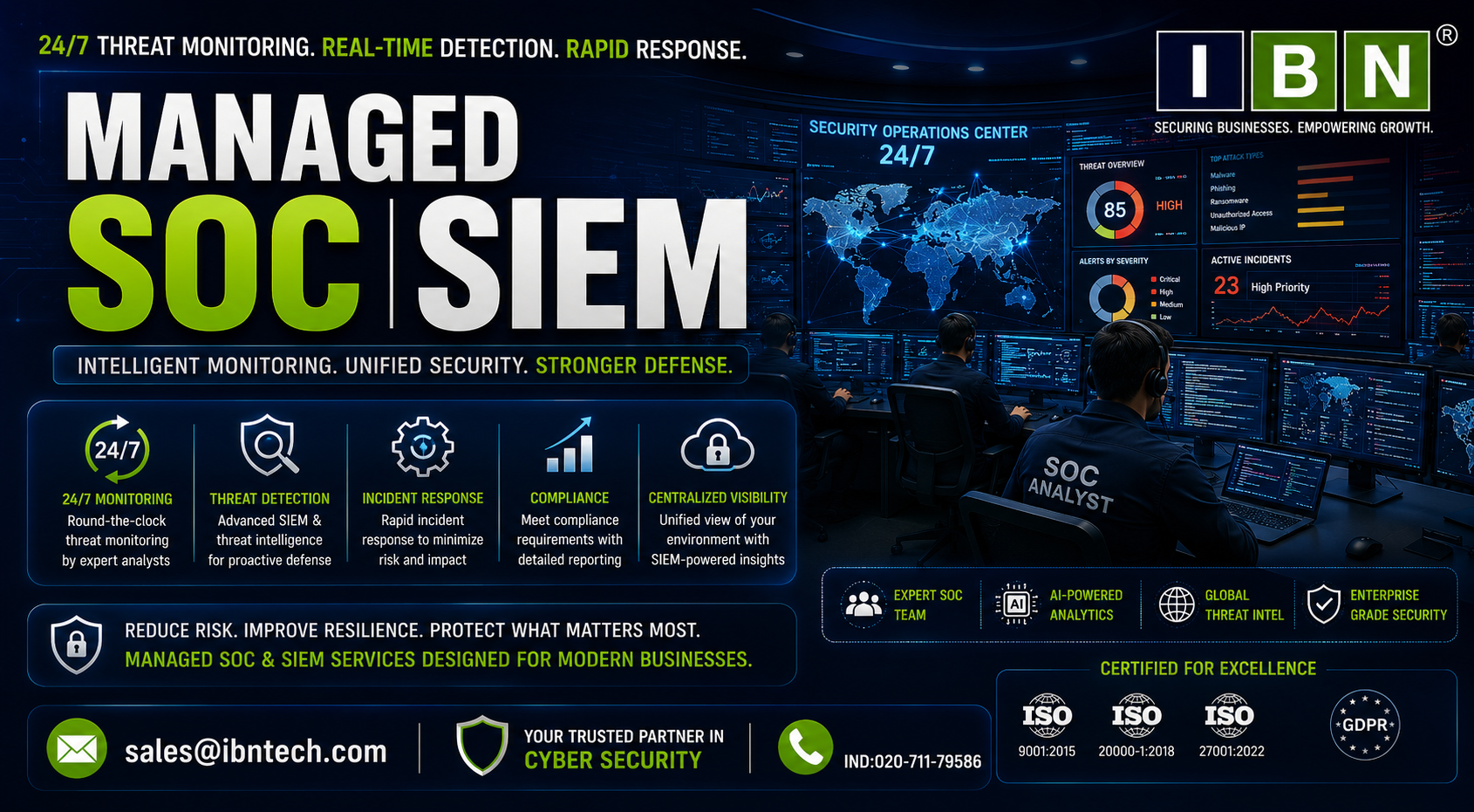
Managed SOC SIEM: How Indian Banks Gain Visibility
Indian banks and NBFCs generate security signals across core banking systems, payment interfaces, cloud platforms, identities and branch networks. managed soc siem combines a SIEM’s ability to collect and correlate security events with a SOC’s analyst-led monitoring and response process. For a financial institution, this turns scattered alerts into timely, evidence-based decisions.
How managed SOC SIEM works
A SIEM, or security information and event management platform, collects security-related logs from multiple systems and correlates them into meaningful events. In BFSI, those sources may include identity platforms, cloud audit logs, endpoints, network devices, payment applications and customer-facing systems.
Monitoring alone is not enough. A SIEM can generate thousands of events, but someone must decide which signals deserve investigation. A managed SOC adds analyst judgement: analysts review correlated events, assess context and escalate only activity that meets agreed risk criteria.
A capable managed soc service provider begins by understanding the bank’s environment rather than offering a standard package. It asks which systems hold customer data, which applications support payments, which identities have privileged access and who responds to alerts after business hours.
What does managed SOC SIEM monitor in a bank?
Managed SOC SIEM monitors security events from identity systems, cloud platforms, endpoints, network devices and business applications connected to the SIEM. In a bank, priority attention often goes to privileged access, payment-related systems, customer data stores and unusual remote activity.
The objective is not to monitor every log without purpose. It is to gain enough visibility to answer practical questions about who accessed critical systems, what changed and whether the activity matches a known risk pattern.
From raw logs to useful alerts
Raw logs rarely tell a complete story. A failed login may be harmless. A successful login from an unfamiliar location may also be harmless. But when those events are followed by a privilege change, access to customer data or movement into a payment-related system, the pattern deserves attention.
A SIEM correlates these separate signals into a single event. The SOC analyst then adds context: Is the account normally active at this time? Does the source location match known behaviour? Was the activity approved through a change process? Are other systems showing related anomalies?
This process reduces noise. Instead of forwarding every raw alert, the SOC escalates a smaller number of meaningful events with evidence, impact assessment and recommended next steps.
|
Signal |
What correlation can reveal |
Why it matters for BFSI |
|
Repeated failed logins followed by success |
Possible credential testing or account compromise |
Protects customer accounts and internal access |
|
Unexpected privilege change |
Possible misuse of administrative rights |
Limits access to critical financial systems |
|
Unusual data access |
Possible data extraction or compromised account |
Helps protect customer and transaction data |
|
Abnormal payment-system activity |
Possible fraud, misuse or system issue |
Supports faster action around revenue and trust |
|
Remote access from new location |
Possible vendor misuse or exposed access path |
Reduces risk around third-party connections |
Correlation does not prove wrongdoing. It gives the bank enough context to decide quickly whether an event needs containment, investigation or acceptance as normal activity.
How does a managed SOC service provider reduce false positives?
A managed SOC service provider reduces false positives by tuning detections around the bank’s normal operating patterns, approved maintenance activity and known user behaviour. Analysts group related events, suppress expected activity and escalate only alerts that meet agreed severity criteria.
Regular feedback improves accuracy. When the bank explains why an alert was legitimate, the provider can refine the detection logic and reduce repeat noise.
Why round-the-clock monitoring matters in BFSI
Financial systems operate continuously. Customers transact at night, payment interfaces process requests continuously and third-party integrations may access systems at any time. Security events do not wait for business hours.
An internal team may handle daytime alerts well but struggle to maintain coverage during nights, weekends and holiday periods. A managed SOC fills that gap with shift-based analyst capacity and a defined escalation process.
The value is speed. When suspicious privileged access is detected at 2 a.m., the SOC can investigate the related signals and contact the bank’s designated owner with evidence. The bank can then decide whether to restrict access, investigate further or take customer-protection action.
Can managed SOC SIEM help banks meet regulatory expectations?
Managed SOC SIEM can help banks meet regulatory expectations by providing evidence of continuous monitoring, incident detection and response activity. Banks can use investigation records, alert timelines and escalation reports to demonstrate that security controls are operating.
The bank remains responsible for risk decisions, customer communication and regulatory reporting. The SOC supports those responsibilities by supplying monitoring evidence and technical context.
A practical BFSI scenario
Consider an NBFC that receives an alert showing repeated failed logins followed by a successful login from an unfamiliar location. The account belongs to a user with access to loan-servicing data.
In an unmonitored environment, the alert may sit in a queue until the next business day. In a managed arrangement, the SOC analyst correlates the login activity with identity, endpoint and application signals. If the pattern appears credible, the provider escalates to the NBFC’s designated contact with a concise timeline, affected account details and recommended checks.
The internal team can then decide whether to restrict access, investigate further or take customer-protection action. After the event, both sides review what happened. The bank may tighten monitoring around privileged access, while the SOC refines detection rules.
What to look for in a managed SOC SIEM service
Start with coverage. Ask which systems will be connected, which logs will be retained and how the provider handles new applications or cloud accounts. A bank’s environment changes often, so the service must adapt.
Then examine alert quality. Ask how the provider reduces noise, correlates related events and decides when to escalate. A service that forwards every raw alert will create fatigue rather than clarity.
Finally, review reporting. Bank leadership needs reports that explain incident trends, response performance, coverage gaps and recommended improvements. These reports should support both operational decisions and governance discussions.
Best practices for BFSI security leaders
Map critical business processes before onboarding. Payment initiation, customer onboarding, loan servicing, reconciliation and administrative access should each have a clear view of the systems and logs involved.
Keep ownership explicit. The bank should own risk appetite, incident decisions, customer communication and regulatory engagement. The provider should own agreed monitoring, analysis and escalation activities. Clear boundaries make day-to-day cooperation faster.
Test the process before an incident. A tabletop exercise involving the internal incident team and the SOC provider will reveal unclear contacts, missing log visibility and slow handoffs while there is still time to fix them.
Frequently asked questions
Is managed SOC SIEM the same as having a SOC?
No. Managed SOC SIEM combines a SIEM’s log collection and correlation capability with a SOC’s analyst-led monitoring, investigation and response process. The combination provides both visibility and operational action.
Can a smaller NBFC use managed SOC SIEM?
Yes. A smaller NBFC can start with a focused scope covering customer-facing applications, identity systems, cloud infrastructure and critical payment-related systems. The scope can expand as the institution grows.
How quickly should a bank expect escalation from a managed SOC?
Escalation expectations should be agreed in the service scope, especially for high-priority alerts. More important than a generic promise is a tested escalation path with named contacts and clear handover information.
IBN Technologies provides managed SOC and SIEM services designed to support continuous threat monitoring, incident response and compliance-ready security operations for Indian BFSI organisations.
Contact Us
IBN Technologies
Phone: +91 20 6768 0404
Email: [email protected]

 English
 Arabic
 French
 Spanish
 Portuguese
 Deutsch
 Turkish
 Dutch
 Russian
 Romaian
 Portuguese (Brazil)
 Greek
