


 About Urh Social
 Terms of Service
 Privacy Policy
 Contact
Exploring the Different Levels of Compression for Stockings
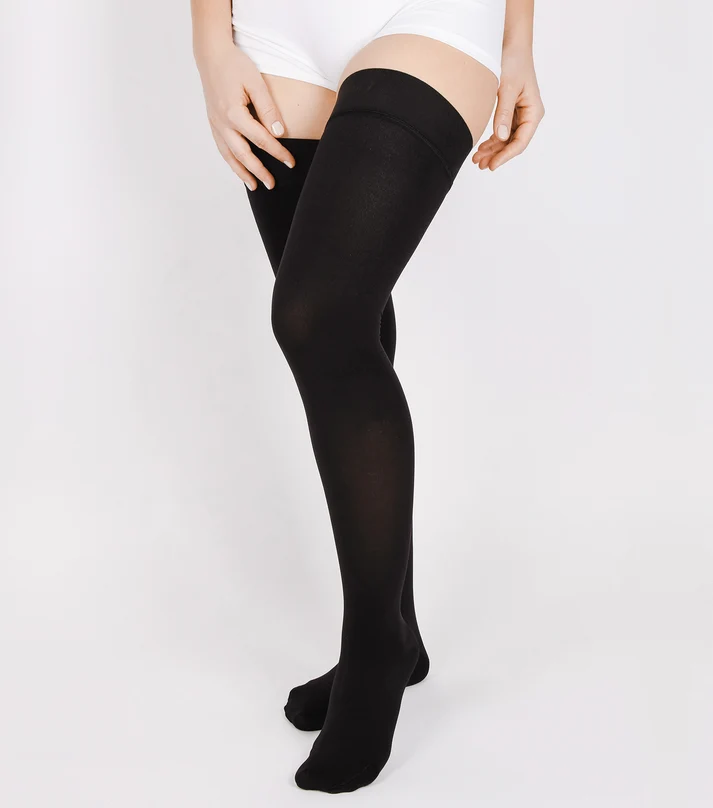
Compression socks or stockings have evolved significantly beyond their practical roots, now indispensable to various different activities, from medicine to sport and casual wear. These stockings can provide many benefits, from improving blood flow to reducing swelling and discomfort.
However, it is hard for many consumers to know where to begin in this vast realm of different compression levels. So, we will explore the depths of stockings with varying compressions and pinpoint the right one for you!
Defining the Levels of Compression in Stockings
A range of values, such as "20-30 mmHg compression stockings," is used to represent mean compression levels. This indicates that the degree of compression will not drop below 20 mmHg or rise over 30 mmHg. "Millimeters of mercury" is the basic unit of measurement for pressure, which is also used to measure blood pressure.
CEP, Juzo, Mediven, and Sigvaris all grade the compression characteristics of their compression socks and stockings, another crucial aspect of compression stockings. When there is "graduated compression," the compression is greatest at the ankle and becomes progressively less severe as it rises the leg.
Improved circulation is made possible by this unique knitting technique to create compression stockings for the legs.
Over the Counter 15–20 mmHg
For daily compression stockings, a modest amount of compression, like compression stockings 15-20 mmHg, is a wonderful option to aid with moderate edema and tired legs after prolonged sitting, standing, or traveling. Knee-high, thigh-high, pantyhose, and maternity pantyhose designs are available for 15-20 mmHg compression stockings.
There are several styles available for both men & women to choose from. There are dressy-looking compression socks for everyday wear and cotton socks for casual use. For ladies, there are additional sheer fashion options. There are also sports compression socks with a 15-20 mmHg compression level.
Many individuals wear compression sleeves with a 15-20 mmHg while they fly or vacation. Because they come in various designs and are comfortable, an increasing number of individuals are deciding to include a small amount of 15-20 mmHg compression into their daily lives.
Class I Medical Grade 20–30 mmHg
The initial compression level considered medical grade is between 20 and 30 mmHg. It's the most popular medical grade since it gives your legs enough compression without being too forceful. The compression level of 20–30 mmHg is excellent for travel, sports, spider veins, varicose veins, and post-surgery edema in the legs.
Expectant moms are beginning to use 20–30 mmHg compression stockings to relieve discomfort, swelling, and weight in their legs as they become aware of the advantages of this kind of clothing.
For men and women, a range of designs in knee-high, thigh-high, pantyhose, and maternity pantyhose are available with 20–30 mmHg of compression. CEP, Juzo, Mediven, and Sigvaris also offer opaque, dress, sports, and sheer fashion styles in addition to opaque designs for their 20–30 mmHg compression stockings.
Class II Medical Grade 30–40 mmHg
Stronger medical grade class II compression is seen at 30–40 mmHg. If you have mild to severe leg health issues, it is advised. If you are dealing from DVT (deep vein thrombosis) or a blood clot, you should also use compression at 30–40 mmHg. Patients with lymphedema are also advised to use a compression level of 30–40 mmHg. Be careful to consider the kind of fabric that compression stockings or socks should be made of while selecting the 30–40 mmHg compression.
Class III Medical Grade 40–50 mmHg
A fairly significant compression is seen in the 40–50 mmHg range. It is highly advised that anybody thinking about using this degree of compression have had a full discussion on compression stockings & their health with their physician or other healthcare provider. This degree of compression is used for lymphedema, wound care, and severe venous stasis.
Conclusion
To sum up, the compression level spectrum in socks offers a wide selection of choices to fit different needs for very different individuals, from medical treatment and entertainment to performance and fashion.
Suppose you're trying to get relief from venous disorders, become faster while competing in sports, or just acquire something that will add some class to your outfit that people might admire for its beauty and taste. In that case, a compression stocking on the market is designed for your specific occasion.

 Arabic
 French
 Spanish
 Portuguese
 Deutsch
 Turkish
 Dutch
 Italiano
 Russian
 Romaian
 Portuguese (Brazil)
 Greek
