


 About Urh Social
 Terms of Service
 سياسة الخصوصية
 Contact
Agro Textiles Market Growth Outlook to 2036 at USD 11.4 Billion; China 8.6% and India 8.0% CAGR
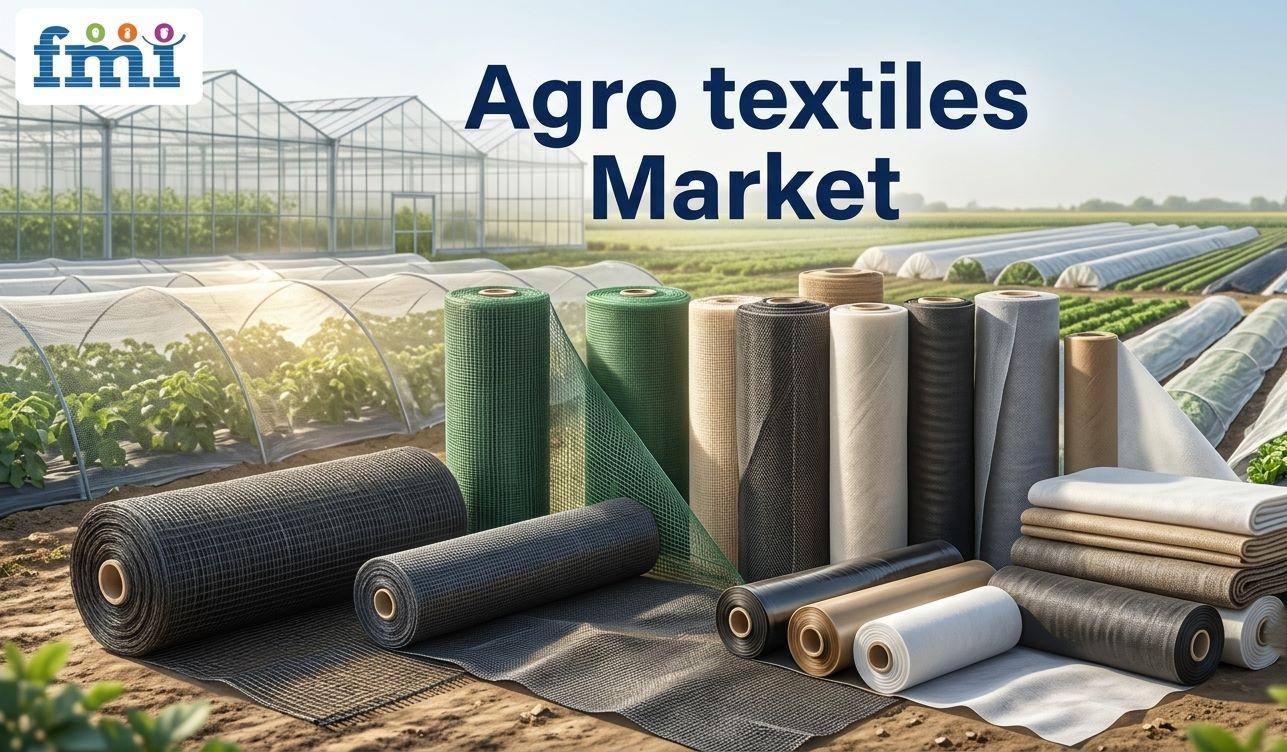
The global agro textiles market is projected to grow from USD 6.1 billion in 2026 to USD 11.4 billion by 2036, registering a CAGR of 6.4% during the forecast period, according to Future Market Insights (FMI). Shade nets are expected to lead the product type segment with a 29.0% share in 2026, while polyethylene is projected to account for a 33.0% share of the fiber segment. Crop production is anticipated to represent 36% of application demand.
Agro textiles help farmers protect crops from sunlight, hail, wind, and pests. Growing demand for protected cultivation, horticulture, and aquaculture is creating opportunities for durable, UV-resistant agricultural textiles.
Get Detailed Market Forecasts, Competitive Benchmarking, and Pricing Trends: https://www.futuremarketinsights.com/reports/sample/rep-gb-11747
Key Takeaways of the Agro Textiles Market
- The market is projected to reach USD 11.4 billion by 2036, growing at a 6.4% CAGR from 2026 to 2036.
- Market valuation is estimated at USD 6.1 billion in 2026, following USD 5.77 billion in 2025.
- Shade nets are expected to account for a 29.0% share of the product type segment in 2026.
- Polyethylene is projected to hold a 33.0% share of the fiber segment.
- Crop production is anticipated to represent 36% of application demand.
- China is projected to register the fastest growth among the profiled countries at an 8.6% CAGR.
- Key companies include Garware Technical Fibers Ltd., Freudenberg Performance Materials, TenCate Industrial Fabrics, Beaulieu Technical Textiles, AB Ludvig Svensson, Karatzis Group, Mogul Co Ltd, Belton Industries Inc., and Zhongshan Hongjun Nonwovens Co Ltd.
How Is the Agro Textiles Market Segmented?
The agro textiles market is segmented by product type, fiber, application, and region. Product categories include shade nets, mulch mats, fishing nets, anti-hail and bird protection nets, and other agricultural textile products.
Fiber categories include polyethylene, polypropylene, nylon, polyester, polyolefin, jute, and wool. Applications cover crop production, horticulture, floriculture and forestry, animal husbandry and aquaculture, and agro engineering. The market also spans North America, Latin America, Europe, East Asia, South Asia and Pacific, and the Middle East and Africa.
Why Do Shade Nets Lead the Product Type Segment?
Shade nets are expected to account for a 29.0% share of the product type segment in 2026. Their use in greenhouse cultivation and open-field horticulture supports demand from farmers seeking to manage sunlight exposure and protect high-value crops.
- Shade nets help regulate light and temperature for horticulture and floriculture applications.
- UV-stabilized materials support outdoor durability and extended service life.
- Different mesh specifications allow growers to select products according to crop requirements and growing conditions.
What Drives Polyethylene and Crop Production Demand?
Polyethylene is projected to account for a 33.0% share of the fiber segment in 2026. Its relatively low material cost, compatibility with extrusion processes, and suitability for UV-stabilized netting support its use in agricultural textiles. Polyethylene products are used in shade nets, fishing nets, and other protective applications where durability and production efficiency are important.
Crop production is anticipated to represent 36% of application demand. Farmers use agricultural textiles for mulching, wind protection, bird deterrence, and other crop management activities.
What Are the Key Dynamics in the Agro Textiles Market?
- Driver: Increasing adoption of protected cultivation, climate-related crop protection measures, and government support for agricultural infrastructure are encouraging demand.
- Restraint: Polymer price volatility and pressure on margins can affect manufacturers, particularly in price-sensitive commodity textile categories.
- Opportunity: Aquaculture expansion, high-specification protective netting, and biodegradable agricultural textile products offer opportunities for product development and market expansion.
Which Country Shows the Highest Growth Potential?
China is projected to register the fastest growth at an 8.6% CAGR through 2036. India follows at 8.0%, Germany at 7.4%, Brazil at 6.7%, the United States at 6.1%, the United Kingdom at 5.4%, and Japan at 4.8%.
China benefits from its extensive protected cultivation activities, domestic polymer production, and expanding aquaculture sector. India offers opportunities through horticulture subsidy programs, floriculture development, and growing demand for agricultural protection products.
Germany's horticulture infrastructure and interest in specialized agricultural textiles support market opportunities. Brazil's agricultural activities create demand for crop protection materials, while the United States benefits from greenhouse cultivation, orchard protection, and commercial aquaculture.
Which Companies Are Notable in the Agro Textiles Market?
Major companies include Garware Technical Fibers Ltd., Freudenberg Performance Materials, TenCate Industrial Fabrics, Beaulieu Technical Textiles, AB Ludvig Svensson, Karatzis Group, Mogul Co Ltd, Belton Industries Inc., and Zhongshan Hongjun Nonwovens Co Ltd.
Competition centers on product durability, manufacturing efficiency, distribution reach, material performance, and application-specific product development. Garware Technical Fibers Ltd. has an established presence in agricultural and aquaculture netting, while other suppliers offer products for greenhouse cultivation, crop protection, and horticulture.
About the Report
Future Market Insights' Agro Textiles Market report examines market size, growth forecasts, product types, fiber categories, agricultural applications, regional demand, country-level opportunities, and the competitive landscape from 2026 to 2036. The study provides insights into protected cultivation, crop protection requirements, aquaculture demand, material selection, polymer cost considerations, and product development opportunities to support strategic planning and market assessment.
Explore More Related Studies Published by FMI Research:
FMI Custom Research: Strategic Intelligence for Confident Decision-Making
In today's rapidly evolving construction environment, leadership teams need more than market data—they need actionable intelligence tailored to their strategic priorities. FMI's Custom Research solutions help organizations evaluate growth opportunities, validate investments, assess competitive dynamics, understand technology adoption, and reduce uncertainty before making critical business decisions.
Key Executive Benefits
- Decision-Ready Insights: Research tailored to specific business challenges, expansion plans, technology priorities, and investment requirements.
- Reduced Strategic Risk: Validate market opportunities, customer demand, competitive positioning, and technology adoption before committing resources.
- Market Entry Confidence: Assess opportunity size, regulatory barriers, distribution dynamics, project specifications, and competitive landscapes before entering new markets.
- Competitive Advantage: Gain proprietary intelligence unavailable through syndicated reports or internal datasets.
- Faster Growth Decisions: Accelerate market expansion, product development, portfolio optimization, partnerships, and investment planning.
Business Impact
FMI helps organizations transform market complexity into strategic clarity, enabling leadership teams to identify growth opportunities faster, optimize resource allocation, strengthen competitive positioning, and make high-stakes business decisions with confidence.
To explore how FMI Custom Research can support your strategic priorities, connect with the team at [email protected].

 English
 French
 Spanish
 Portuguese
 Deutsch
 Turkish
 Dutch
 Italiano
 Russian
 Romaian
 Portuguese (Brazil)
 Greek
