


 About Urh Social
 Terms of Service
 Privacy Policy
 Contact
Copyediting vs Proofreading What Is the Difference and Does Your Book Need Both
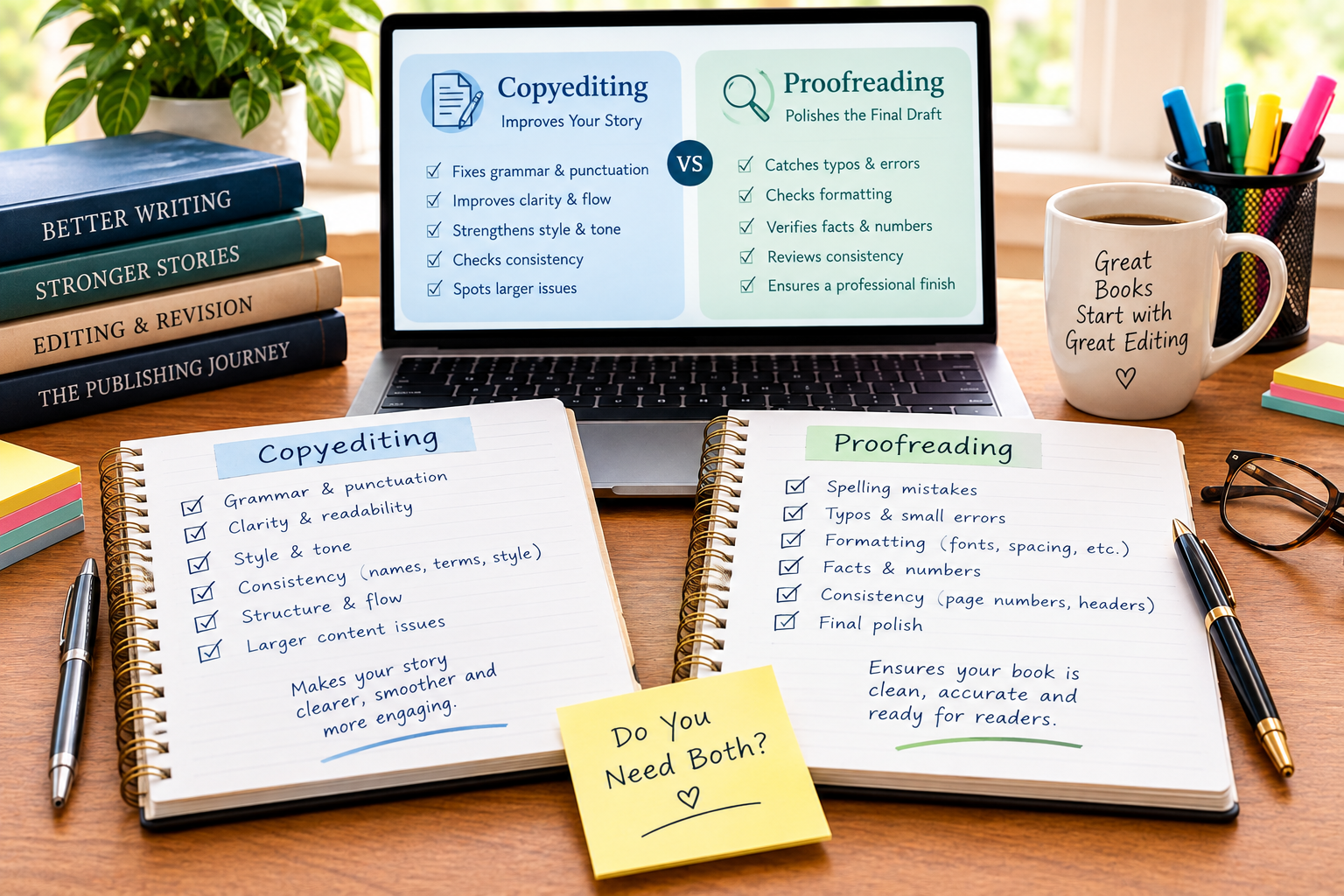
Every book deserves careful editing before it reaches readers. However, many authors struggle to understand the difference between copyediting and proofreading. Although both services improve a manuscript's quality, they address different problems and serve distinct purposes during the publishing process. Choosing the right editorial support can help you produce a professional book that communicates your ideas clearly and confidently.
Copyediting focuses on language, consistency, grammar, and sentence structure, while proofreading identifies remaining errors in a nearly finished book. Understanding how these services work, when to use them, and whether your manuscript needs both can help you make informed publishing decisions and avoid preventable mistakes.
What Is Copyediting?
Copyediting is a detailed review of a manuscript that improves its language, readability, accuracy, and consistency without changing the author's intended meaning. A copyeditor examines sentence construction, grammar, spelling, punctuation, word choice, and other language-related issues. The goal is to make the manuscript clear, polished, and professional while preserving the writer's unique voice and style.
Beyond correcting individual errors, copyediting establishes consistency throughout the book. A professional book publishing company may provide copyediting services to standardize capitalization, ensure consistent spelling, correct confusing sentences, and identify unnecessary repetition. These improvements help readers follow the author's ideas without distractions, making the book more enjoyable and easier to understand.
What Does a Copyeditor Check?
A professional copyeditor examines several aspects of a manuscript to ensure that the writing meets appropriate editorial standards. Although the exact scope depends on the agreement, common responsibilities include the following:
-
Grammar and punctuation: Correcting grammatical mistakes, misplaced commas, apostrophe errors, and punctuation inconsistencies.
-
Spelling and word usage: Identifying misspelled words, incorrect terminology, and commonly confused expressions.
-
Sentence clarity: Rewriting awkward or confusing sentences while preserving the author's intended meaning.
-
Consistency: Standardizing names, dates, capitalization, abbreviations, numbers, and recurring terminology.
-
Readability: Improving sentence flow, removing unnecessary repetition, and addressing wordiness.
-
Style and tone: Maintaining a consistent writing style that suits the intended audience and genre.
Additionally, copyeditors may flag factual inconsistencies, questionable statements, or passages that require clarification. However, extensive fact-checking, structural revisions, and substantive content changes generally fall outside standard copyediting unless the author specifically requests them.
What Is Proofreading?
Proofreading is the final quality-control review conducted after editing and typesetting have prepared a manuscript for publication. At this stage, the text should already be polished, and the proofreader concentrates on identifying remaining mistakes that could affect the finished book. These may include typographical errors, missing words, incorrect punctuation, formatting inconsistencies, and layout problems.
Unlike copyediting, proofreading usually takes place when the book has reached its designed or formatted stage. The proofreader checks not only the text but also how it appears on the page. This final inspection helps ensure that the published edition looks professional and presents the content accurately to readers.
What Does a Proofreader Check?
Proofreaders examine the final pages carefully to catch errors that earlier editorial stages may have missed. Their responsibilities often include checking:
-
Typographical errors: Correcting accidental keystrokes, duplicated words, and missing letters.
-
Punctuation and spelling: Identifying overlooked mistakes in the final text.
-
Formatting consistency: Checking headings, spacing, fonts, indentation, and paragraph alignment.
-
Page layout: Identifying awkward page breaks, uneven spacing, and text that appears incorrectly positioned.
-
Page elements: Verifying page numbers, running headers, footers, and chapter titles.
-
Cross-references: Checking references to chapters, illustrations, tables, and other sections.
-
Design-related issues: Flagging text that appears clipped, misplaced, or difficult to read.
For printed books, proofreaders may also inspect the placement of images, captions, and other visual elements. For ebooks, they may review navigation, heading structure, and formatting across supported devices. The exact checks depend on the format and the proof supplied.
Copyediting vs Proofreading: Key Differences
Although copyediting and proofreading both improve a book's quality, their timing, scope, and objectives differ. Copyediting improves the manuscript before final design, whereas proofreading checks the prepared pages for remaining errors. Understanding these distinctions helps authors plan their publishing schedules and choose the appropriate services.
|
Feature |
Copyediting |
Proofreading |
|
Main purpose |
Improve language and consistency |
Catch remaining errors |
|
Typical stage |
Before final typesetting |
After typesetting |
|
Grammar and style |
Detailed review |
Final error check |
|
Sentence clarity |
May revise awkward sentences |
Usually makes minimal changes |
|
Formatting |
Limited manuscript-level consistency |
Checks the designed pages |
|
Layout problems |
Generally not the primary focus |
Identifies visible layout issues |
|
Extent of changes |
May involve many corrections |
Usually involves smaller corrections |
The most important distinction is that copyediting improves the writing itself, while proofreading checks the near-final product. Although both professionals may notice grammatical errors, they approach the manuscript at different stages and with different priorities.
Why Copyediting and Proofreading Are Both Important
A manuscript can contain excellent ideas yet still disappoint readers if its language is confusing or its final pages contain distracting errors. Copyediting and proofreading address these problems at different stages, creating a more reliable quality-control process. Together, they help authors present a book that reflects the care and professionalism invested in its creation.
Copyediting Improves the Reading Experience
Even a well-written first draft can contain repetitive phrases, inconsistent terminology, awkward transitions, and sentences that require clarification. Copyediting addresses these issues before they become part of the final design. As a result, readers can focus on the story, information, or message instead of struggling with unclear language.
Moreover, a consistent editorial style strengthens the author's credibility. Nonfiction readers benefit from clear explanations and accurate terminology, while fiction readers appreciate smooth dialogue, consistent character names, and readable prose. Copyediting supports both outcomes without unnecessarily replacing the author's individual voice.
Proofreading Protects the Final Book
Errors can appear or remain unnoticed even after extensive editing. During typesetting, for example, a word might disappear, a heading might become inconsistent, or a page number might be incorrect. Proofreading catches these problems before publication, helping prevent avoidable distractions in the finished book.
Furthermore, a final proofread provides an opportunity to examine the actual reading experience. A sentence that looked fine in a word-processing document might become awkward when split across pages. By reviewing the designed pages, a proofreader can identify issues that a manuscript-level review may not reveal.
Does Your Book Need Both Copyediting and Proofreading?
For most professionally published books, using both services is a sensible choice. Each stage addresses different concerns, and neither completely replaces the other. Copyediting improves the manuscript before it enters final production, while proofreading checks the resulting pages for errors that remain or arise during formatting.
However, the level of editorial support your book requires depends on its condition, complexity, intended readership, and publishing budget. Authors can also benefit from publishing consulting services to evaluate their manuscript's needs and determine which editorial solutions best fit their publishing goals. Rather than assuming that one service will resolve every issue, authors should assess their manuscript honestly before making a decision.
When You Should Choose Both Services
Consider using copyediting and proofreading if you are preparing a commercial book, submitting a professional nonfiction title, publishing a memoir, or releasing a novel to a broad readership. These projects benefit from a thorough language review followed by a final inspection of the formatted edition.
Both services are particularly valuable when your manuscript contains specialized terminology, multiple contributors, extensive references, illustrations, or complicated formatting. In these cases, consistency and production accuracy become especially important. A two-stage editorial process gives you a better opportunity to identify different categories of mistakes before readers encounter them.
When Copyediting May Be Your First Priority
If your manuscript contains frequent grammatical errors, inconsistent writing, repetitive passages, or sentences that need clarification, prioritize copyediting. Proofreading alone cannot replace a detailed review of language and sentence structure. Publishing an unpolished manuscript after only a final proofread could leave substantial problems unresolved.
Similarly, first-time authors may benefit from professional copyediting if they are unfamiliar with editorial standards or need help preparing their work for publication. Once the manuscript has been copyedited and formatted, a proofreader can examine the final pages before release.
When Proofreading May Be Enough
Proofreading may be appropriate if an experienced editor has already reviewed your manuscript thoroughly and you have made the agreed corrections. It can also suit a short publication that has received substantial editorial attention and only requires a final quality check. However, this approach assumes that the underlying writing is already polished.
Before choosing proofreading alone, review the manuscript carefully or request an editorial assessment. If the editor identifies recurring grammar problems, unclear sentences, or inconsistent terminology, copyediting may still be necessary. Making this decision early can prevent expensive corrections and unnecessary delays later in production.
Where Copyediting and Proofreading Fit in the Publishing Process
Understanding the correct order of editorial services helps authors manage their production schedules more effectively. Although publishing workflows vary, the following sequence works well for many books.
Step 1: Complete the manuscript. Finish the major revisions and address structural issues before requesting a copyedit. If the book still needs significant changes to its organization, plot, or argument, developmental editing may be more appropriate first.
Step 2: Copyedit the manuscript. Have a qualified editor review grammar, punctuation, consistency, clarity, and sentence-level issues. Review the suggested changes and approve the final text before moving into production.
Step 3: Format and design the book. Prepare the interior layout, chapter headings, page numbers, and other design elements. Create the print-ready file or formatted ebook according to the intended publishing requirements.
Step 4: Proofread the formatted pages. Review the final proof for typographical mistakes, formatting problems, missing text, and other production issues. Make the necessary corrections before approving the publication files.
Step 5: Conduct a final review. Confirm that the approved corrections appear correctly and that the final files meet the publisher's or distributor's requirements. Depending on the extent of changes, an additional proof check may be worthwhile.
Following this sequence reduces the risk of correcting the same passage repeatedly. It also helps authors avoid introducing fresh errors when making late changes to a formatted book.
How to Choose the Right Editorial Services for Your Book
Selecting an editor involves more than comparing prices. Authors should consider the manuscript's current condition, the editor's experience, the services included, and the intended publishing format. A clear understanding of these factors makes it easier to choose professional support that matches the project's needs.
Evaluate Your Manuscript Honestly
Start by identifying your biggest concerns. Does your writing contain frequent grammatical errors? Do readers struggle to understand certain passages? Have you already completed several rounds of editing? Your answers can help determine whether you need copyediting, proofreading, or a broader editorial assessment.
Additionally, consider the book's genre and intended audience. Academic publications, business books, memoirs, and novels may require different editorial priorities. A qualified professional can recommend an appropriate level of review after examining a representative sample or evaluating the manuscript.
Review the Editor's Experience and Scope
Ask prospective editors about their experience with your genre, their editing approach, expected turnaround time, and the deliverables included in their fee. Request a sample edit when available, and clarify whether the service covers consistency, style-sheet preparation, references, or formatting checks.
Authors seeking broader guidance can also explore publishing consulting services to understand how editing fits into their overall publishing plan. A publishing consultant may help coordinate editorial work, design, production, and distribution decisions, although the specific services depend on the provider.
Balance Quality With Your Budget
Editorial costs vary according to manuscript length, complexity, turnaround time, and the editor's experience. Instead of selecting a service solely because it is inexpensive, compare its scope with your actual requirements. A lower-priced proofreading package may not include the detailed language improvements your manuscript needs.
If your budget is limited, prioritize the work that addresses the manuscript's most significant weaknesses. However, avoid treating proofreading as a substitute for necessary copyediting. Investing in the correct service at the appropriate stage can reduce avoidable revisions and help you prepare a more professional book.
Common Mistakes Authors Should Avoid
One common mistake is requesting proofreading before the manuscript has undergone sufficient editing. This can leave sentence-level problems unresolved and may require further corrections after the proofreader finishes. Another mistake is making substantial content changes after proofreading without arranging an additional check of the affected pages.
Authors should also avoid assuming that every editor provides identical services. Some professionals offer combined packages, while others specialize in a single editorial stage. Always confirm the scope of work in writing, including whether revisions, formatting checks, and follow-up reviews are included. Clear expectations help everyone work toward the same publishing goal.
Conclusion
Copyediting and proofreading serve different but complementary purposes in book publishing. Copyediting improves grammar, clarity, consistency, and readability, while proofreading catches remaining mistakes in the formatted book before publication. Although some manuscripts may need only limited editorial support, most books benefit from both stages when the budget and publishing schedule allow.
To make the right decision, assess your manuscript's current condition, identify its editorial needs, and work with qualified professionals who understand your genre. By following a well-planned editing process, you can protect your author's voice, improve the reader's experience, and publish a polished book that reflects the quality of your work.

 English
 Arabic
 French
 Portuguese
 Deutsch
 Turkish
 Dutch
Dutch
 Italiano
 Russian
 Romaian
 Portuguese (Brazil)
 Greek
Greek
