


 About Urh Social
 Terms of Service
 Política de Privacidade
 Contact
How to choose the right API automation approach for a growing team
Manual API testing works fine when a project has a handful of endpoints and one developer who knows them all. It stops working the moment a team starts shipping several times a week across multiple services. At that point, someone forgets to rerun a request before a release, a breaking change slips through, and the team realizes testing needs to happen automatically, every time.
The good news is that the tooling has matured a lot. The harder part is picking an approach that fits how your team actually works, rather than adopting whatever is most popular.
Start with the problem, not the tool
Before comparing api automation testing tools, it helps to be honest about what is slowing your team down. Most teams fall into one of three situations.
Some have almost no automated API tests and need basic coverage on critical flows like login, checkout, and payments. Others already have tests, but maintaining them takes so much effort that coverage keeps falling behind. And some have decent coverage but struggle with flaky tests caused by unreliable dependencies like databases and third-party services.
Each of these points to a different kind of solution.
Three common approaches
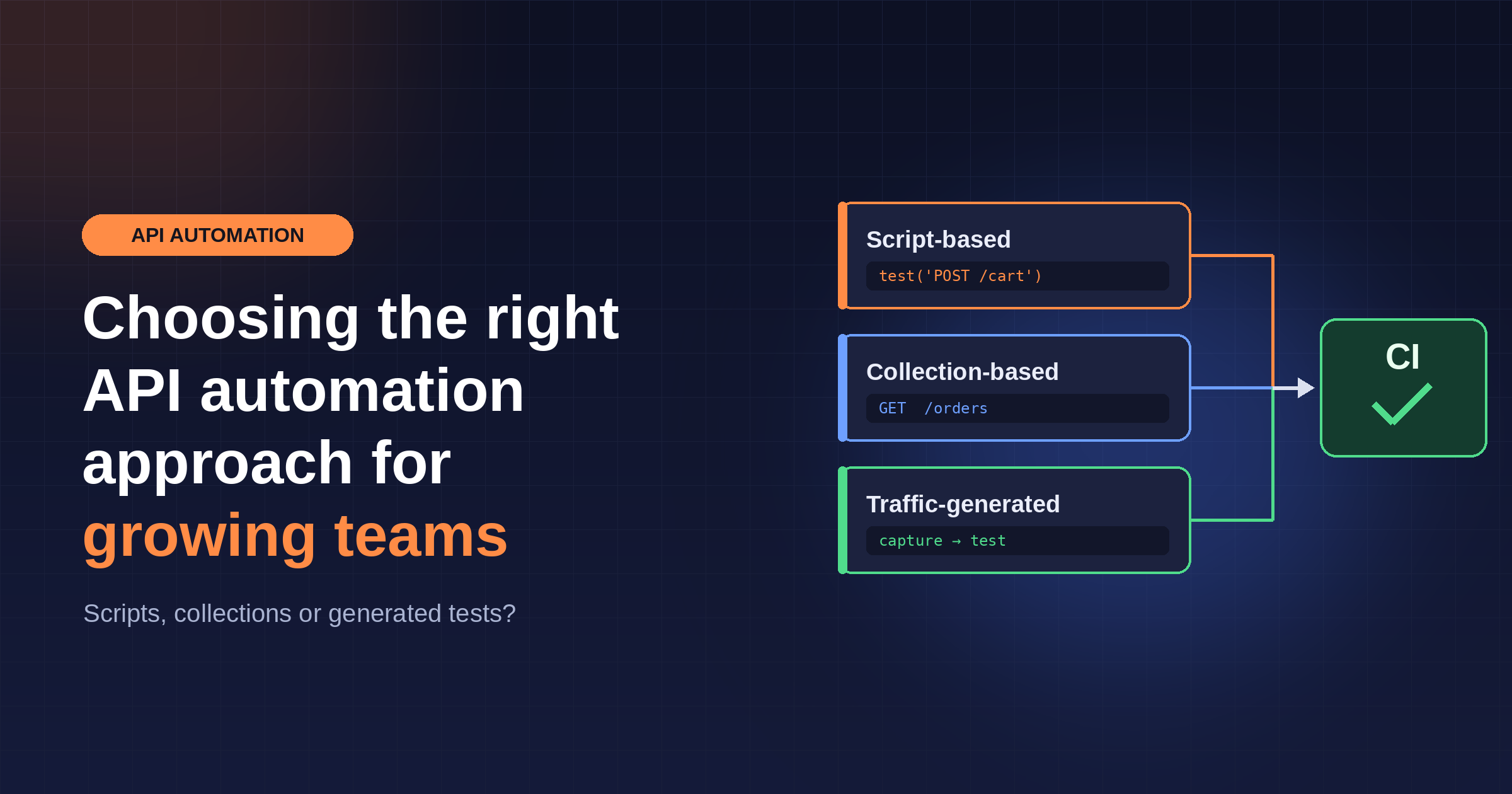
Script-based frameworks. These let developers write tests in code, usually in the same language as the service. They offer full control and fit naturally into code review, but every test has to be written and maintained by hand.
Collection-based clients. These are GUI tools where requests are built visually and grouped into collections that can be run as test suites. They are easy to start with, but collections often drift out of sync with the codebase over time.
Traffic-based test generation. These tools capture real API calls and turn them into test cases and mocks automatically. They are especially useful when maintenance is the bottleneck, since tests can be regenerated as the API evolves instead of rewritten.
Questions to ask during evaluation
Can tests live in Git alongside the code they verify?
Does the tool run headlessly in CI without extra licensing costs?
How does it handle external dependencies? Built-in mocking saves a lot of setup time.
How much effort does it take to update tests when an endpoint changes?
Is there an active community or open source project behind it?
Roll it out gradually
Teams that adopt automation successfully rarely do it all at once. Pick one service with real business logic, automate its most important flows, and get those tests running in CI on every pull request. Once the team trusts the results, expand to other services.
The right tool is the one your team will actually keep using six months from now. Choosing based on your real bottleneck, rather than a feature checklist, is the best way to get there.

 English
 Arabic
 French
 Spanish
 Deutsch
 Turkish
 Dutch
Dutch
 Italiano
 Russian
 Romaian
 Portuguese (Brazil)
 Greek
Greek
