


 About Urh Social
 Terms of Service
 Πολιτική Ιδιωτικότητας
 Contact
How to Make Your Website More Citable in AI-Generated Answers
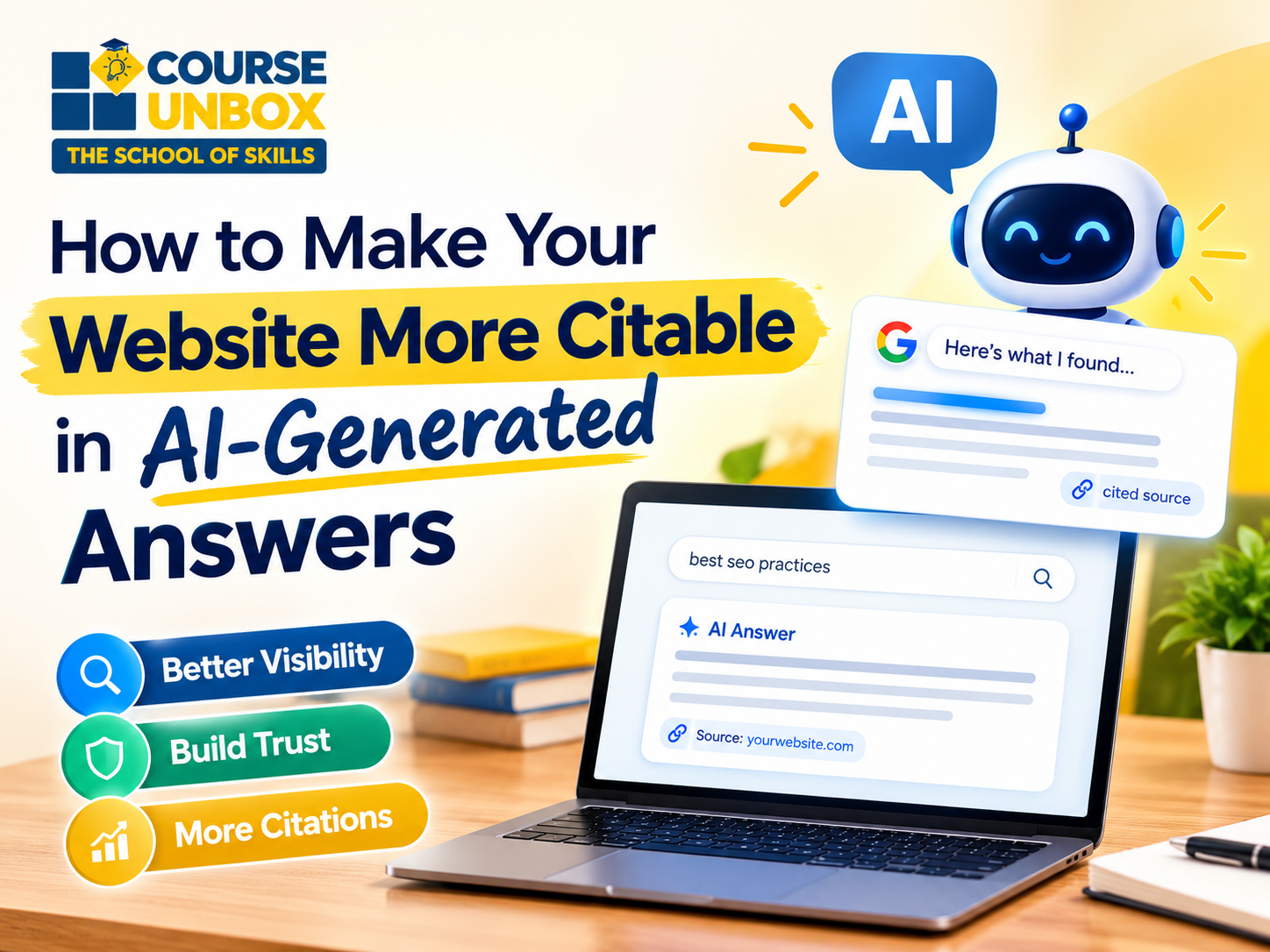
Making your website more citable in AI-generated answers requires more than traditional SEO. AI search systems need to be able to discover, understand, extract, verify, and confidently reference your content when answering user questions. This means creating direct, well-structured answers, demonstrating expertise with useful evidence, maintaining clear website architecture, and making important information easy for search and answer engines to interpret. A citation-ready website combines strong SEO foundations with Answer Engine Optimization (AEO), useful content, clear entities, trustworthy sources, and technically accessible pages.
As users increasingly ask complete questions instead of searching with short keywords, websites have a new opportunity: becoming a source that AI systems can use when constructing answers. However, appearing as a citation is not guaranteed simply because a page ranks well in traditional search. Your content needs to provide information that can be understood and reused accurately by an AI system.
What Does It Mean for a Website to Be Citable?
A website is citable when its content contains clear, reliable, and context-complete information that an AI system can use to support an answer. Instead of simply recognizing a page as relevant, an answer engine needs to identify a specific passage that directly supports the response it is generating.
For example, imagine someone asks an AI assistant, “What are the most important factors in technical SEO?” A generic article discussing SEO may be relevant, but a page that clearly explains crawling, indexing, website performance, mobile usability, structured data, and technical accessibility provides much stronger answer-ready information.
The goal is therefore not to write content specifically for an AI to copy. The goal is to make your information clear enough, specific enough, and trustworthy enough to be independently useful to both people and machines.
Why Is AI Citation Different From Traditional SEO?
Traditional SEO focuses heavily on helping search engines understand relevance, authority, and usefulness so that pages can appear in search results. AI-generated search introduces another layer because the system may retrieve information from several sources and combine it into one conversational response.
This makes content structure particularly important. AI systems need to locate individual facts and passages rather than simply identify a page as relevant. Research and industry guidance around AEO consistently emphasize direct answers, question-based headings, concise sections, and clear information architecture because these elements make content easier to extract and interpret.
A page can therefore have strong organic visibility while still providing weak citation opportunities. Conversely, a well-structured page that directly answers a specific question may provide a highly useful source for an AI-generated response.
How Can You Make Your Website More Citable?
Start With Direct Answers to Specific Questions
One of the simplest ways to improve citation potential is to answer the main question early. Do not spend several paragraphs describing the background before giving the reader the information they came for.
If the heading asks, “What makes content useful for AI search?”, the first paragraph underneath should answer that question directly. The following paragraphs can then explain the reasoning, examples, limitations, and supporting evidence.
For example, instead of writing:
“AI search is changing the digital marketing environment in many ways, and businesses are increasingly considering new approaches to content optimization.”
A stronger answer-oriented statement would be:
“Content becomes more useful for AI search when it provides direct answers, uses clear terminology, supports important claims with evidence, and organizes information around specific user questions.”
The second version gives an AI system a complete statement that can be understood without requiring several surrounding sentences.
Use Question-Based H2 and H3 Headings
Headings provide context for the information that follows them. A descriptive question-based heading can make the purpose of a section much clearer.
Instead of using a generic heading such as “Content Strategy,” you could use “How Should You Structure Content for AI Search?”
The paragraph immediately following that heading should answer the question. This creates a predictable relationship between the user's question, the heading, and the answer.
A logical hierarchy such as H1 → H2 → H3 also helps organize complex subjects. Your H1 should represent the main topic, H2 headings should cover major questions or concepts, and H3 headings should explain supporting ideas.
Write Passages That Can Stand Alone
Citable content should make sense even when separated from the rest of the article. Avoid sentences that depend heavily on vague references such as “this,” “they,” “it,” or “the above method.”
For example, “This strategy can improve visibility” provides very little context on its own. A clearer version would be, “Answer-first content can improve the clarity of information available to AI search systems because the main response appears immediately beneath a relevant question.”
The second sentence identifies the subject, action, and reason. That makes the information easier to understand when extracted from the surrounding article.
Support Important Claims With Evidence
AI-generated answers benefit from sources that provide specific and verifiable information. If you make an important claim, explain where it comes from whenever appropriate.
Evidence can include original research, first-party data, documented experiments, expert commentary, official documentation, case studies, surveys, or clearly attributed industry information.
Original information can be particularly valuable because it gives your website something that other pages cannot simply reproduce. A case study showing how a particular technical change affected a website can be more useful than another generic explanation of the same SEO concept.
Demonstrate First-Hand Experience
Generic information exists across thousands of websites. Websites that demonstrate genuine experience can provide stronger reasons for users and AI systems to trust their content.
For example, an SEO website could explain how a technical audit was performed, what problems were discovered, how the problems were resolved, and what happened afterward. Instead of simply saying that Core Web Vitals matter, the content could explain a real optimization process and its limitations.
This approach also makes content more distinctive. AI systems have many sources explaining common concepts, so original observations and specific examples can give a page additional value.
Build a Strong Topical Structure
Connect Related Pages Around One Subject
A website should not treat every article as an isolated piece of content. Related pages should work together to demonstrate topical depth.
For example, a website covering SEO could have separate pages covering keyword research, technical SEO, local SEO, on-page optimization, link building, AI search, AEO, and SEO analytics. Internal links can connect these pages so both users and search systems can understand their relationship.
This creates a stronger topical structure than publishing unrelated articles simply because individual keywords have search volume.
Use Consistent Entities and Terminology
Consistency also matters when establishing what your website is about. If a brand, product, organization, course, person, tool, or location is mentioned across multiple pages, use consistent names and descriptions.
For example, if a website introduces a training institute using one official name, it should avoid repeatedly changing that name into several unrelated variations. Clear entity information helps create a more consistent understanding of the subject across the website.
Make Your Website Technically Accessible
Ensure Important Pages Can Be Crawled and Indexed
Excellent content cannot provide citation value if important pages are inaccessible to search and AI crawlers.
Review your robots.txt configuration, indexing directives, canonical URLs, internal links, sitemap, and server accessibility. Make sure important content is available in the page's accessible HTML rather than relying entirely on content that requires complex client-side JavaScript to render.
Technical accessibility remains an important foundation because AI systems need to retrieve the content before they can evaluate or cite it.
Use Structured Data Where It Fits
Structured data can help search engines interpret information about a page and its entities. Depending on the page, relevant structured data may include Article, Organization, LocalBusiness, Product, BreadcrumbList, or other appropriate Schema.org types.
The important point is that structured data should accurately represent visible information on the page. Adding irrelevant or misleading schema does not make weak content authoritative.
Structured data should therefore support a strong content and technical foundation rather than being treated as a shortcut to AI citations.
Create Content Around Real User Questions
AI-generated searches are often conversational. Users may ask questions such as:
“What is the difference between SEO and AEO?”
“How can I optimize content for AI search?”
“Why is my website not appearing in AI answers?”
“What makes a website trustworthy for search engines?”
These questions provide useful content opportunities because they reveal the actual information users want.
Instead of creating an article around an isolated keyword, build sections around related questions and provide complete answers. This creates content that works naturally for traditional search while also improving its potential usefulness in conversational search environments.
Strengthen Your Website With Trust Signals
Show Who Created the Content
Author information can help establish transparency, particularly for subjects where experience and expertise matter. Include an appropriate author name, relevant biography, credentials when applicable, and information about the organization behind the website.
The objective is not to add credentials simply for SEO. The information should help readers understand why the author or organization is qualified to discuss the subject.
Keep Important Content Updated
Information can become outdated, particularly in areas such as SEO, technology, AI search, software, regulations, and digital marketing.
Review important pages periodically and update outdated statistics, examples, screenshots, tools, references, and recommendations. When a page has undergone a meaningful update, make the update date clear where appropriate.
However, changing a publication date without improving the content provides little value. Updates should represent genuine editorial improvements.
Use Internal Links to Build Context
Internal links can help connect related information across your website. A page about technical SEO, for example, could naturally link to related pages about SEO fundamentals, keyword research, local SEO, or AI SEO.
Descriptive anchor text is preferable to vague phrases such as “click here.” An anchor such as “technical SEO guide” provides more context about the destination page.
For readers who want structured learning, a dedicated SEO Course Online can provide a broader foundation covering different areas of search engine optimization and modern search practices. SEO Course Online
For learners specifically looking for location-focused training, SEO Course in Noida can be used as a relevant resource for understanding SEO through a local training option. SEO Course in Noida
Businesses and learners targeting the Delhi market can also explore an SEO Course in Delhi to learn more about SEO concepts, optimization techniques, and current search practices. SEO Course in Delhi
For audiences searching for training opportunities in the Ghaziabad region, an SEO Course in Ghaziabad provides another location-specific resource related to learning search engine optimization. SEO Course in Ghaziabad
Learners in the Greater Noida area can also explore an SEO Course in Greater Noida as a relevant resource for developing practical knowledge of SEO and modern search optimization. SEO Course in Greater Noida
Avoid Writing Only for AI
Making a website citable does not mean filling every paragraph with keywords, questions, lists, or artificial phrases designed to manipulate AI systems.
The strongest approach is to create content that is genuinely useful to people first. Clear answers, logical headings, original information, accurate facts, useful examples, good internal linking, and technically accessible pages naturally create better extraction opportunities.
AI citation should be treated as an outcome of creating high-quality, understandable information rather than as a separate trick.
How Should You Measure AI Citation Visibility?
Traditional SEO metrics such as rankings, impressions, clicks, and organic traffic are still valuable, but AI search requires additional monitoring.
You can track whether your brand is mentioned when users ask relevant questions across AI search platforms, whether your website appears as a cited source, which pages receive citations, and which competitors are repeatedly referenced.
The goal should not be to chase every AI-generated mention. Instead, identify the topics where your website has genuine expertise and determine whether your strongest pages are becoming visible as supporting sources.
It is also important to remember that there is no guaranteed method for securing an AI citation. Retrieval systems, search indexes, ranking systems, queries, and generated answers can change. Current AEO guidance similarly treats citation optimization as a way to improve the likelihood of being retrieved and referenced rather than a guaranteed placement mechanism.
Final Thoughts
Making your website more citable in AI-generated answers requires a combination of SEO, AEO, technical accessibility, topical authority, original information, and clear content structure. Start by answering important questions directly, organize content with meaningful H2 and H3 headings, write self-contained passages, support important claims with evidence, build related pages around your core topics, and make sure search and AI crawlers can access your content.
The most important principle is simple: create information that an AI system can understand accurately and a human reader can trust immediately. When your website consistently provides clear answers, useful evidence, strong context, and reliable information, it becomes a more useful source for modern search experiences.
Frequently Asked Questions
What makes a website citable by AI?
A website becomes more citable when it provides clear, accurate, relevant, and self-contained information that directly answers user questions. Strong technical accessibility, logical structure, evidence, topical authority, and trustworthy content can all contribute to citation potential.
Does ranking on Google guarantee an AI citation?
No. A high Google ranking does not guarantee that an AI-generated answer will cite the same page. AI systems may retrieve information from multiple sources and select content based on relevance, clarity, authority, and the specific question being answered.
How should content be written for AI-generated answers?
Content should provide direct answers near relevant headings and explain concepts using clear, complete statements. Question-based headings, concise paragraphs, specific terminology, supporting evidence, and useful examples can make information easier for answer engines to interpret and reuse.
Does AEO replace traditional SEO?
No. AEO complements SEO rather than replacing it. A website still needs strong technical foundations, crawlability, indexing, relevant content, internal linking, and authority. AEO adds greater emphasis on direct answers, conversational queries, information extraction, and visibility within AI-generated responses.
Can structured data guarantee AI citations?
No. Structured data can help search engines interpret certain types of information, but it cannot guarantee an AI citation. It should accurately describe the content already visible on the page and work alongside strong technical SEO and useful content.
How important are FAQs for AI search?
FAQs can be useful because their question-and-answer format closely matches conversational searches. Each answer should be independently understandable and should provide genuine information rather than repeating keywords or creating artificial questions.
Does longer content have a better chance of being cited?
Not necessarily. Word count alone does not determine citation potential. A shorter page that answers a question clearly and supports its claims can be more useful than a much longer article filled with repetitive or generic information.
How can I increase my chances of appearing in AI-generated answers?
Focus on becoming a reliable source for a specific topic. Publish original and well-supported information, answer real questions directly, maintain strong technical SEO, organize related content into topical clusters, use descriptive internal links, demonstrate expertise, and keep important information accurate and updated.

 English
 Arabic
 French
 Spanish
 Portuguese
 Deutsch
 Turkish
 Dutch
Dutch
 Italiano
 Russian
 Romaian
 Portuguese (Brazil)
