


 About Urh Social
 Terms of Service
 Privacy Policy
 Contact
How Can Newcomers Practise English with a Canadian Accent for Work in 2026?
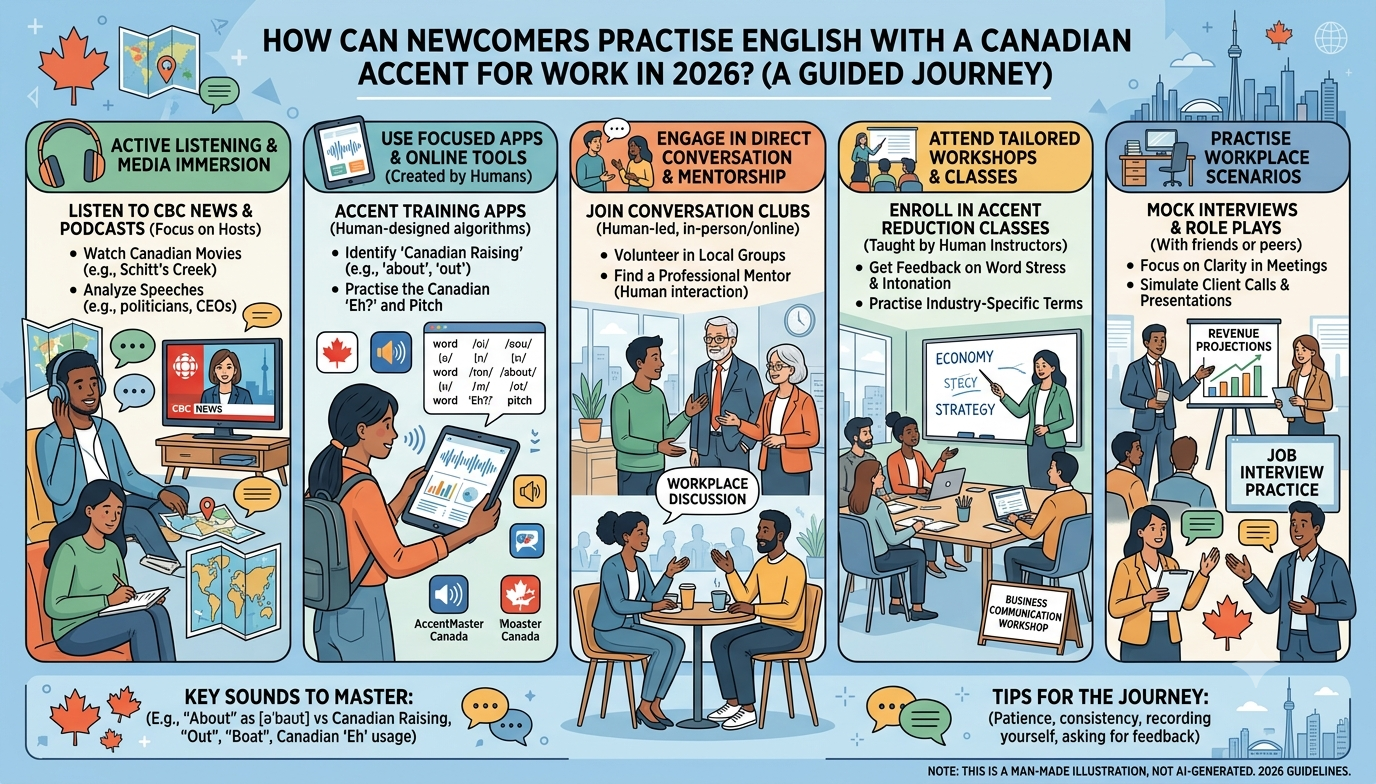
If you are moving to Canada or starting work there, you may wonder: “Do I need to sound Canadian?”
Usually, that is the wrong goal.
You do not need to erase your original accent or copy one particular Canadian speaker. Canadian English varies by region, community, age, profession, and individual speaker. For work, the more useful goals are clear pronunciation, comfortable listening, natural rhythm, useful workplace vocabulary, confidence, and effective two-way communication.
The Government of Canada’s Canadian Language Benchmarks (CLB) focus on practical abilities in listening, speaking, reading, and writing, including communication in Canadian work and social contexts. Canada+1
So, what is the best English speaking practice with Canadian accent for newcomers in 2026? The answer is not one course, app, or pronunciation trick. A stronger approach combines listening, structured learning, pronunciation practice, real conversation, and realistic workplace role-play.
1. How Can You Start With Canadian Workplace Listening Practice?
Before trying to change how you speak, improve how well you understand other people.
At work, you may hear different speaking speeds, accents, vocabulary, communication styles, and levels of formality. Practising only textbook English may not prepare you for an actual meeting or conversation.
Use realistic English from:
-
Workplace conversations and presentations
-
Canadian news and public broadcasts
-
Professional podcasts
-
Interviews
-
Meetings and webinars
-
Everyday conversations
While listening, notice:
-
Which words receive stress
-
Where speakers pause
-
How sentences rise or fall
-
How quickly words connect
-
How formal or informal the language is
-
Which phrases speakers use repeatedly
Do not try to copy every speaker. Instead, ask: “What makes this speaker easy for me—or difficult for me—to understand?”
This develops listening awareness that you can later apply to your own speaking.
Newcomers can also explore government-funded language training and job-related language programs. Canada’s settlement services specifically include language assessment and employment-related language training. IRCC+1
2. What English Phrases Should You Learn for Work?
Learning individual vocabulary words is useful, but complete phrases and sentence patterns are often more practical.
For example, instead of memorising only deadline, practise:
“Could you confirm the deadline for this?”
Instead of learning only clarification, practise:
“Could you clarify what you would like me to do?”
Build a personal phrase bank around situations you actually encounter.
Asking for clarification
-
“Could you explain that another way?”
-
“Just to make sure I understand, do you mean…?”
-
“Could you clarify the next step?”
Giving an update
-
“I’ve completed the first stage.”
-
“I’m currently working on…”
-
“I expect to have this finished by Friday.”
Requesting help
-
“Could you help me with this?”
-
“Would you mind showing me how this works?”
-
“I’m having trouble with this part.”
Agreeing or disagreeing professionally
-
“I agree with that approach.”
-
“That makes sense.”
-
“I see your point. Another option might be…”
Practising these as complete expressions makes your English communication skills more immediately useful.
3. Can Shadowing Improve English Pronunciation and Rhythm?
Yes. Shadowing is a useful pronunciation and listening exercise, but it should not be treated as a shortcut to acquiring a Canadian accent.
The technique involves repeating a speaker's words immediately or shortly after hearing them. Language-learning guidance and pronunciation research describe shadowing as a technique that can support pronunciation, speech perception, listening, and production. British Council Americas+1
Try this seven-step routine:
-
Choose a short recording from a clear English speaker.
-
Listen once without repeating to understand the meaning.
-
Listen again and notice stress, pauses, and rhythm.
-
Repeat along with the speaker.
-
Record yourself.
-
Compare your rhythm and clarity with the model.
-
Repeat only the difficult sections.
Focus particularly on word stress, sentence rhythm, connected speech, and intonation.
The objective is not: “How can I sound exactly like this Canadian?”
It is: “How can I make my English easier to understand and more natural to listen to?”
4. Is One-to-One English Speaking Practice Useful for Newcomers?
Yes, particularly when you need to practise spontaneous conversation rather than simply repeat prepared sentences.
An app exercise might ask you to complete a sentence. A recording might give you time to prepare your answer. Real conversation is different: another person may interrupt, ask a follow-up question, misunderstand you, change the topic, or ask you to explain something differently.
That creates useful practice in:
-
Responding spontaneously
-
Asking follow-up questions
-
Clarifying information
-
Explaining ideas
-
Handling misunderstandings
-
Disagreeing politely
-
Speaking without translating every sentence first
Newcomers who need additional speaking opportunities can supplement independent study with a live one-to-one platform such as EngVarta, which provides live conversations with English experts and real-time speaking feedback. EngVarta+1
This does not replace formal language classes or workplace experience. It can instead provide another place to practise speaking before you need those skills in an actual meeting, interview, or conversation.
5. How Can You Practise Common Canadian Workplace Situations?
Role-play makes spoken English practice more relevant because you rehearse the communication task—not just the vocabulary.
With a manager
Practise:
-
Asking for clarification
-
Discussing a deadline
-
Giving a progress update
-
Requesting additional support
Example:
“I’ve completed most of the report, but I need some clarification about the final section.”
With colleagues
Practise:
-
Small talk
-
Asking for help
-
Sharing an opinion
-
Discussing tasks
Example:
“Have you worked with this system before? I’m trying to understand how this part works.”
During meetings
Practise:
-
Joining a discussion
-
Agreeing politely
-
Disagreeing professionally
-
Asking questions
-
Summarising an idea
Useful phrases include:
“Can I add something here?”
“I agree with that, although I think we should also consider…”
With customers or clients
Practise:
-
Clarifying requirements
-
Explaining a service
-
Responding to concerns
-
Confirming next steps
Role-play is valuable because workplace conversations rarely follow a perfect script.
6. Can an English Speaking App Help With Daily Practice?
An English speaking app can be useful for building a consistent routine.
Depending on the platform, you may use an app for:
-
Pronunciation exercises
-
Vocabulary
-
Listening practice
-
Speaking prompts
-
AI conversation
-
Grammar
-
Repetition
The main advantage is convenience. You can practise for a short period even when you do not have another person available.
The limitation is that app-based practice may not fully reproduce the unpredictability of human conversation. That is why many learners can benefit from combining an app with English conversation practice involving another person.
If you are an Indian learner preparing for Canada, searching for the best English speaking app in India can be useful when comparing resources, but availability in India should not be confused with preparation for Canadian workplace communication. Choose resources according to the skills you actually need.
7. Should You Take Online English Speaking Classes?
Structured learning can give your practice direction.
Options include:
-
An English speaking course online
-
Group classes
-
An online spoken English course
-
1-on-1 English speaking classes
-
Self-study applications
Formal classes can provide curriculum, grammar support, vocabulary development, regular assignments, and accountability.
For newcomers specifically, government-funded programs may also provide general and job-specific language instruction. Canada notes that some programs teach advanced and job-specific language skills designed to help learners succeed in the workplace. Canada
One-to-one English speaking practice can then add more personalised speaking time.
The important point is that structured learning and conversation practice do not have to compete. They can solve different problems.
8. How Can You Practise English for Canadian Job Interviews?
Interview preparation should involve speaking—not just writing perfect answers.
Practise questions such as:
-
“Tell me about yourself.”
-
“Why are you interested in this position?”
-
“Tell me about your previous experience.”
-
“Describe a challenge you faced at work.”
-
“How do you handle deadlines?”
-
“Tell me about a time you worked in a team.”
-
“Do you have any questions for us?”
Avoid memorising a complete script. If the interviewer asks a slightly different question, a memorised answer can become difficult to adapt.
Instead, prepare key points and examples.
For realistic English speaking practice for interviews, ask someone to interrupt with follow-up questions such as:
“What was your specific role?”
“What happened next?”
“What would you do differently?”
“Can you give me an example?”
This trains you to respond naturally rather than recite.
9. What Is a Practical 30-Day Workplace English Plan?
Think of the following as a practice framework, not a guaranteed 30-day fluency programme.
Week 1 — Listening and awareness
Spend time on:
-
Daily English listening
-
Workplace vocabulary
-
Pronunciation awareness
-
Short spoken responses
Keep a list of expressions you hear repeatedly.
Week 2 — Pronunciation and speaking
Focus on:
-
Shadowing
-
Recording yourself
-
Speaking aloud
-
Workplace phrases
Compare your recordings over time.
Week 3 — Conversation
Add:
-
Live English conversation practice
-
Workplace role-play
-
Follow-up questions
-
Spontaneous responses
Try to speak without translating every sentence in your head.
Week 4 — Workplace performance
Practise:
-
Meetings
-
Presentations
-
Job interviews
-
Small talk
-
Professional introductions
-
Unexpected questions
The goal is not to sound like someone born in Canada. The goal is to become more comfortable, understandable, and effective.
Which English Practice Method Fits Which Goal?
|
Method |
Best for |
Personalisation |
Workplace relevance |
Main limitation |
|
Listening practice |
Understanding speech patterns |
Low |
Medium |
Limited speaking |
|
Shadowing |
Rhythm and pronunciation |
Medium |
Medium |
No real interaction |
|
English speaking app |
Daily repetition |
Low–Medium |
Medium |
May not reproduce human conversation |
|
Online classes |
Structured learning |
Medium |
Medium–High |
Speaking time varies |
|
One-to-one practice |
Spontaneous speaking |
High |
High |
Requires regular participation |
|
Workplace role-play |
Professional situations |
High |
Very high |
Needs realistic scenarios |
|
Interview practice |
Interview confidence |
High |
Very high |
Focused on one situation |
No single method is automatically the best. Your current level, goals, available time, and access to speaking opportunities should determine the combination.
How Can You Tell If Your English Is Improving?
Measure communication outcomes, not how closely you resemble a particular speaker.
Every few weeks, ask yourself:
-
Can I speak for 2–3 minutes without constantly translating?
-
Can I understand workplace questions the first time?
-
Can I ask for clarification confidently?
-
Can I explain a problem clearly?
-
Can I participate in a meeting?
-
Can I answer interview questions naturally?
-
Am I using fewer filler words?
-
Is my pronunciation easier for other people to understand?
The CLB framework is another useful reference because it describes progressively more complex speaking and listening abilities for adults in Canada. Canada+1
Is a Canadian Accent the Same as English Fluency?
No.
Accent = how your speech sounds, including features influenced by your language background and community.
Pronunciation = how individual sounds, words, stress, rhythm, and intonation are produced.
Fluency = how smoothly and effectively you express ideas.
Workplace communication = your ability to understand others and communicate appropriately in professional situations.
These are related, but they are not the same.
A newcomer can have a noticeable accent and communicate extremely effectively. Conversely, someone can have pronunciation that sounds relatively Canadian but struggle to explain an idea, participate in meetings, or understand a fast conversation.
That is why improving English speaking should focus on communication first.
Final Takeaway :
The most practical approach is a combination of listening, pronunciation awareness, workplace phrases, shadowing, structured learning, real conversation, and role-play.
Do not make accent elimination your target.
Instead, aim to:
-
Understand different English speakers more comfortably.
-
Speak clearly and naturally.
-
Build useful workplace vocabulary.
-
Practise real two-way conversations.
-
Prepare for meetings, interviews, and everyday workplace situations.
-
Get feedback on recurring problems.
-
Practise consistently.
For newcomers looking for additional one-to-one English speaking practice, EngVarta can be one option to complement courses, self-study, and workplace exposure. Its current offering centres on live conversations with English experts rather than replacing structured language education. EngVarta
Week 2 — Pronunciation and speaking
-
Shadowing
-
Recording yourself
-
Speaking aloud
-
Workplace phrases
Compare your recordings over time.
Week 3 — Conversation
-
Live English conversation practice
-
Workplace role-play
-
Follow-up questions
-
Spontaneous responses
Week 4 — Workplace performance
Practise:
The Canadian government's newcomer services are also worth exploring because they include language assessment, English training, and job-related language support. IRCC+1
Ultimately, successful workplace English is not about losing where your voice comes from. It is about making sure your ideas are understood—and feeling confident enough to express them.
Frequently Asked Questions
1. Do newcomers need to learn a Canadian accent for work?
No. Newcomers do not need to erase their existing accent. For professional communication, prioritise intelligibility, pronunciation, listening comprehension, workplace vocabulary, fluency, and confidence. A familiar or noticeable accent is not automatically a communication problem.
2. How can I practise Canadian English pronunciation?
Listen to a variety of Canadian English speakers, notice stress, rhythm, pauses, and intonation, and use shadowing with short recordings. Record yourself and compare your speech for clarity. Focus on pronunciation features that affect understanding rather than trying to copy one person's entire accent.
3. What is the best way to improve spoken English for work in Canada?
Combine several methods: regular listening, workplace vocabulary, pronunciation practice, structured lessons, and frequent two-way conversation. Add role-play for meetings, interviews, client conversations, and workplace situations. The most useful routine is one you can practise consistently.
4. Is one-to-one English speaking practice useful for newcomers?
It can be particularly useful for spontaneous speaking. One-to-one practice gives you opportunities to respond to questions, explain ideas, ask for clarification, and handle unexpected conversation. It can complement formal classes and independent study.
5. Can an English speaking app improve workplace communication?
An app can support regular practice with vocabulary, pronunciation, listening, grammar, and speaking prompts. However, workplace communication also requires responding to real people, handling follow-up questions, and adapting to unexpected situations. Combining app practice with human conversation can address both areas.
6. How can I practise English for Canadian job interviews?
Practise common interview questions aloud and prepare flexible talking points rather than memorised scripts. Then use mock interviews with follow-up questions so you learn to respond naturally. Record yourself and review clarity, grammar, vocabulary, pace, and unnecessary filler words.
7. How often should I practise spoken English?
Frequent, manageable practice is generally easier to sustain than occasional long sessions. A routine could combine daily listening and short speaking practice with longer sessions for role-play, classes, or interviews. Adjust the schedule according to your level, work, studies, and available opportunities.
8. Can EngVarta help with one-to-one English conversation practice?
EngVarta currently offers live one-to-one English speaking sessions with English experts, including practice focused on conversations and professional situations. It can be used as a supplement to structured courses, self-study, and other opportunities to practise speaking. EngVarta+1

 English
 Arabic
 French
 Spanish
 Portuguese
 Deutsch
 Turkish
 Dutch
Dutch
 Italiano
 Russian
 Portuguese (Brazil)
 Greek
Greek
