


 About Urh Social
 Terms of Service
 Privacy Policy
 Contact
Quantum Computing Market Sees System Solutions Hold 62.4% Share as Hardware Infrastructure Leads Offerings
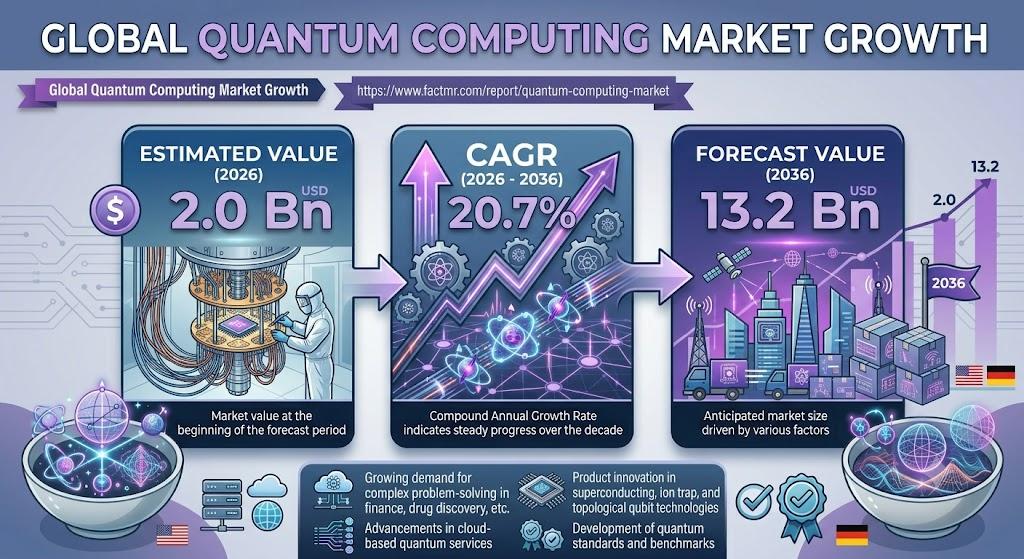
The global Quantum Computing Market is estimated at USD 2.02 billion in 2026 and is projected to reach USD 13.23 billion by 2036, expanding at a 20.7% CAGR during the forecast period. The market was valued at approximately USD 1.67 billion in 2025 and is expected to create an absolute dollar opportunity of USD 11.21 billion between 2026 and 2036.
Quantum computing is being evaluated across optimization, simulation, machine learning, cryptography, cybersecurity, and energy-system applications. The market covers quantum hardware and processors as well as consulting, integration, and maintenance services. Deployment models include on-premises and cloud access, while technologies include superconducting, quantum annealing, photonic, and trapped-ion systems.
Get Detailed Market Forecasts, Competitive Benchmarking, and Pricing Trends: https://www.factmr.com/connectus/sample?flag=S&rep_id=11674
Global Segment Leaders
- System leads the offering segment with 62.4% share in 2026. The category includes quantum hardware, processors, and control electronics.
- Optimization accounts for 34.8% of the application segment, covering portfolio optimization, supply-chain optimization, and route planning.
- On-Premises holds 53.1% of the deployment segment, covering private infrastructure and enterprise data centers.
- BFSI represents 28.6% of the end-user segment, reflecting the role of quantum computing in financial and investment applications.
- The technology landscape includes superconducting quantum computing, quantum annealing, photonic quantum computing, and trapped-ion quantum computing.
Optimization and Simulation Expand the Quantum Computing Opportunity
Optimization remains the largest application segment in 2026. Its use cases include portfolio optimization, supply-chain planning, and route planning. These applications give organizations a way to assess quantum computing for complex decision-making problems.
Simulation is identified by Fact.MR as an emerging growth area. The report covers molecular simulation, financial modeling, and material simulation within this application category. Machine learning is another defined use case, including pattern recognition, data classification, and predictive analytics.
The market is also developing across different access models. Cloud access includes subscription and pay-per-use models, while dedicated access covers private quantum systems. Shared access supports collaborative research programs.
Cloud Access and Emerging Markets Create Opportunities
The report identifies China and India as the fastest-growing country markets, with CAGRs of 26.6% and 24.6%, respectively. Fact.MR links their expansion to growing participation in core end-use applications, improved accessibility, and expanding demand.
The development of cloud-based access also broadens the ways organizations can engage with quantum computing. Instead of requiring every user to operate dedicated infrastructure, cloud access provides subscription and pay-per-use models within the market's defined access structure.
At the same time, the market faces adoption constraints. Price sensitivity can limit uptake in lower-budget segments, while competition from alternative computing approaches can influence purchasing decisions. The report also identifies the need for stronger product differentiation and broader distribution access as competitive considerations.
Country-Level Performance
- China: The market is projected to expand at a 26.6% CAGR through 2036, the highest country growth rate covered by the report. Fact.MR points to strong participation, an established buyer base, growing accessibility, and premium product adoption as factors supporting the market.
- India: Expected to grow at a 24.6% CAGR, supported by expanding end-use applications, rising awareness, improved online and specialty distribution, and interest in higher-performance categories.
- Germany: Forecast to register a 22.7% CAGR, with institutional demand, organized procurement channels, and improving distribution infrastructure supporting growth.
- Brazil: Projected to advance at a 20.7% CAGR, supported by established networks, strong brand presence, regulatory standards, and demand for performance-oriented products.
- United States: Expected to expand at 18.7% CAGR. The U.S. is the largest country market in 2026 at approximately USD 0.71 billion, supported by its established market base and institutional procurement.
- United Kingdom: Forecast to grow at 16.8% CAGR through 2036.
- Japan: Expected to register a 14.8% CAGR, the lowest among the seven country rates published in the report.
North America remains the largest regional market, while Asia Pacific is expanding as China and other markets increase their participation. Europe shows steady demand, with Germany recording a stronger growth rate than the United Kingdom.
Competitive Landscape and Recent Developments
The competitive landscape includes major technology companies and specialist quantum computing providers. Fact.MR identifies IBM Corporation, Google LLC (Alphabet), Microsoft Corporation, D-Wave Systems Inc., Intel Corporation, Quantinuum Ltd., Rigetti & Co Inc., Accenture Plc., Riverlane, and Zapata Computing Inc. as key companies.
Fact.MR describes the market as moderately fragmented. IBM, Google, Microsoft, and D-Wave are identified among the leading players, while Intel, Quantinuum, Rigetti, and Accenture participate across specific user segments. Riverlane and Zapata Computing also maintain positions through focused offerings.
Recent developments highlighted on the report page include:
- IBM's 2025 technology roadmap: IBM continued operating Quantum System Two powered by Heron processors with 133- and 156-qubit configurations featuring tunable couplers. The company also announced partnerships with HSBC and AMD and installed Europe's first IBM Quantum System Two in the Basque Country.
- IBM's 2026 strategic target: IBM is targeting near-term quantum advantage by the end of 2026 and a first large-scale fault-tolerant quantum computer by 2029. Its longer-term roadmap includes the Nighthawk processor with 120 qubits on a square lattice.
Analyst Perspective
Shambhu Nath Jha, Principal Consultant at Fact.MR, states:
“The quantum computing is moving beyond volume-led replacement cycles. Growth is increasingly shaped by premiumization, expanding distribution through direct-to-consumer and e-commerce channels, and rising participation in system applications. Buyers in China and India are entering the market at higher price points, while established markets like the United States are shifting toward performance-driven and specialty products.”
The report's segmentation provides a broader view of the market, covering quantum systems and services, optimization and simulation, multiple deployment models, major end-user industries, four core quantum technologies, and different access models.
Report Coverage
The Fact.MR study covers the global quantum computing market across offering, application, deployment, end user, technology, organization size, access model, and region.
The offering segment includes quantum hardware, quantum processors, control electronics, consulting services, integration services, and maintenance services. Applications include optimization, simulation, machine learning, cryptography, cybersecurity, and energy systems.
The report covers 30+ countries, including China, India, Germany, Brazil, the United States, the United Kingdom, and Japan. Its methodology draws on 120+ secondary sources, 65+ company product portfolios, and 25+ primary interviews, with market sizing supported by a demand-side model and top-down validation.
Explore More Related Studies Published by Fact.MR Research:
https://blog.factmr.com/microled-transfer-metrology-market/
https://blog.factmr.com/microled-mass-repair-market/
https://blog.factmr.com/hbm-for-automotive-ai-processor-market/
About Fact.MR
Fact.MR is a global market research and consulting firm, trusted by Fortune 500 companies and emerging businesses for reliable insights and strategic intelligence. With a presence across the U.S., UK, India, and Dubai, we deliver data-driven research and tailored consulting solutions across 30+ industries and 1,000+ markets. Backed by deep expertise and advanced analytics, Fact.MR helps organizations uncover opportunities, reduce risks, and make informed decisions for sustainable growth.

 Arabic
 French
 Spanish
 Portuguese
 Deutsch
 Turkish
 Dutch
Dutch
 Italiano
 Russian
 Romaian
 Portuguese (Brazil)
 Greek
Greek
