


 About Urh Social
 Terms of Service
 Privacy Policy
 Contact
Instant Noodles Market Reaches USD 28.2 Bn in 2026 as Urban Consumers Seek Quick Meal Options
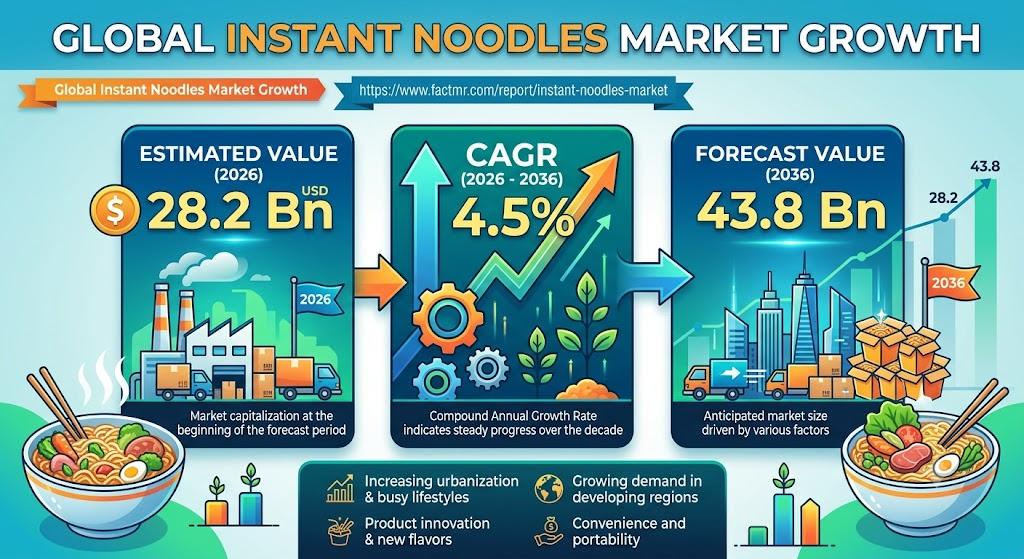
The global Instant Noodles Market is projected to grow from USD 28.2 billion in 2026 to USD 43.8 billion by 2036, registering a 4.5% CAGR during the forecast period. The market was valued at approximately USD 27.0 billion in 2025 and is expected to create an absolute dollar opportunity of USD 15.6 billion between 2026 and 2036.
Instant noodles are moving beyond their traditional role as low-cost convenience food. Urbanization, quick-commerce platforms, premium flavors, improved nutritional profiles, and wider acceptance of Asian cuisine are expanding consumption across both established and emerging markets. Manufacturers are also developing non-fried, whole grain, plant-based, and functional formats to reach consumers looking for alternatives to conventional fried noodles.
Get Detailed Market Forecasts, Competitive Benchmarking, and Pricing Trends: https://www.factmr.com/connectus/sample?flag=S&rep_id=7847
Global Segment Leaders
- Fried instant noodles hold 48.3% share of the product segment in 2026. Established production infrastructure, familiar taste and texture, and efficient oil-frying processes continue to support their lead.
- Chicken flavor noodles account for 44.1% share of the flavor profile segment. The flavor has broad acceptance across markets and is commonly used as an entry-point product for consumers trying a brand.
- Packet packaging holds 51.6% share, supported by household consumption and the better per-unit economics of multipacks.
- Retail distribution leads the distribution channel with 46.2% share, reflecting the category's broad presence across supermarkets and convenience stores.
Urbanization and Quick Commerce Strengthen Demand
Urbanization remains a key demand driver for instant noodles. Consumers in Asia, Africa, and Latin America continue to seek affordable, shelf-stable meals that require little preparation. Rising disposable incomes are also allowing consumers to trade up from basic products toward premium flavors and higher-quality ingredients.
Quick-commerce platforms are changing how consumers discover and purchase instant noodles. Faster delivery makes it easier for new and premium brands to compete without depending entirely on established physical shelf space.
Premiumization is another important shift. Restaurant-style flavors, improved ingredients, more sophisticated packaging, and regional recipes are helping manufacturers position instant noodles as more than a basic meal product.
Cross-cultural consumption is expanding the addressable market in Western countries. Korean, Japanese, and Southeast Asian flavors are increasingly moving into mainstream retail, while younger consumers are showing greater interest in spicy and regional noodle varieties.
Non-Fried and Whole Grain Formats Create New Opportunities
Health considerations are creating opportunities for non-fried and whole grain instant noodles. Air-dried and steam-processed products are gaining attention as manufacturers work to reduce the nutritional trade-offs associated with conventional fried formats.
Japan and South Korea are leading markets for non-fried products, where consumers show greater willingness to accept differences in texture and taste in exchange for lower fat and calorie content. Functional variants, including protein-fortified and reduced-sodium products, are also being developed for changing nutritional needs.
Africa represents another significant opportunity. Per-capita consumption remains much lower than in Asia, leaving room for volume expansion as distribution infrastructure improves. Korean cultural exports are also helping popularize spicy and more complex flavor profiles in Western markets.
The market faces several constraints. Health concerns and regulatory scrutiny around sodium, palm oil, and front-of-pack warnings can influence purchasing decisions. Volatility in wheat flour and palm oil prices can pressure manufacturer margins, while export-focused producers face seasonal demand and price sensitivity in high-volume markets.
Country-Level Performance
- China: The market is projected to grow at a 6.1% CAGR through 2036, making it the fastest-growing country market covered. Rural-to-urban migration, premium product adoption, and quick-commerce expansion are supporting demand. Non-fried products are also gaining share in Tier 1 cities.
- South Korea: Expected to expand at a 5.8% CAGR. Korean cultural exports are building international recognition for domestic brands, while limited-edition flavors and expanded export capacity support continued growth.
- U.S.: Forecast to grow at 4.6% CAGR. The market is shifting from economy-focused products toward premium Korean, Japanese, and Southeast Asian brands, with mainstream retailers expanding Asian food sections.
- Japan: Projected to advance at 4.3% CAGR. Its mature market remains a testing ground for new cup formats, limited editions, collaborations, non-fried products, and functional variants.
- ANZ: Expected to record 4.0% CAGR, supported by greater mainstream acceptance of Asian flavors and wider retail distribution of Korean and Japanese premium brands.
- U.K.: Forecast to grow at 3.9% CAGR, with reformulation around sodium, fat, front-of-pack nutrition labeling, and HFSS advertising requirements shaping product strategies.
- Germany: Projected to expand at 3.7% CAGR. Multicultural demographics and wider acceptance of Asian cuisine are supporting demand, while consumers show growing interest in non-fried and whole grain variants.
- France: Expected to grow at 3.5% CAGR through 2036.
- Italy: Forecast to register 3.2% CAGR, the lowest among the country growth rates listed on the report page.
Competitive Landscape and Recent Developments
The competitive landscape includes Nissin Food Holdings, Nestle India Limited, Toyo Suisan Kaisha Ltd., Ajinomoto Co., Inc., The Campbell Soup Company, Sco-Fro Foods Ltd., Capital Foods Pvt. Ltd., Nongshim Co. Ltd., Indomie (PT Indofood Sukses Makmur Tbk), and Ottogi Co. Ltd.
Nissin maintains a strong global position through its manufacturing footprint, Cup Noodles and Top Ramen brands, and continued product innovation. Korean manufacturers are gaining international share through cultural relevance, digital marketing, product differentiation, and expanded export manufacturing. In India, Maggi from Nestle India and Ching's Secret from Capital Foods use broad distribution and localized flavors to compete in tier-2 and tier-3 cities.
Recent developments highlight the industry's focus on flavor innovation and international expansion:
- Nissin Foods USA launched Cup Noodles Dill Pickle in June 2025 as a limited-edition flavor targeting younger consumers interested in unconventional flavors.
- Nongshim began construction of its Busan Noksan export-oriented plant in May 2025, with three planned production lines and expected annual export production capacity of 500 million noodle packs after completion.
- Nongshim launched Shin Ramyun Kimchi Stir Fry in India in May 2026, using quick-commerce availability through Blinkit to support its expansion in India's premium Korean instant noodle segment.
Analyst Perspective
Shambhu Nath Jha, Principal Consultant at Fact.MR, states:
“The instant noodles market is seeing a structural shift from being a commodity staple to a segmented convenience food category. Fried noodles continue to account for half the market as they provide the taste and texture that consumers expect from the category, but the incremental margin opportunity is in non-fried and whole grain formats.”
The report points to a market increasingly divided between mass-market fried products competing on price and distribution, and premium, health-focused, and regionally authentic products competing through product differentiation and brand equity.
Report Coverage
The Fact.MR study covers pre-cooked, dried, or preserved noodles designed for rapid preparation through boiling, soaking, or microwaving. Product categories include fried, non-fried, rice-based, whole grain, and specialty instant noodles.
The report evaluates flavor profile, packaging format, processing technology, distribution channel, and regional markets. Packaging formats include packets, cups, bowls, and trays, while distribution channels cover retail, online, foodservice, and wholesale.
The research uses a hybrid demand-side and top-down methodology incorporating World Instant Noodles Association consumption data, manufacturer production volumes, retail sell-through information, import-export statistics, and primary interviews with producers, distributors, retailers, and foodservice operators.
Explore More Related Studies Published by Fact.MR Research:
https://www.newstrail.com/hybrid-marine-capstans-market-forecast/
https://www.newstrail.com/industrial-dataops-frameworks-market/
https://www.newstrail.com/computer-numerical-control-cnc-machine-tools-market/
About Fact.MR
Fact.MR is a global market research and consulting firm, trusted by Fortune 500 companies and emerging businesses for reliable insights and strategic intelligence. With a presence across the U.S., UK, India, and Dubai, we deliver data-driven research and tailored consulting solutions across 30+ industries and 1,000+ markets. Backed by deep expertise and advanced analytics, Fact.MR helps organizations uncover opportunities, reduce risks, and make informed decisions for sustainable growth.

 English
 Arabic
 French
 Spanish
 Portuguese
 Deutsch
 Dutch
Dutch
 Italiano
 Russian
 Romaian
 Portuguese (Brazil)
 Greek
Greek
