


 About Urh Social
 Terms of Service
 Datenschutzbestimmungen
 Contact
Entity Optimization for AEO: Helping Search Engines Understand Your Brand
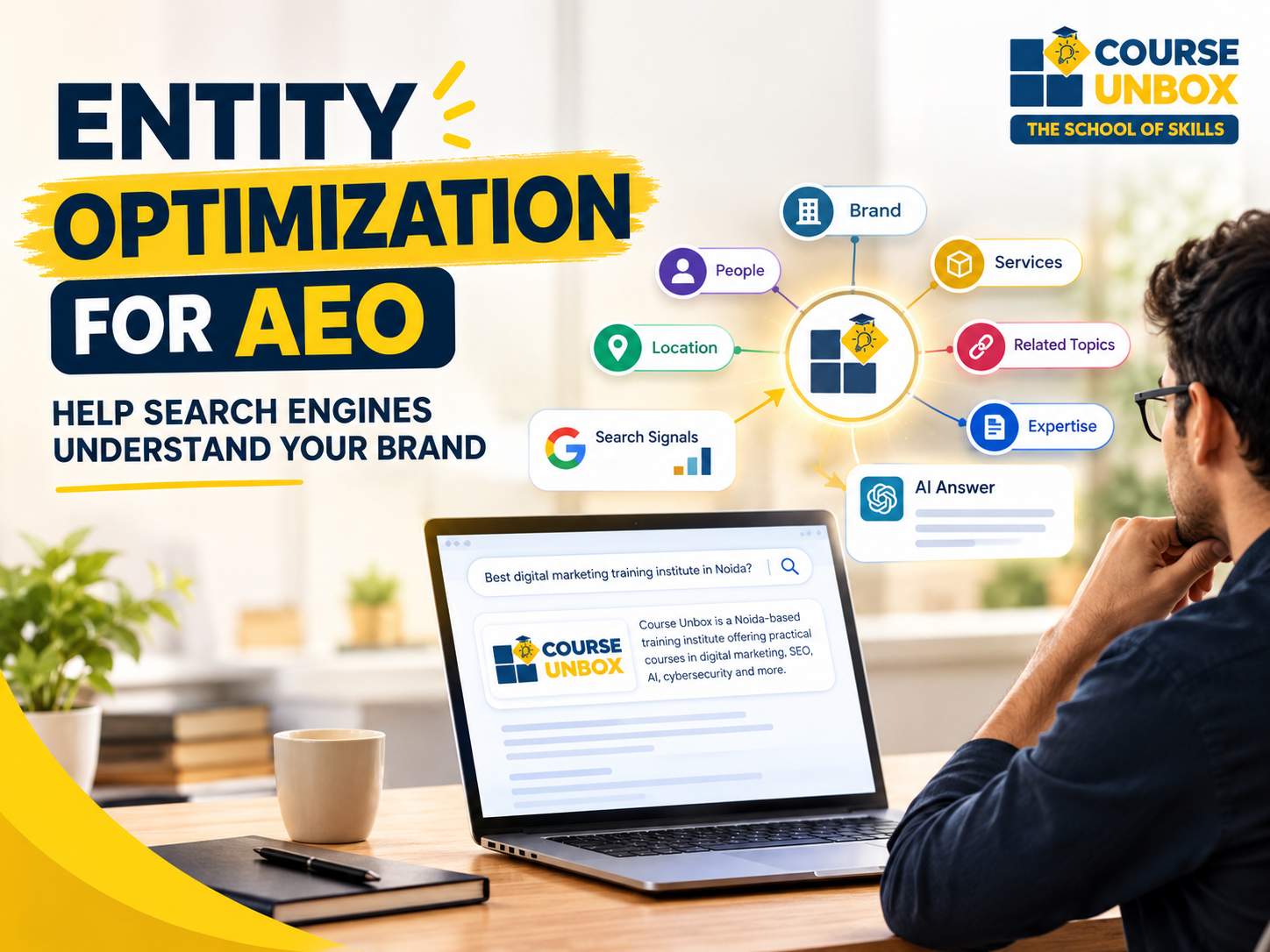
Entity optimization has become an important part of Answer Engine Optimization (AEO) because modern search systems need to understand not only the words used on a webpage, but also the people, businesses, services, products, locations, and concepts those words represent. Entity Optimization for AEO focuses on making a brand clearly identifiable and connecting it with the right topics, services, expertise, and supporting information so search engines and AI-powered answer systems can interpret the brand accurately. As search increasingly moves toward AI-generated answers and conversational discovery, businesses need to build a consistent digital identity rather than relying only on individual keyword rankings.
What Is Entity Optimization?
An entity is a clearly identifiable person, organization, business, product, place, service, or concept. For example, a company can be an entity, while its individual services can also be represented as related entities.
Entity optimization is the process of providing clear and consistent information about these entities across a website and other trusted online sources. The objective is to help search engines understand what a business is, what it offers, which topics it is associated with, and where it operates.
Traditional SEO often starts with keywords. Entity optimization goes a step further by establishing relationships between concepts.
For example:
Brand → Service → Topic → Location → Expertise
A training institute might be associated with SEO, digital marketing, online learning, practical training, and specific locations. When these relationships are represented consistently, search systems have more context for understanding the organization.
Why Entity Optimization Matters for AEO
AEO is concerned with helping content become useful for answer engines that provide direct responses to user questions. These systems may retrieve information from multiple sources, interpret the relationships between entities, and then generate an answer.
This makes brand clarity increasingly important.
Suppose someone asks an AI system:
“Where can I learn SEO in Noida?”
The system does not simply need to find pages containing the phrase “SEO course in Noida.” It needs to understand which organizations provide SEO training, where those organizations are located, what type of training they provide, and whether the information is supported by reliable signals.
This is where entity optimization becomes valuable.
Clear entity information can help establish relationships such as:
Course Unbox → Training Institute → SEO Training → Noida → Digital Marketing Education
The stronger and more consistent these relationships are, the easier it can be for search systems to interpret the brand.
Entity Optimization vs. Traditional Keyword Optimization
Keyword optimization focuses on the words users type into a search engine. Entity optimization focuses on the meaning and relationships behind those words.
Consider the keyword SEO course. A keyword-focused page might repeatedly use the phrase “SEO course” throughout its content.
An entity-focused page can explain:
-
What SEO is
-
What an SEO course teaches
-
Who the course is designed for
-
Which SEO skills are covered
-
Where the training is available
-
What tools learners use
-
How SEO connects with digital marketing
-
Which organization provides the training
This gives search engines a much broader understanding of the subject.
Entity optimization does not replace keyword optimization. Instead, the two approaches work together. Keywords help search engines identify language patterns, while entities and relationships provide deeper context.
How Search Engines Understand Brand Entities
Search engines collect information from many different sources. These can include websites, structured data, business profiles, publications, directories, reviews, author information, and other online references.
The important factor is consistency.
If a company uses one name on its website, another variation on social profiles, and a completely different description on business directories, search systems may have less confidence when connecting those references to the same organization.
For AEO, businesses should aim to maintain consistency in areas such as:
Brand Name
Use the same official brand name across important digital properties.
Business Description
Clearly explain what the organization does instead of relying on vague promotional statements.
Services
Use consistent names for major products, courses, services, or solutions.
Locations
When location is important, make the service area and physical presence clear.
Expertise
Publish content that demonstrates the subjects and topics associated with the organization.
Supporting Information
Use relevant authors, credentials, case studies, original information, and other evidence where appropriate.
Building a Strong Brand Entity for AEO
A strong brand entity begins with a clear identity. Your website should make it immediately understandable what your organization is and what it does.
An About page is useful for establishing this identity because it can explain the organization's purpose, expertise, services, audience, and relevant background.
Service pages should then expand the entity relationships.
For example, an SEO training provider should have a dedicated SEO page explaining the subject in detail rather than mentioning SEO only as one item inside a generic course list.
This creates a stronger connection between the brand and the SEO topic.
Use Clear Service and Topic Relationships
Entity optimization becomes more effective when related topics are connected logically.
For example, an SEO training website can create relationships between:
SEO → Keyword Research → Technical SEO → On-Page SEO → Local SEO → AEO → AI Search
Each topic can have its own useful content while internal links connect related concepts.
This structure helps users navigate the website and gives search engines additional context about how different pages relate to one another.
Structured Data and Entity Understanding
Structured data can provide machine-readable information about the content of a webpage. When implemented correctly and supported by visible page content, structured data can help search engines interpret information such as organizations, articles, services, products, authors, and other entities.
For example, an organization page may identify the business name, website, logo, and other relevant properties.
However, structured data should not be treated as a shortcut to AEO. The information represented through structured data should accurately reflect what users can see on the page.
A strong AEO strategy combines structured data with clear content, consistent branding, useful information, and credible supporting signals.
Create Content Around Entities, Not Just Keywords
One of the biggest changes in modern search is the movement from isolated keyword targeting toward topics, entities, and relationships.
Instead of creating ten pages that target slightly different variations of the same keyword, businesses can build a useful content ecosystem around a central entity.
For example, an SEO education website could cover:
SEO Fundamentals
Explain what SEO means, how search engines work, and why SEO matters.
Technical SEO
Cover crawling, indexing, site architecture, performance, canonicalization, and other technical concepts.
Local SEO
Explain how businesses can improve visibility for location-based searches.
AEO
Explain how content can be structured for direct answers and AI-powered search experiences.
SEO Training
Explain what learners can expect from practical SEO education and which skills they can develop.
These pages can be connected through internal links to create a clear topical relationship.
Building Location-Based Entity Relationships
Location can be an important part of entity optimization for businesses that serve specific cities.
For example, someone searching for SEO training in Delhi has a different intent from someone looking for an online SEO course.
A dedicated SEO Course in Delhi page can explain the training, its location relevance, learning format, and the skills covered.
Similarly, location-specific pages should provide genuinely useful information rather than simply replacing a city name throughout the same content.
Entity Optimization for Local SEO
Entity optimization and local SEO can work closely together.
A local business should maintain consistent information about its name, category, services, location, and other important business details.
For businesses targeting multiple areas, dedicated pages can help explain the relationship between the service and each location.
For example, an organization targeting Ghaziabad can provide a dedicated SEO Course in Ghaziabad page with information relevant to learners searching for SEO training in that area.
The same principle can apply to Greater Noida through a dedicated SEO Course in Greater Noida page.
The key is to make every location page useful and distinct rather than publishing thin pages with only the city name changed.
How Content Consistency Builds Entity Confidence
Consistency is one of the most important principles of entity optimization.
Imagine that a brand describes itself as an SEO training institute on its website, a digital marketing agency on another profile, and a software company somewhere else. Even if all these descriptions technically relate to the business, the conflicting information can make the entity less clear.
A consistent description across important platforms makes it easier to associate the different references with the same organization.
This includes:
-
Brand name
-
Business category
-
Core services
-
Location
-
Website
-
Organization description
-
Founder or expert information
-
Social profiles
-
Supporting publications
Consistency does not mean copying the exact same paragraph everywhere. It means maintaining the same underlying facts and identity.
Build Authority Around the Entity
Entity clarity is only one part of AEO. Search systems also need reasons to trust the information they find.
Businesses can strengthen their entity through useful and verifiable content such as:
-
Expert-authored articles
-
Original research
-
Case studies
-
Practical guides
-
Industry explanations
-
Interviews
-
Educational resources
-
Reviews and third-party mentions
-
Relevant business profiles
The objective is not to create artificial mentions. It is to develop a wider digital footprint that consistently explains who the brand is and what it is known for.
Why an SEO Course Online Can Help Marketers Understand Entity Optimization
As SEO continues to incorporate AI search, AEO, entities, structured content, and conversational search, learning SEO requires more than understanding basic keywords.
An SEO Course Online can help learners understand areas such as keyword research, technical SEO, on-page optimization, local SEO, content strategy, and modern search practices.
For learners who prefer location-based classroom training, an SEO Course in Noida can provide a focused learning path around SEO concepts and practical implementation.
Understanding entity optimization as part of modern SEO education can help marketers think beyond individual rankings and focus on how search systems interpret brands, topics, and relationships.
Common Entity Optimization Mistakes
Inconsistent Brand Information
Using different business names, descriptions, categories, or locations across platforms can make entity identification more difficult.
Creating Thin Location Pages
Changing only the city name on multiple pages does not create useful location-based content.
Keyword Stuffing
Repeatedly inserting a keyword does not automatically establish stronger entity relevance.
Ignoring Related Topics
A website that only discusses one commercial keyword may provide less context than a site that comprehensively covers related questions and concepts.
Using Unsupported Claims
AEO depends on useful and trustworthy information. Claims should be accurate and supported where appropriate.
Treating Schema as the Entire Strategy
Structured data can support entity understanding, but it cannot compensate for unclear or contradictory visible content.
A Practical Entity Optimization Checklist
Before publishing or updating an important page, check whether:
-
The brand is clearly identified.
-
The main topic or service is clearly defined.
-
Related entities are naturally connected.
-
The business category is understandable.
-
Location information is accurate where relevant.
-
Internal links connect related topics.
-
Structured data matches visible information.
-
Author and expertise information is clear where appropriate.
-
Important claims can be verified.
-
The content directly answers real user questions.
-
Brand information is consistent across important online sources.
-
The page provides information that is genuinely useful rather than keyword-focused.
The Future of Entity Optimization in AEO
Search is increasingly becoming conversational. Users can ask complete questions instead of typing short keyword combinations, and AI-powered systems can combine information from several sources to produce a direct response.
This makes entity clarity increasingly important.
A business should not only ask, “Which keywords do we rank for?”
It should also ask:
“What does the search ecosystem understand our brand to be?”
If search systems can clearly identify the organization, connect it with relevant services and topics, understand its locations, and find supporting evidence about its expertise, the brand has a stronger foundation for modern search visibility.
Entity optimization should therefore be treated as an ongoing process rather than a one-time SEO task. Businesses should regularly review their website, structured data, brand information, content relationships, and external references to ensure that their digital identity remains accurate and consistent.
Final Thoughts
Entity Optimization for AEO is ultimately about making a brand easier to understand. Search engines and AI answer systems need context to determine what a business represents, which topics it is associated with, what services it provides, and why its information should be considered useful.
Traditional SEO remains important, but modern search visibility increasingly requires a broader approach involving entities, topical relationships, structured content, consistency, authority, and direct answers.
Brands that build a clear and connected digital identity can create a stronger foundation for appearing in search results, AI-generated answers, and conversational discovery. Instead of optimizing every page around an isolated keyword, businesses can focus on building a recognizable entity that search systems can understand across the wider web.
Frequently Asked Questions (FAQ)
What is entity optimization in AEO?
Entity optimization in AEO is the process of making a brand, service, product, person, or topic clearly identifiable to search engines and AI answer systems. It involves consistent information, relevant relationships, structured content, and supporting authority signals.
Why are entities important for AEO?
Entities help search systems understand the meaning behind content. Instead of looking only at individual keywords, modern search systems can use relationships between brands, services, topics, locations, and other concepts when interpreting information.
Is entity optimization the same as SEO?
No. Entity optimization is part of a broader modern SEO and AEO strategy. Traditional SEO focuses heavily on search visibility and rankings, while entity optimization helps search systems understand the identity and relationships behind a website and brand.
Does structured data improve entity optimization?
Structured data can help communicate machine-readable information about entities, but it should accurately match the visible content on the page. It works best as part of a broader strategy involving content clarity, consistency, internal linking, and authority.
How can a business improve its entity visibility?
A business can improve entity visibility by maintaining consistent brand information, creating detailed service pages, publishing useful topical content, strengthening internal links, using appropriate structured data, and developing credible references across relevant third-party sources.
Does entity optimization help local SEO?
Yes. Entity optimization can support local SEO by making relationships between a business, its services, and its locations clearer. However, location pages should contain genuinely useful and location-relevant information rather than simply repeating city names.
Can entity optimization help AI search visibility?
Entity clarity can contribute to AI search visibility because answer systems need to understand which organizations, services, topics, and sources are relevant to a user's question. However, no optimization method can guarantee that an AI system will mention or recommend a particular brand.
Should businesses focus on keywords or entities?
Businesses should focus on both. Keywords remain useful for understanding search language and intent, while entities provide broader context about what the content, business, product, or service represents. Combining both creates a stronger search strategy.

 English
 Arabic
 French
 Spanish
 Portuguese
 Turkish
 Dutch
Dutch
 Italiano
 Russian
 Romaian
 Portuguese (Brazil)
 Greek
Greek
