


 About Urh Social
 Terms of Service
 Privacy Policy
 Contact
BDD in practice: how teams turn conversations into tests
Most software bugs that reach production are not coding mistakes. They are misunderstandings. The product owner meant one thing, the developer built another, and the tester checked a third.
Behavior driven development (BDD) exists to close that gap. Instead of handing requirements down a chain, the people who define, build and test a feature agree on its behavior together, write that behavior as plain-language examples, and then turn those examples into automated tests.
This article focuses on the practical side: how to run BDD in a real team, how to write scenarios that stay useful, and where BDD fits alongside the rest of your testing strategy. If you want a full reference on the concepts, Gherkin syntax and tooling, start with this guide to the behavior driven development framework.
Why requirements break down between business and engineering
Requirements usually fail in translation, not in intent. A user story like "users should be able to reset their password" sounds complete until someone asks what happens when the reset link expires, or when the email is not registered.
Three patterns show up again and again:
- Abstract requirements. Statements like "the checkout should be fast" or "login must be secure" leave every person to fill in the details differently.
- Late discovery of edge cases. Testers often find missing rules only after the code is written, which turns a five minute conversation into a rework cycle.
- Documentation drift. Specs written at the start of a sprint stop matching the system within weeks, so nobody trusts them.
BDD tackles all three by replacing abstract statements with concrete examples, surfacing edge cases before development starts, and keeping the examples executable so they cannot silently go stale.
What BDD changes in your workflow
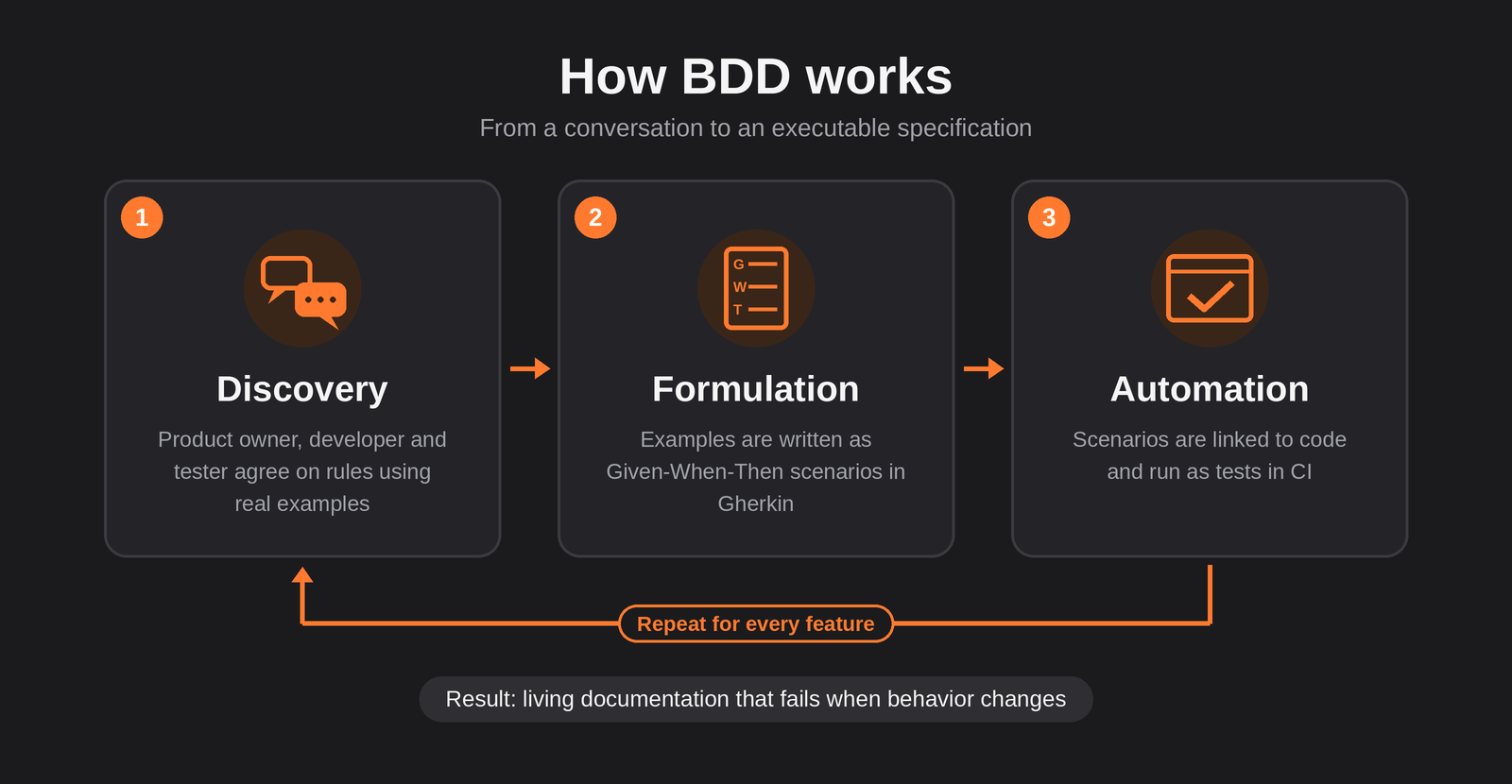
BDD adds three repeating practices to every feature, and each one has a clear output.
- Discovery. The team talks through a user story and uses concrete examples to uncover rules, edge cases and open questions. The output is a shared understanding and a short list of agreed examples.
- Formulation. Those examples are written as structured Given-When-Then scenarios in Gherkin, a format both business and technical people can read. The output is a
.featurefile. - Automation. Developers connect each scenario step to code, so the scenario runs as a test. The output is an executable specification that runs in CI.
The order matters. Teams that jump straight to automation and skip discovery end up with Gherkin files that nobody outside engineering reads. At that point they are doing BDD testing, not BDD. The conversations are where most of the value comes from.
Running a Three Amigos session that actually works
The Three Amigos session is the heart of discovery. A product owner or business analyst, a developer and a tester review one user story together. Each brings a different lens: business value, implementation and risk.
A few habits keep these sessions short and productive:
- Timebox to 25 to 30 minutes per story. If a story needs longer, it is probably too big and should be split.
- Use example mapping. Write the story on one card, each business rule on its own card, and at least one concrete example under every rule. Questions nobody can answer go on a separate card as follow-ups.
- Talk in real data. "A user with an expired card" is better than "invalid payment". Real values expose edge cases faster.
- Stop when the rules are clear. You do not need to write polished Gherkin in the room. Capture the examples and formulate them later.
- Treat a pile of question cards as a signal. It means the story is not ready for development yet, which is a cheap thing to learn before a sprint starts.
Writing scenarios that age well
The biggest long-term cost in BDD is a suite of brittle, overly detailed scenarios. The fix is to describe what the user achieves, not how they click through the screen.
Compare an imperative scenario:
Scenario: Login
  Given the user opens the login page
  When the user clicks the email field
  And the user types "[email protected]"
  And the user clicks the password field
  And the user types "correct-password"
  And the user clicks the login button
  Then the user sees the dashboard
With a declarative one:
Scenario: Successful login with valid credentials
  Given a registered user "[email protected]"
  When she logs in with the correct password
  Then she should see her dashboard
The second version survives a UI redesign, reads like a business rule, and lets stakeholders review it without translation.
Rules of thumb for good scenarios
- One behavior per scenario. Several
Whensteps usually mean you are testing more than one rule. - Use domain language. Name things the way the business does, such as "order", "refund" or "plan upgrade".
- Cover failure cases. A rule is defined as much by what the system rejects as by what it accepts.
- Use Scenario Outline for data variations. Run one scenario against a table of inputs instead of copying it five times.
- Reuse steps, not scenarios. Shared step definitions keep the suite maintainable as it grows.
- Tag your suites. Run fast
@smokescenarios on every commit and the full suite before release.
Choosing a BDD tool for your stack
The right tool is usually the one that fits the language and test runner your team already uses.
|
Tool |
Language |
Scenario format |
Best fit |
|---|---|---|---|
|
Java, JavaScript, Ruby and more |
Gherkin |
Teams that want the most widely used, well-documented option |
|
|
Behave |
Python |
Gherkin |
Python projects that want a standalone BDD runner |
|
pytest-bdd |
Python |
Gherkin |
Teams already on pytest who want to keep fixtures and plugins |
|
Reqnroll |
.NET |
Gherkin |
.NET teams, including those migrating off SpecFlow |
|
JBehave |
Java |
Story files |
Java teams with existing JUnit setups |
|
Gauge |
Multiple |
Markdown |
Teams that prefer Markdown specs over Gherkin |
If your team still runs SpecFlow, plan a migration. SpecFlow reached end-of-life on December 31, 2024, and Reqnroll is its open-source successor.
Applying BDD to APIs and microservices
BDD is often taught with UI examples, but it works especially well for APIs. Behavior is defined by requests and responses, so scenarios stay short, run fast and break far less often than browser tests.
Feature: Checkout API

  Scenario: Checkout succeeds for a cart with items
    Given a cart with 2 items
    When the client sends POST /checkout for that cart
    Then the response status should be 201
    And the response should contain an order id

  Scenario: Checkout fails for an empty cart
    Given an empty cart
    When the client sends POST /checkout for that cart
    Then the response status should be 400
    And the error should say "Cart is empty"
A few tips for API-level BDD:
- Describe contracts, not internals. Assert on status codes, response fields and side effects the client can observe.
- Keep setup in Given steps. Create carts, users or tokens through the API or fixtures, not through hidden database scripts.
- Isolate dependencies. Payment gateways and third-party services should be mocked so scenarios stay deterministic.
- Push UI scenarios down. If a rule can be verified at the API level, test it there and keep only a few end-to-end UI scenarios.
Where BDD stops and how Keploy fills the gap
BDD scenarios capture the behavior a team intends to build. They do not capture every request, payload variation and dependency interaction that real users trigger once a service is live. Writing scenarios for all of that by hand is not practical, and trying usually produces a slow, bloated suite.
That is why BDD is not a replacement for other testing. Teams still need unit testing, integration testing and regression testing underneath their scenarios.
Keploy covers the regression side for APIs. It records real API traffic and turns it into test cases, along with mocks for databases and downstream services. The result is a regression suite based on how your system is actually used, with no test code to write or maintain.
The two approaches split the work cleanly:
- BDD defines and agrees on new behavior before it is built.
- Keploy protects existing behavior from regressions as the codebase changes.

 English
 Arabic
 French
 Spanish
 Portuguese
 Deutsch
 Turkish
 Italiano
 Russian
 Romaian
 Portuguese (Brazil)
 Greek
Greek
