


 About Urh Social
 Terms of Service
 Privacy Policy
 Contact
Manufacturing Safety Analytics: How AI Helps Analyse Workplace Risks
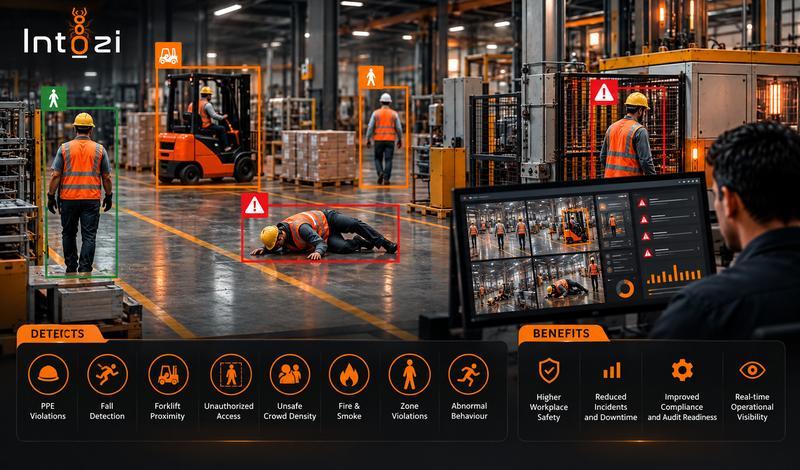
Manufacturing plants involve workers, machinery, production lines, vehicles, hazardous materials, and multiple simultaneous processes. Identifying every unsafe condition through manual supervision can be difficult, especially across large facilities. Manufacturing video analytics provides an additional layer of visibility by analysing camera feeds for predefined safety, compliance, and operational conditions.
How can a manufacturing plant identify a safety violation when supervisors cannot observe every production area at the same time? Intozi’s Ikshana can analyse configured video feeds to identify events such as PPE violations, restricted-area entry, unsafe activities, and other visible safety conditions for review by relevant teams.
How Does AI Analyse Manufacturing Safety Risks?
AI-based systems analyse video frames to identify people, objects, movement patterns, and predefined zones. Computer vision models can then compare these observations against configured safety rules.
For example, AI compliance detection in manufacturing can analyse whether workers entering a designated production area are wearing required protective equipment. If a configured compliance condition is not met, the system can generate an event for review.
Similarly, AI process safety detection in manufacturing can analyse defined operational areas for conditions such as unauthorized access, unsafe worker movement, or activity within restricted zones.
Detection performance depends on factors including camera positioning, lighting, image quality, visibility, environmental conditions, and the specific use case.
How Does AI Compliance Detection Support Manufacturing Teams?
AI compliance detection in manufacturing can help organizations identify recurring safety conditions across production environments. For example, if PPE violations repeatedly occur at a particular entry point or during a specific shift, recorded event information can help safety teams investigate the underlying operational factors.
The technology can also support faster review by directing attention toward relevant events rather than requiring personnel to manually examine hours of video.
However, AI analytics does not independently determine the complete context of every incident. Human review remains important, particularly when an event requires investigation, corrective action, or a change to established safety procedures.
Where Can Manufacturing Video Analytics Be Used?
Manufacturing video analytics can be applied across different areas of an industrial facility, depending on camera coverage and safety requirements.
Typical applications include:
- Production floors
- Assembly lines
- Warehouses and material-handling areas
- Loading and unloading zones
- Machine operating areas
- Restricted production zones
- Worker entry and exit areas
For example, a facility can use PPE analysis at production-floor entrances while applying restricted-zone detection around hazardous machinery. Multiple use cases can operate together as part of a broader manufacturing safety analytics framework.
How Intozi and Ikshana Support Manufacturing Safety Analysis
Intozi’s Ikshana is an AI video analytics platform that can be configured for manufacturing-related safety and compliance use cases. Depending on deployment requirements, the platform can support video-based analysis of PPE compliance, worker activities, restricted zones, and other predefined safety conditions.
The practical value of analytics depends on how well the technology is aligned with the facility's safety procedures, camera coverage, environmental conditions, and operational requirements. It should therefore complement HSE programs, worker training, inspections, physical safeguards, and established response processes.
Conclusion: How Manufacturing Safety Analytics Supports Workplace Risk Analysis
Manufacturing safety analytics can provide continuous video-based visibility into predefined workplace safety and compliance conditions. By combining manufacturing video analytics, AI safety and compliance detection, AI compliance detection in manufacturing, and AI process safety detection in manufacturing, organizations can create a more structured approach to analysing visible workplace risks.
Intozi’s Ikshana can support this approach by analysing configured video feeds for safety, compliance, and operational events across manufacturing environments. The platform can help identify predefined conditions such as PPE violations, restricted-zone activity, and other visible safety risks for review by relevant teams.
Frequently Asked Questions
How does AI detect safety violations in manufacturing?
AI detects manufacturing safety violations by analysing video footage with computer vision models configured for specific conditions. These may include missing PPE, restricted-zone entry, unsafe worker activity, or movement near designated hazardous areas. When the system identifies a configured condition, it can generate an event for review.
What is AI compliance detection in manufacturing used for?
AI compliance detection in manufacturing is used to identify visible conditions that do or do not meet predefined safety or operational requirements. A common example is PPE compliance, where computer vision analyses whether workers appear to have required protective equipment. It can also support restricted-area monitoring and other site-specific compliance rules.
Can AI identify process safety risks in manufacturing plants?
Yes, AI can identify certain visible process safety conditions when appropriate video analytics models and rules are configured. AI process safety detection in manufacturing can support use cases involving restricted areas, worker activity, equipment zones, and defined operational conditions.
What can manufacturing video analytics detect?
Manufacturing video analytics can detect a range of predefined visual events, including PPE violations, worker movement, restricted-zone entry, unsafe proximity to equipment, falls, and activity within designated danger areas.
How can AI safety analytics help HSE teams?
AI safety analytics can help HSE teams by providing structured information about predefined safety events across monitored areas. Instead of manually reviewing every camera feed, teams can focus on relevant events such as PPE violations, restricted-zone entry, or other configured safety conditions.

 English
 Arabic
 French
 Spanish
 Portuguese
 Deutsch
 Dutch
Dutch
 Italiano
 Russian
 Romaian
 Portuguese (Brazil)
 Greek
Greek
