


 About Urh Social
 Terms of Service
 Privacy Policy
 Contact
AI Voice Cloning Market Adds USD 25.1 Bn Through 2036: UK Matches Global Growth at 22.5% as Enterprise Use Expands
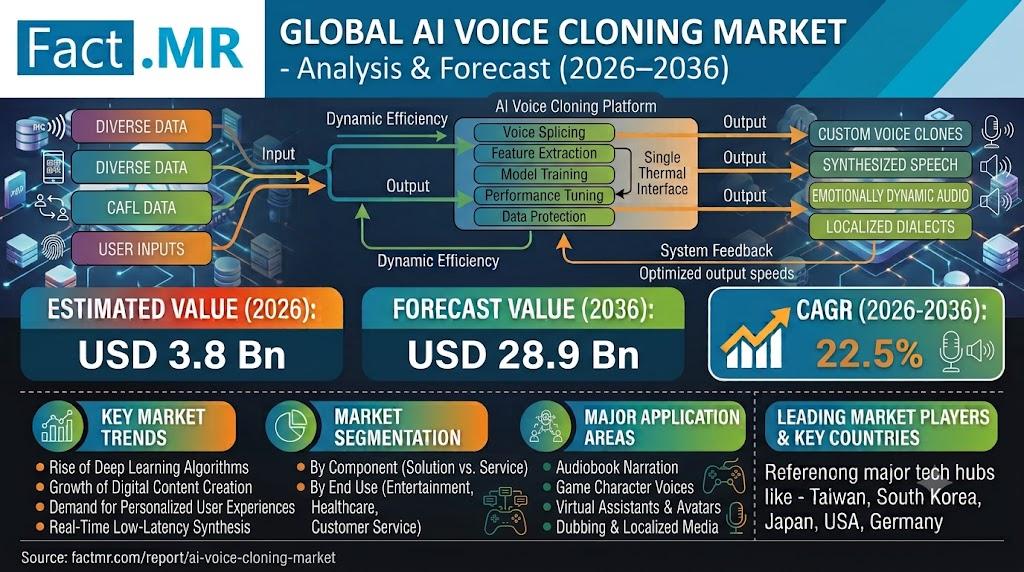
AI Voice Cloning Market is projected to increase from USD 3.8 billion in 2026 to USD 28.9 billion by 2036, registering a 22.5% CAGR during the forecast period. The market reached USD 3.1 billion in 2025, with an absolute opportunity of USD 25.1 billion through 2036. Demand is being supported by licensed voice localization, conversational automation, enterprise assistants, accessibility applications, and API-based delivery.
Licensed voice cloning allows approved speaker identities to be reproduced across different content and service workflows. Media companies can use authorized voices for multilingual releases, while enterprises can apply branded speech to customer service and training. The report also identifies consent, impersonation risk, and uncertainty around voice rights as key factors that can slow procurement and deployment.
Get Detailed Market Forecasts, Competitive Benchmarking, and Pricing Trends: https://www.factmr.com/connectus/sample?flag=S&rep_id=15840
Global Segment Leaders
- Cloud-Based Deployment — 68.0% share in 2026: Cloud-based platforms lead because they allow buyers to scale voice generation without maintaining specialist internal infrastructure. Public APIs also support faster integration, while private-cloud options provide tighter control over recordings and permissions.
- Media & Entertainment Application — 32.0% share: Film, television, games, podcasts, and audiobooks require consistent voices across repeated revisions. Licensed cloning can support dubbing and content localization while maintaining approved speaker identities.
- Large Enterprises — 47.0% share: Large enterprises have the budgets required for integration reviews, legal approval, service deployment, and voice-library management. Access controls and activity logs remain important before wider adoption.
- Deep Learning — 45.0% share: Deep learning leads technology demand as transformer models and neural text-to-speech systems improve timing, tone, and voice consistency across longer scripts.
- Media & Entertainment Industry Vertical — 29.0% share: Entertainment companies require continuity across characters and narrators, while localized releases add review requirements. Approved synthetic voices can help production teams manage repeated voice updates.
Country-Level Performance
- South Korea — 23.9% CAGR: South Korea records the highest listed country CAGR. Entertainment and gaming companies are testing faster voice workflows, with stable character identity across updates remaining an important requirement.
- USA — 23.2% CAGR: U.S. buyers are evaluating voice-cloning platforms through consent proof and customer-channel risk. Media companies require approved speech for localization, while enterprises are exploring branded voices for service and training.
- Canada — 22.8% CAGR: Canadian organizations need English and French voice assets for service and training applications. Cloud delivery allows smaller teams to test voice-cloning use cases without building extensive infrastructure.
- UK — 22.5% CAGR: UK demand is linked to approved narration and service voices that can be managed contract by contract. Publishers value revision speed, while accessibility teams require clear disclosure practices.
- Germany — 22.2% CAGR: German enterprises typically route voice projects through privacy and legal checks before deployment. Suppliers need to demonstrate permissions, security controls, and accessible usage logs.
- Australia — 21.9% CAGR: Australian buyers are expected to test cloned voices across contact centers and learning content. Wider adoption depends partly on brand-safety review and controlled deployment.
- Japan — 21.5% CAGR: Japanese adoption is shaped by character identity and speech timing. Animation studios and game publishers require continuity, including accurate pitch accent and natural delivery.
Regional Context
The AI Voice Cloning Market covers North America, Latin America, Western Europe, Eastern Europe, East Asia, South Asia and Pacific, and the Middle East and Africa. The highlighted country analysis includes the USA, Japan, Germany, UK, Canada, Australia, and South Korea.
The country forecasts range from 21.5% to 23.9% CAGR. South Korea is projected at 23.9%, while the USA and Canada are forecast at 23.2% and 22.8%, respectively. The UK and Germany follow at 22.5% and 22.2%, while Australia and Japan are projected at 21.9% and 21.5%. These forecasts reflect different mixes of media demand, enterprise adoption, localization requirements, and governance needs.
Market Drivers and Opportunities
Licensed localization and dubbing is a key demand driver. Content owners can use approved voices across multiple languages without repeatedly scheduling new recording sessions. Conversational automation is another growth area, particularly when service teams use authorized voices with audit controls built into the workflow.
The report identifies governed multilingual voice platforms and consent registry and revocation tools as high-relevance opportunities. Real-time voice agents and studio workflow integration are also identified as longer-term opportunities.
At the same time, consent and impersonation risk remains a major restraint. Buyers need evidence that a speaker authorized the voice's use. Rights can also vary by territory and duration, making contracts more detailed when voice reuse expands. Disclosure rules for synthetic content may further affect deployment decisions.
Competitive Landscape
The competitive landscape includes technology companies and specialist voice-AI providers. Key companies profiled by Fact.MR include Microsoft Corporation, ElevenLabs, Google LLC, Amazon Web Services, Inc., Resemble AI, PlayHT, Murf AI, LOVO AI, and Speechify.
Microsoft provides consent-gated custom neural voice capabilities. ElevenLabs offers voice cloning and multilingual dubbing. Google Cloud and Amazon Web Services provide custom speech capabilities and APIs, while Resemble AI, PlayHT, Murf AI, LOVO AI, and Speechify provide custom voice or voice-cloning functions for content, localization, and enterprise applications.
The report's competitive assessment indicates that procurement is increasingly tied to more than voice realism. Consent management, permitted-use controls, revocation capabilities, audit logs, and integration with existing production or service workflows are becoming important evaluation factors.
Analyst Opinion
Shambhu Nath Jha, Sr. Consultant at Fact.MR, states: “The next procurement test is not realism alone. Buyers need proof of speaker consent, controls over permitted use and a practical way to withdraw access when rights change. Quality remains important, but ownership terms and audit evidence will determine whether a platform can move into scaled production.”
Report Coverage
The AI Voice Cloning Market covers licensed AI voice cloning software, cloud services, APIs, enterprise platforms, and directly associated voice-generation capabilities used to create authorized synthetic voices. The study includes media localization, content creation, customer service, training, accessibility, gaming, healthcare, education, and audiobook applications.
The report analyzes the market by deployment, application, end user, technology, industry vertical, and region. Deployment includes cloud-based and on-premises models. Technology categories include deep learning, generative AI, speech synthesis, hybrid AI models, and custom voice engines.
Generic speech synthesis without approved voice cloning, downstream finished-content revenue, unrelated audio-editing tools, general contact-center software, and unauthorized voice-impersonation services are outside the market scope.
Other Related Reports:
https://factmr.gorillawiki.jp/entry/076c2cc740286470669d037f31ced2c5
https://factmr.gorillawiki.jp/entry/99a2edce1c4ded557151f16aeb675ad6
https://factmr.gorillawiki.jp/entry/cc39ebe5e3e065ee88616ed002fa84d8
About Fact.MR
Fact.MR is a global market research and consulting firm providing syndicated and customized research across technology, consumer goods, healthcare, industrial goods, automotive, food and beverage, and other major industries. Its research combines company analysis, public sources, market indicators, industry assessment, and quantitative forecasting to evaluate market size, competitive conditions, regional trends, and emerging opportunities.

 English
 Arabic
 French
 Spanish
 Portuguese
 Deutsch
 Turkish
 Dutch
 Russian
 Romaian
 Portuguese (Brazil)
 Greek
