


 About Urh Social
 Terms of Service
 Privacy Policy
 Contact
3D Printing Automotive Market Growth and Forecast 2032
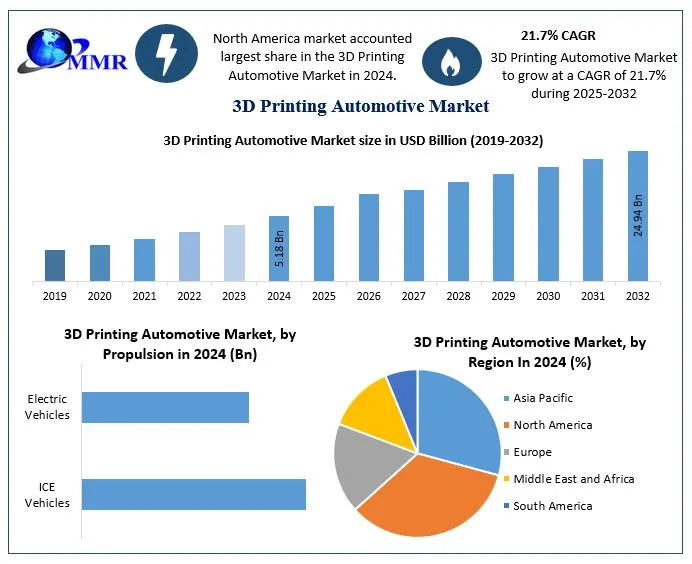
Market Overview
The 3D Printing Automotive Market was valued at USD 5.18 billion in 2024 and is expected to grow at a CAGR of 21.7% from 2025 to 2032, reaching nearly USD 24.94 billion by 2032. The market is undergoing a significant transformation as automotive manufacturers increasingly adopt additive manufacturing for vehicle design, rapid prototyping, tooling, research and development, and production of complex components. 3D printing enables manufacturers to produce intricate geometries, reduce material waste, shorten development cycles, and make design modifications without the tooling changes required by conventional manufacturing.
The major growth drivers include increasing demand for lightweight automotive components, the expansion of electric vehicles, growing vehicle customization, shorter product-development cycles, and the need for more flexible manufacturing systems. Additive manufacturing also allows automotive companies to consolidate multiple components into a single printed part, which can reduce assembly requirements and improve functional performance. The increasing availability of engineering-grade polymers, composites and metal materials is further expanding applications beyond prototyping toward production components. Opportunities are particularly strong in customized interiors, battery and thermal-management components, lightweight structural parts, aftermarket components, manufacturing tools, jigs and fixtures, and digital inventories for low-volume spare parts.
U.S. Market Trends and Investment
The United States remains an important market for automotive additive manufacturing because of its large automotive manufacturing base, established technology suppliers and continuing investment in advanced production. In January 2025, General Motors reported that its teams had completed more than 5,400 new additive-manufacturing projects during 2024, covering prototypes, tooling, ergonomic production aids and production components, with further applications expected during 2025. In April 2025, GM also highlighted the use of more than 130 additively manufactured components in the Cadillac CELESTIQ, including a metal component produced through laser powder-bed fusion. Ford disclosed in February 2025 that its additive-manufacturing teams had produced approximately 1,000 complex metal and polymer components for its Red Bull Powertrains Formula 1 program, demonstrating the use of advanced AM for highly demanding applications. In June 2025, GM announced plans to invest approximately USD 4 billion in U.S. manufacturing plants over two years to increase domestic production of gasoline and electric vehicles, supporting the broader advanced-manufacturing ecosystem in which additive technologies are being deployed.
Request To Free Sample of This Strategic Report ➤ https://www.maximizemarketresearch.com/request-sample/9760/
Largest Market Segment
The competitive landscape includes global additive-manufacturing companies offering printers, materials, software and production services. Public 2025 industry estimates identify Stratasys, 3D Systems, HP, EOS and GE Additive/Colibrium Additive among the leading companies; one 2025 market estimate placed Stratasys at approximately 6.4% of the automotive 3D-printing market and reported the leading five companies collectively at about 26%. These figures come from a separate industry estimate rather than the MMR report and should therefore not be treated as MMR market-share figures.
Stratasys continues to expand production-oriented polymer additive manufacturing. Its F3300 FDM platform is designed for higher throughput automotive tooling and production applications, while the company has continued developing validated materials and production workflows. Stratasys also expanded into metal and ceramic additive manufacturing through its investment and commercial agreement with Tritone Technologies, broadening its technology portfolio beyond polymers.
3D Systems is strengthening production and digital manufacturing capabilities. In January 2025, the company and Daimler Truck/Daimler Buses announced a solution for remote, on-demand production of certified spare parts, combining additive manufacturing with digital rights management and manufacturing software. The approach can help reduce supply-chain bottlenecks and delivery times for replacement components.
HP is advancing Multi Jet Fusion technology for automotive production and customization. At RAPID + TCT 2025, HP highlighted an automotive application involving more than 75 MJF-printed components and introduced its halogen-free flame-retardant 3D HR PA 12 FR material, which offers 60% material reusability.
EOS continues to focus on industrial polymer and metal additive manufacturing for automotive applications, including lightweight structures, thermal-management components, tooling, customization and on-demand spare parts. Its portfolio supports applications from prototyping through series production.
GE Additive/Colibrium Additive has developed large-scale metal additive manufacturing and binder-jet technologies aimed at industrial production. GE has highlighted the potential of binder jetting for automotive manufacturing because of its ability to support scalable production of complex metal components.
Regional Analysis
United States: MMR identifies the United States as the leading country within North America's automotive 3D-printing market. Its large automotive manufacturing base, strong presence of additive-technology companies, development of electric vehicles and demand for plastic and metal components support adoption. MMR's public report does not disclose a separate percentage global-market share for the U.S.; therefore, no country-level percentage is assigned here.
Germany: Germany remains a major European automotive and industrial-manufacturing center, with companies using additive manufacturing for prototypes, tooling, lightweight components and series applications. EOS's automotive portfolio demonstrates applications in customized parts, thermal management, tooling and production.
United Kingdom: The UK's advanced-manufacturing ecosystem supports additive manufacturing through research, engineering and industrial applications. The government's 2025 Defence Advanced Manufacturing Strategy also emphasized additive manufacturing for resilient supply chains, shorter lead times and decentralized production, supporting the broader national AM ecosystem.
France: France benefits from its established automotive manufacturing and engineering base, where additive manufacturing is used for prototyping, tooling, motorsport and specialized components. European demand for lightweight and customized vehicle components provides additional opportunities.
Japan: Japan's automotive sector is increasingly connected with digital manufacturing and advanced mobility technologies. In June 2025, Japan's METI and MLIT released an updated Mobility DX Strategy focused on strengthening automotive competitiveness through digital transformation, advanced technologies and public-private cooperation.
China: China offers significant growth potential because of its extensive automotive manufacturing capacity, expanding electric-vehicle industry and increasing adoption of digital production technologies. The combination of EV development, manufacturing scale and demand for rapid product development creates opportunities for automotive additive manufacturing.
Request To Free Sample of This Strategic Report ➤ https://www.maximizemarketresearch.com/request-sample/9760/
Key Players
1. 3D Systems Corporation (US)
2. Autodesk, Inc. (US)
3. Envisiontec Inc. (US)
4. Polymaker (US)
5. Ponoko Ltd (US)
6. Webcrawler (US)
7. Local Motors Materialise Nv (US)
8. Optomec Inc. (US)
9. Exone (US)
10. Chizel Prints Manufacturing Pvt. Ltd (US)
11. Desktop Metal, Inc. (US)
12. General Electric Company (US)
13. AI Design. (US)
14. EOS GmbH (Germany)
15. Concept Laser (Germany)
16. Materialise NV (Belgium)
17. Ultimaker BV (Netherlands)
18. Arcam Ab (Sweden)
19. Hoganas Ab (Sweden)
20. Gearbest (Italy)
21. Sanya Si Hai (India)
22. Stratasys Inc. (Israel)
23. Voxeljet Ag (Germany)
24. XEV (UK)
25. Hanhook Tires (South Korea)
Conclusion
The 3D Printing Automotive Market is transitioning from a technology primarily associated with prototyping toward a broader manufacturing platform covering tooling, customized components, production parts and digital spare-parts inventories. In our view, the most significant growth opportunity lies in combining additive manufacturing with lightweight design, EV development, automation, advanced materials and digital production workflows. As printing speed, material performance, quality certification and production economics improve, automotive manufacturers can increasingly apply 3D printing to applications where conventional manufacturing is slower, less flexible or more material-intensive. The combination of rapid product development, customized manufacturing and increasingly capable metal and polymer technologies is expected to remain a major contributor to market expansion through 2032.
About Maximize Market Research
Maximize Market Research Pvt. Ltd. (MMR) is a global market research and consulting company that provides reliable, data-focused, and practical business insights. The firm serves a wide range of industries, including healthcare, pharmaceuticals, technology, automotive, electronics, chemicals, personal care, and consumer goods. Through market forecasts, competitive analysis, strategic consulting, and industry impact assessments, MMR helps organizations understand changing market conditions, identify growth opportunities, and make informed business decisions for long-term success.
Contact Us
2nd Floor, Navale IT Park Phase 3
Pune Bangalore Highway, Narhe
Pune, Maharashtra 411041, India
+91 9607365656
[email protected]

 Arabic
 French
 Spanish
 Portuguese
 Deutsch
 Turkish
 Dutch
Dutch
 Italiano
 Russian
 Romaian
 Portuguese (Brazil)
 Greek
Greek
