


 About Urh Social
 Terms of Service
 Πολιτική Ιδιωτικότητας
 Contact
How Can B2B Sales Professionals Improve Their English Speaking Skills in 2026?
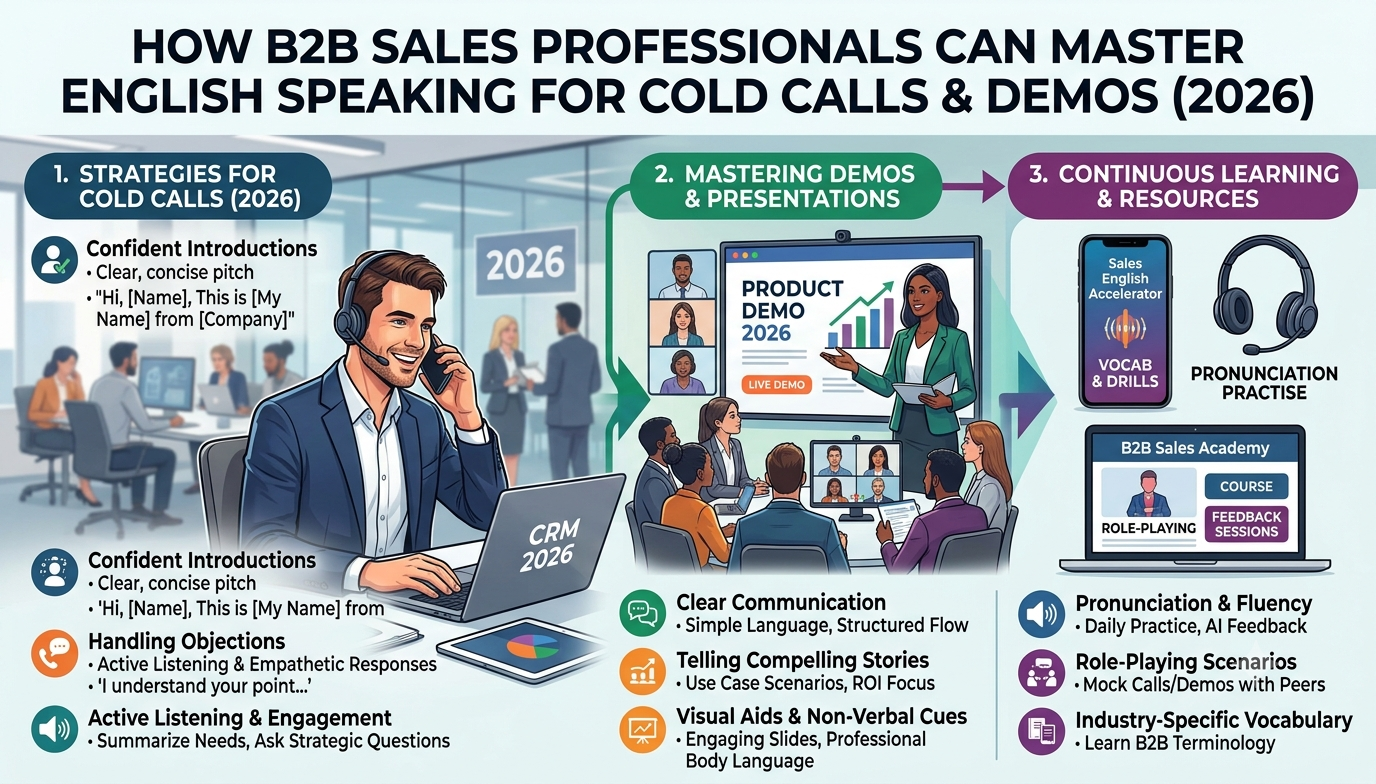
Knowing English and speaking English confidently are two different skills. A B2B sales professional may understand emails, product documentation, and client questions perfectly well but still hesitate when responding during a live sales call.
Sales conversations require professionals to think, listen, respond, explain, clarify, and persuade in real time. A salesperson may need to introduce a product, ask discovery questions, simplify technical concepts, handle objections, discuss pricing, negotiate terms, and agree on the next step—all in English.
That is why English Speaking Practice for Sales Professionals should go beyond grammar lessons and vocabulary memorization. The most useful approach combines structured speaking exercises, sales role-play, recording, feedback, vocabulary development, and regular conversation practice.
Here are 12 practical ways B2B and SaaS sales professionals can improve their spoken English in 2026.
1. Practise a 60-Second Product Pitch Every Day
What it means
A 60-second product pitch trains you to explain your product clearly without overthinking every sentence.
Use this structure:
Problem → Product → Benefit → Differentiator → Business value → Next step
How to practise
Set a timer for one minute and explain your product without reading a script. Record yourself, listen back, and repeat the pitch using slightly different wording.
The goal is not to memorize one perfect paragraph. It is to become comfortable explaining the same idea naturally.
B2B sales example
For a fictional CRM platform:
“Our CRM helps growing sales teams organize leads, automate follow-ups, and get a clearer view of their pipeline. Instead of managing customer information across spreadsheets and separate tools, reps can manage the process from one platform. This can make follow-up activity more organized and give managers better visibility. If improving pipeline management is a priority, we can look at how your team handles it today.”
Why it helps
Repeated short pitches improve fluency, vocabulary recall, sentence structure, and speaking confidence. They also make it easier to start a client conversation without unnecessary hesitation.
2. Role-Play B2B Discovery Calls
What it means
Discovery calls require more than asking prepared questions. Salespeople need to listen to answers and respond with relevant follow-up questions.
Useful questions include:
-
“What challenges are you currently facing?”
-
“How are you managing this process today?”
-
“What would you like to improve?”
-
“What impact is this issue having on your team?”
-
“What would an ideal solution look like?”
How to practise
Practise with a colleague or speaking partner. Ask one question, listen to the answer, and create the next question based on what you heard.
Avoid reading a complete script.
B2B sales example
If a prospect says, “Our sales reps are spending too much time preparing reports,” you might respond:
“What part of the reporting process takes the most time?”
That follow-up sounds more natural than immediately moving to the next question on a checklist.
Why it helps
Discovery-call role-play develops spontaneous English conversation, listening, follow-up questioning, and response speed. It is more closely connected to sales communication than practising generic English topics.
3. Record Yourself Speaking and Review the Recording
What it means
Recording your own speech gives you an opportunity to notice habits that are difficult to recognize while speaking.
How to practise
Record yourself delivering a product pitch, answering discovery questions, explaining a SaaS feature, or responding to an objection.
Review the recording for:
-
Excessive filler words
-
Long pauses
-
Unclear pronunciation
-
Repeated vocabulary
-
Very long sentences
-
Grammar mistakes
-
Unclear explanations
Do not record actual customer conversations unless you have the appropriate consent and are following your company's policies.
B2B sales example
You may notice that you repeatedly say “basically” before explaining a product feature. Once you recognize the pattern, you can practise replacing it with a direct statement.
Why it helps
Recording develops speaking self-awareness. It can help you identify whether the problem is pronunciation, sentence structure, hesitation, vocabulary recall, or simply trying to say too much at once.
4. Practise Handling Common Sales Objections
What it means
Salespeople often lose fluency when prospects raise unexpected objections. Objection practice helps you prepare for the communication challenge without memorizing robotic responses.
Use:
Listen → Acknowledge → Clarify → Respond → Next step
How to practise
Ask a colleague to give you objections randomly.
Practise responding to:
-
“Your price is too high.”
-
“We already use another solution.”
-
“We need to think about it.”
-
“Send me the details.”
-
“We are not ready to switch.”
B2B sales example
Prospect: “Your pricing is higher than what we're currently paying.”
A professional response could be:
“I understand that budget is important. Could I ask what you're comparing our pricing against and which outcomes you're looking to improve?”
Why it helps
Repeated spoken practice improves response speed, listening, clarity, and confidence under pressure. The objective is to understand and address the buyer's concern—not to overpower it with aggressive sales language.
5. Learn to Explain Complex Products in Simple English
What it means
SaaS products can involve APIs, integrations, automation, analytics, workflows, security, and other technical concepts. A salesperson needs to explain these ideas in language appropriate for the buyer.
Use:
Feature → Problem → Benefit → Business impact
How to practise
Choose one technical feature every day and explain it first to a technical buyer. Then explain it again to a business decision-maker with limited technical knowledge.
B2B sales example
Instead of saying:
“Our system uses automated workflow triggers to initiate downstream processes.”
Try:
“Our platform automatically starts the next step when a specific customer action happens, so your team doesn't have to manage that process manually.”
Why it helps
This develops clarity, audience awareness, business English, and explanation skills. Simple English does not mean oversimplifying the product; it means communicating the important idea without unnecessary complexity.
6. Use English Shadowing for Business Communication
What it means
English shadowing involves listening to a short section of professional English and repeating it aloud.
How to practise
Choose a short section from a business presentation, SaaS webinar, professional interview, business podcast, or sales-training video.
Then:
-
Listen for meaning.
-
Listen again carefully.
-
Repeat the speaker's sentences aloud.
-
Pay attention to rhythm and intonation.
-
Record your version.
-
Compare your delivery with the original.
Do not make accent imitation the objective. Focus on clear pronunciation, natural rhythm, sentence patterns, and comfortable speaking speed.
B2B sales example
If a speaker says, “Let me walk you through how this works,” practise saying the sentence naturally and then use the structure in your own product-demo context.
Why it helps
Shadowing combines listening and speaking. It can help professionals become more comfortable with natural business English, pronunciation patterns, sentence rhythm, and professional phrasing.
7. Build a Personal B2B Sales Vocabulary Bank
What it means
Instead of memorizing random English words, build a vocabulary bank from the language you actually use at work.
Organize useful phrases around:
-
Discovery
-
Product demos
-
Objections
-
Pricing
-
Negotiation
-
Closing
-
Follow-ups
How to practise
Whenever you hear a useful phrase during a meeting, webinar, sales call, or presentation, write it down with an example.
For example:
Discovery: “Could you walk me through your current process?”
Pricing: “Could we look at the scope before discussing the commercial terms?”
Follow-up: “Would it make sense to schedule a technical discussion next week?”
Practise the complete phrase rather than memorizing individual words.
Why it helps
Context-based vocabulary is easier to connect with real situations. It can improve vocabulary recall and make professional English sound more natural.
8. Practise English Conversation With Live Feedback
What it means
Independent practice is useful, but sales professionals also need spontaneous conversation. A live speaking partner can ask unexpected questions, change topics, and respond to what you actually say.
How to practise
Use live role-play for situations such as:
-
Client calls
-
Discovery meetings
-
Product demos
-
Presentations
-
Objection handling
-
Negotiations
One possible resource is EngVarta, which currently describes itself as a 1-to-1 spoken-English practice platform for working professionals. Its official information says learners speak with live TESOL/ESL-certified English Experts through audio calls, with real-time corrections and consolidated feedback. It also describes professional practice around meetings, presentations, interviews, client calls, and sales/client-facing situations. EngVarta
This kind of live practice can complement self-recording, shadowing, vocabulary work, and sales simulations. For example, a SaaS salesperson could use a practice session to rehearse a product pitch and then work on specific speaking issues identified during the conversation.
Why it helps
Live conversation develops real-time English fluency, listening, response speed, and confidence. Human feedback can also highlight recurring speaking patterns that may be difficult to identify independently.
9. Practise SaaS Product Demos in English
What it means
A product demo is not simply a tour of software features. The salesperson needs to connect the product to the customer's situation.
Practise this sequence:
Opening → Customer problem → Product overview → Feature explanation → Benefit → Questions → Next step
How to practise
Choose a fictional customer and deliver a complete five-minute demo explanation without reading every sentence.
Focus on transitions such as:
“Based on what you mentioned earlier…”
“Let me show you how this addresses that problem.”
“The important point here is…”
SaaS example
For a customer-support platform, do not spend several minutes listing dashboard functions. Explain how the dashboard helps managers identify unresolved customer issues and prioritize work.
Why it helps
Demo practice improves fluency, product vocabulary, explanation skills, transitions, and confidence. It also helps salespeople avoid jumping between features without explaining their relevance.
10. Practise Pricing and Negotiation Conversations
What it means
Pricing conversations require clear business English because buyers may ask about discounts, contract duration, procurement requirements, ROI, or commercial terms.
How to practise
Ask a colleague to challenge your proposal.
Practise situations involving:
-
Pricing
-
Discounts
-
Contract duration
-
Procurement
-
Budget
-
ROI
-
Commercial terms
Use calm, professional language.
For example:
“Before we discuss a discount, could we look at the scope and outcomes you're expecting?”
Or:
“If the current budget is a constraint, we could review which parts of the scope are essential for the first phase.”
Why it helps
Negotiation practice develops business vocabulary, response speed, clarity, and confidence during higher-pressure conversations. The goal is to explain value respectfully, not to sound confrontational.
11. Use a Daily 15-Minute English Speaking Routine
What it means
Busy sales professionals often struggle to maintain long study sessions. A short, focused routine can make spoken English practice easier to fit into the workday.
How to practise
Try:
-
5 minutes: Product pitch
-
5 minutes: Objection handling
-
5 minutes: English conversation or recording review
The exercises can change according to your calendar.
Before a demo: practise your product explanation.
Before a discovery call: practise open-ended questions.
Before a negotiation: practise pricing and objection responses.
Before a presentation: practise your story and key explanations.
Why it helps
A short routine encourages consistency and keeps practice connected to actual work. The objective is not to spend more time studying English; it is to spend more time actively speaking English that you need for your job.
12. Simulate the Complete B2B Sales Conversation
What it means
A full sales-call simulation combines individual speaking skills into one realistic exercise.
Practise:
Opening → Rapport → Discovery → Qualification → Product explanation → Objection → Pricing → Next step
How to practise
Ask a colleague or practice partner to act as the prospect. Do not tell yourself exactly what the prospect will say.
Record the simulation where appropriate and with the necessary consent.
Afterward, evaluate:
-
Fluency
-
Clarity
-
Grammar
-
Vocabulary
-
Pronunciation
-
Filler words
-
Pauses
-
Listening responses
-
Confidence
Also ask one practical question: Did my English help the buyer understand the business value clearly?
B2B sales example
A complete simulation could begin with a cold-call opening, move into discovery, introduce a CRM platform, handle a pricing objection, and finish by agreeing on a technical evaluation.
Why it helps
Full simulations connect individual exercises with realistic professional communication. They help salespeople practise switching between listening, questioning, explaining, responding, and closing instead of treating each skill separately.
Quick Summary of the 12 Methods
|
English Practice Method |
Main Skill Developed |
Suggested Practice Time |
|
60-second product pitch |
Fluency and clarity |
5 minutes |
|
Discovery-call role-play |
Spontaneous speaking |
10 minutes |
|
Record and review |
Self-awareness and clarity |
5–10 minutes |
|
Objection practice |
Response speed |
10 minutes |
|
Complex-to-simple explanations |
Communication clarity |
5–10 minutes |
|
English shadowing |
Pronunciation and rhythm |
10 minutes |
|
Sales vocabulary bank |
Vocabulary recall |
5 minutes |
|
Live conversation practice |
Real-time fluency |
15–30 minutes |
|
SaaS demo practice |
Explanation skills |
10 minutes |
|
Pricing negotiation practice |
Business communication |
10 minutes |
|
Daily 15-minute routine |
Consistency |
15 minutes |
|
Complete sales simulation |
Integrated communication |
15–30 minutes |
The suggested times are starting points, not fixed requirements. A sales professional can adjust them according to available time, proficiency level, and upcoming work.
How to Choose an English Learning Resource
Sales professionals looking for the Best English Speaking Apps in India (2026) or the Best Online English Speaking Course in India should first identify what kind of practice they actually need.
For example, someone who needs grammar instruction may benefit from a structured English Speaking Course. Someone who mainly struggles to speak spontaneously may need frequent conversation practice. Others may prefer Best Online Spoken English Classes or Online English Classes in India that combine structured lessons with speaking activities.
When evaluating an English speaking app, Best English Learning App, or English speaking course, consider:
-
Live speaking opportunities
-
Human feedback
-
Professional scenarios
-
Course structure
-
Flexibility
-
Practice frequency
-
Pronunciation support
-
Conversation opportunities
-
Cost
-
Individual learning goals
There is no single learning format that suits every professional. A salesperson preparing for international client calls may prioritize live conversation and feedback, while another learner may need a structured course covering grammar, vocabulary, and workplace English.
The important question is not simply where to learn English speaking. It is whether the resource gives you enough opportunities to speak English, practise English conversation, and apply what you learn to your actual work.
For professionals who prefer live practice, EngVarta is one possible option. Its current professional offering describes 1-to-1 audio sessions with live certified English Experts, real-time corrections, professional scenarios, and session recordings for review. EngVarta
Conclusion
B2B sales professionals do not need perfect English to communicate effectively. They need clear speech, useful vocabulary, active listening, confidence, response speed, and familiarity with the situations they face at work.
How to Choose an English Learning Resource
That is why English Speaking Practice for Sales Professionals should focus on real sales activities: discovery calls, product demos, objections, pricing discussions, negotiations, client meetings, and follow-ups. Recording, role-play, shadowing, vocabulary practice, and live feedback can all complement one another.
EngVarta is one possible resource for professionals who want live speaking practice and feedback, alongside independent exercises and sales simulations. EngVarta
Do not try to improve everything at once. Choose one technique and practise it for 10–15 minutes today. Then make the next practice session slightly more challenging.

 English
 Arabic
 French
 Spanish
 Portuguese
 Deutsch
 Turkish
 Dutch
Dutch
 Italiano
 Russian
 Romaian
 Portuguese (Brazil)
