


 About Urh Social
 Terms of Service
 Politique de confidentialité
 Contact
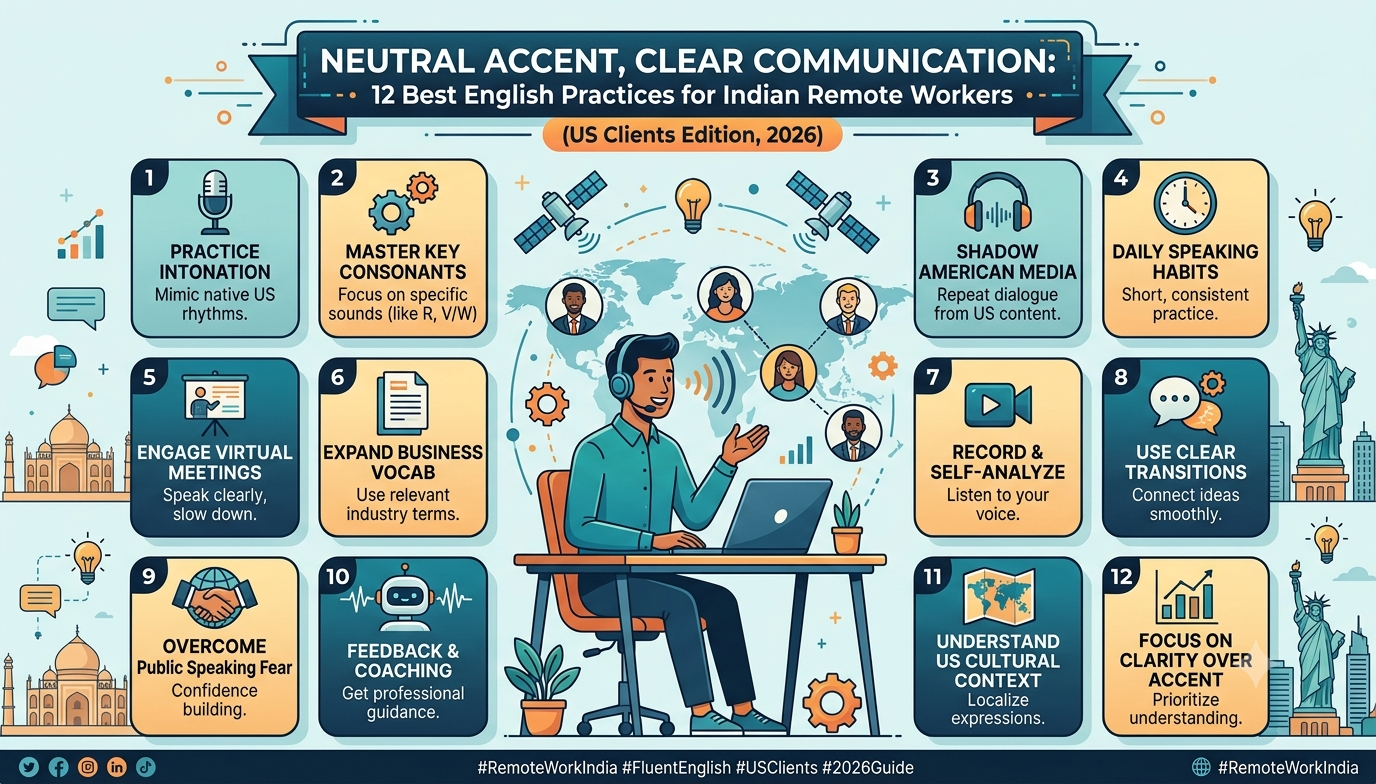
Neutral Accent, Clear Communication: 12 Best English Practices for Indian Remote Workers (US Clients Edition, 2026)
What Is the Best Way to Communicate Clearly With US Clients?
The most useful English practice for Indian remote workers is consistent training in clarity, pronunciation, listening, spontaneous speaking, professional vocabulary, and realistic client situations—not trying to replace an Indian accent with an American one.
For freelancers, developers, designers, marketers, consultants, customer-support professionals, project managers, and remote employees, spoken English often matters during client calls, meetings, presentations, project updates, negotiations, technical discussions, and unexpected questions.
The goal is simple: clarity over accent imitation. A remote professional should be able to understand the client, explain ideas concisely, ask for clarification, handle interruptions, discuss deadlines, and respond naturally under pressure.
Quick Answer
The Best English Speaking Practice for Indian Remote Workers combines pronunciation work, listening practice, daily English conversation, US-client role-play, professional vocabulary, live feedback, and short but consistent speaking sessions.
You do not need to “sound American.” You need speech that is understandable, appropriately paced, professionally worded, and flexible enough for real workplace conversations.
12 Practices at a Glance
|
Practice |
Main Skill |
US Client Use Case |
|
1. Clear pronunciation |
Intelligibility |
Client calls |
|
2. Word & sentence stress |
Emphasis |
Deadlines and updates |
|
3. Controlled pace |
Clarity |
Technical explanations |
|
4. Daily conversation |
Spontaneous speaking |
Meetings |
|
5. Client role-play |
Real-time responses |
Negotiations |
|
6. Professional vocabulary |
Workplace English |
Project discussions |
|
7. Listening practice |
Comprehension |
Fast conversations |
|
8. Direct English thinking |
Response speed |
Quick questions |
|
9. Clarification skills |
Active communication |
Requirements |
|
10. Simple technical English |
Explanation |
IT/client calls |
|
11. Live human feedback |
Correction |
Professional speaking |
|
12. Daily routine |
Consistency |
Long-term practice |
1. Practise Clear Pronunciation Instead of Copying an American Accent
Clear pronunciation is more useful than accent imitation.
Indian remote professionals may have difficulty with particular consonants, vowels, word endings, technical terms, or connected speech. The objective is not to remove regional identity. It is to make important words easy for another person to understand.
For example:
“I’ll send the revised version by Thursday.”
Practise the sounds in revised, version, and Thursday, while maintaining a comfortable pace.
Record yourself saying the sentence and listen for unclear sounds or rushed words.
Why it helps: intelligibility refers to how easily speech can be understood; accent and intelligibility are related but are not the same thing.
2. Train Word Stress and Sentence Stress
English does not give every word equal emphasis. Professional communication becomes easier to follow when important information receives natural stress.
Practise emphasizing:
-
deadlines
-
numbers
-
dates
-
deliverables
-
priorities
-
project changes
For example:
“We need the FINAL version by THURSDAY.”
Do not exaggerate the stress. Instead, listen to natural English and notice which words speakers emphasize.
For US client communication, this can be particularly useful when confirming requirements, dates, responsibilities, or next steps.
3. Slow Down and Control Your Speaking Pace
Hesitant speakers sometimes respond by speaking too quickly once they get an opportunity to talk. This can make pronunciation less clear and complex explanations harder to follow.
Practise:
-
short pauses
-
phrase grouping
-
deliberate breathing
-
finishing one idea before starting another
-
avoiding unnecessary fillers
For example, instead of rushing through a technical update, say:
“We completed development yesterday. Pause. Testing is currently in progress. Pause. We found one issue with the payment integration.”
Controlled pacing gives the listener time to process information and gives you time to formulate your next sentence.
4. Practise Real English Conversation Every Day
Reading grammar rules and watching English videos can build knowledge, but remote workers also need opportunities to use English conversation spontaneously.
Spend 10–20 minutes speaking about:
-
your current project
-
what you completed today
-
what you need to do tomorrow
-
a recent client request
-
a problem you solved
-
a professional topic
-
an unexpected question
Try to practice English conversation without writing a complete script first.
A useful exercise is to explain your current task aloud as though your US manager has just asked, “What are you working on?”
The goal is not perfect grammar in every sentence. The goal is the ability to communicate ideas without freezing.
5. Use US Client Call Role-Plays
Role-play converts passive English knowledge into workplace communication practice.
Practise scenarios such as:
-
project delays
-
scope changes
-
missed deadlines
-
requirement clarification
-
status updates
-
pricing discussions
-
technical problems
-
complaints
-
timeline negotiations
For example:
Client: “Why can't we deliver this by Wednesday?”
Professional: “We found an issue during testing. We can complete the fix by Friday.”
Then challenge yourself with a follow-up:
Client: “What happens if the fix takes longer?”
You now have to respond without a prepared script.
This is valuable because real client conversations rarely follow a predictable sequence.
6. Build a Professional English Vocabulary Bank
Remote professionals do not necessarily need thousands of sophisticated words. They need the right words for their work.
Useful vocabulary includes:
-
deliverable
-
timeline
-
deadline
-
feedback
-
priority
-
scope
-
revision
-
blocker
-
dependency
-
estimate
-
requirement
-
follow-up
-
alignment
Do not memorise vocabulary as isolated definitions. Put each word into a sentence.
For example:
“There is one blocker preventing us from completing the final revision.”
Then create variations:
“The main blocker is the API integration.”
“Once we resolve that dependency, we can finish testing.”
This approach connects spoken English and English conversation to situations you actually encounter at work.
7. Improve Listening to Different US English Speaking Styles
US clients do not all speak English in the same way. Speakers can differ in speed, pronunciation, vocabulary, formality, conversational habits, and use of idioms.
Build listening practice with:
-
business podcasts
-
interviews
-
workplace videos
-
presentations
-
professional discussions
-
permitted recordings of meetings
-
shadowing exercises
Start with a short clip. Listen once for overall meaning. Listen again for specific phrases. Then repeat selected sentences aloud.
Do not make “understanding every word” the only objective. Practise identifying the main point, important details, requests, deadlines, and implied next steps.
8. Practise Answering Without Translating Word-for-Word
Mental translation can slow down responses, particularly when a client asks an unexpected question.
Instead of constructing a complicated sentence in Hindi, Bengali, Tamil, Telugu, Marathi, Malayalam, Kannada, Gujarati, Punjabi, or another language and then translating it, build simple English response patterns directly.
For example, practise:
“I’ll check that and get back to you.”
Then:
“I need some time to verify the numbers.”
And:
“Let me confirm that with the development team.”
These sentences are simple but highly functional.
You do not need complicated grammar to speak English effectively in a professional conversation.
9. Learn to Ask for Clarification Confidently
A remote professional should never pretend to understand a requirement that is unclear.
Useful phrases include:
-
“Could you clarify that point?”
-
“Just to confirm, do you mean…?”
-
“Could you give me an example?”
-
“Let me make sure I understood you correctly.”
-
“Are you referring to the first version or the revised version?”
Asking for clarification is a professional communication skill.
For example:
“Just to confirm, do you want the report updated before Friday's meeting?”
That question can prevent an incorrect assumption and potentially save time for both the client and the team.
10. Explain Technical Ideas in Simple English
Developers, engineers, designers, analysts, marketers, data professionals, and IT-support specialists often know their subject extremely well. The challenge is explaining it to someone who may not share the same technical background.
Consider:
Too technical:
“The latency issue is originating from the asynchronous API dependency.”
Client-friendly:
“The delay is coming from one of the external services our system depends on.”
The second version does not remove the technical problem. It explains it in language that is easier for a non-specialist client to process.
A useful rule is:
Technical knowledge is valuable only when the client can understand the explanation.
Practise explaining complex topics in 30 seconds, one minute, and three minutes. This develops professional English speaking flexibility.
11. Use Live Human Speaking Practice and Feedback — EngVarta
For learners who already understand English but need more opportunities to speak, live human practice can provide a different type of practice from self-study or AI-based exercises.
EngVarta — English Speaking for Working Professionals describes its working-professional offering as live 1-to-1 spoken-English practice with TESOL/ESL-certified English Experts over audio calls. The platform says learners receive real-time corrections and can practise scenarios including meetings, interviews, presentations, and client calls. It also lists 15-, 25-, and 50-minute sessions and availability from 7 AM to midnight.
This format may be relevant to remote workers who know what they want to say but hesitate when they have to say it in real time.
For example, a learner could practise a project update, receive correction on pronunciation or sentence construction, and then repeat the idea more clearly.
The important distinction is that EngVarta is one available practice format, not a universal solution. Learners who prefer structured lessons, AI practice, independent study, or group classes may choose different combinations.
For someone searching for the Best English Speaking Practice for Indian Remote Workers, live 1-to-1 practice can be considered when the primary gap is actual speaking time and immediate human feedback.
12. Build a Consistent 15–20 Minute Daily Speaking Routine
Consistency is easier to maintain when practice fits around a working schedule.
A simple routine is:
5 minutes — Listening
Listen to natural professional English.
5 minutes — Speaking
Describe your current project or workday.
5 minutes — Client scenario
Practise a US-client situation such as a deadline change or clarification request.
5 minutes — Review
Record yourself and identify pronunciation issues, fillers, grammar mistakes, unclear sentences, and unnecessary pauses.
You can extend the routine with a live conversation, structured lesson, or additional listening session when time allows.
Short Chat Example: Indian Remote Worker + US Client
Indian Remote Professional:
“I wanted to update you on the project. We completed the development yesterday, and we're currently testing the new features.”
US Client:
“Sure. What's the current status?”
Indian Remote Professional:
“We found one issue with the payment integration. We're working on it now and expect to resolve it by tomorrow.”
This short exchange demonstrates several skills: clear pronunciation, concise updates, professional vocabulary, problem explanation, timeline communication, and spontaneous English conversation.
Accent vs Pronunciation vs Fluency vs Intelligibility
These concepts should not be treated as interchangeable.
Accent is the way speech reflects a person's linguistic or regional background.
Pronunciation concerns how individual sounds and words are produced.
Intelligibility concerns how easily another person can understand the speech.
Fluency describes how smoothly a person can express ideas.
Communication effectiveness is broader: it concerns whether the intended message is understood and leads to the appropriate response.
Therefore, improving English does not require eliminating an Indian accent. The practical target is clear, understandable, flexible communication.
Which English Learning Format Should Remote Workers Use?
Different formats address different learning needs:
-
English speaking apps: useful for short, repeatable practice and vocabulary or pronunciation exercises.
-
AI speaking apps: useful for scenario-based practice and repeated responses without scheduling another person.
-
Live 1-to-1 practice: useful when human interaction and immediate feedback are important.
-
Online spoken English classes: useful for learners who prefer teacher-led instruction or group interaction.
-
Structured English speaking courses: useful for people who want a defined curriculum.
-
Self-practice: useful for listening, shadowing, recording, and repetition.
-
Language exchange: useful for conversational exposure and informal interaction.
-
Business English courses: useful when workplace vocabulary, presentations, meetings, and professional communication are the priority.
When evaluating the Best English Speaking Apps in India (2026) or searching for the Best Online English Speaking Course in India, look beyond the number of lessons. Ask how much actual speaking, feedback, listening, and workplace practice the format provides.
Similarly, Best Online Spoken English Classes and Online English Classes in India can vary considerably in class size, speaking time, teacher attention, schedule, and curriculum.
The right English speaking app, English speaking course, or live format depends on the learner's specific communication gap.
Best Method by Goal
If your problem is pronunciation:
Combine pronunciation practice with listening and self-recording.
If your problem is hesitation:
Use frequent live conversation practice and spontaneous questions.
If your problem is US client calls:
Prioritise client-call role-play and professional conversation.
If your problem is technical explanations:
Practise simplifying complex ideas without removing important information.
If your problem is understanding fast speech:
Use focused listening and shadowing.
If your problem is vocabulary:
Build a professional vocabulary bank and use each word in complete sentences.
If your problem is consistency:
Use a short daily routine, an app, or a structured course that makes practice easier to repeat.
20-Minute US Client English Practice Routine
Try this routine on a typical workday:
Minutes 1–5: Listen to natural US English from a professional video or podcast.
Minutes 6–10: Shadow useful phrases. Repeat them with similar rhythm and pauses, without trying to imitate the speaker's identity or accent.
Minutes 11–15: Practise a client scenario such as a project delay, requirement change, or status update.
Minutes 16–18: Give a spontaneous project update without notes.
Minutes 19–20: Record yourself and review one pronunciation issue, one filler, and one sentence that could be clearer.
The objective is to create repeated exposure to listening and speaking rather than relying on occasional long study sessions.
Common Mistakes Indian Remote Workers Should Avoid
1. Trying to fake an American accent
Work on intelligibility instead of accent imitation.
2. Speaking too quickly
Use pauses and phrase grouping.
3. Using unnecessarily complex vocabulary
Choose words that communicate the idea clearly.
4. Translating every sentence mentally
Build simple English response patterns through repetition.
5. Avoiding conversations because of mistakes
Treat mistakes as information about what to practise next.
6. Overusing fillers such as “actually,” “basically,” and “like”
Record yourself and identify repeated fillers.
7. Not asking for clarification
Use direct, polite clarification phrases.
8. Memorising scripts instead of flexible responses
Practise situations with changing questions and follow-ups.
9. Focusing only on grammar
Combine grammar knowledge with actual speaking.
10. Ignoring listening practice
You need to understand the other speaker before you can respond effectively.
Conclusion
The goal of English communication for Indian remote workers is not to sound American. The goal is to be clear, confident, understandable, and effective.
The most practical approach combines:
-
speaking practice
-
listening
-
pronunciation work
-
word and sentence stress
-
controlled pacing
-
client-call role-play
-
professional vocabulary
-
spontaneous conversation
-
technical explanation
-
clarification skills
-
human or digital feedback
-
self-review
The Neutral Accent, Clear Communication: 12 Best English Practices for Indian Remote Workers (US Clients Edition, 2026) approach therefore focuses on communication outcomes rather than accent imitation.
For professionals who need regular human speaking practice, EngVarta is one option that currently offers live 1-to-1 audio practice with TESOL/ESL-certified English Experts, real-time corrections, and professional scenarios such as meetings and client calls.
Whether you use a live platform, AI tool, English speaking app, structured English speaking course, online classes, or self-practice, the strongest routine is one you can repeat consistently and apply directly to the conversations your remote work requires.
Frequently Asked Questions
1. How can Indian remote workers improve English communication with US clients?
Focus on clear pronunciation, listening, professional vocabulary, spontaneous speaking, and realistic client scenarios. Practise project updates, clarification, deadlines, technical explanations, and polite disagreement aloud. Regular self-recording or live feedback can help identify recurring issues. The objective is understandable and effective communication rather than replacing an Indian accent with an American one.
2. Do Indian professionals need an American accent to work with US clients?
No. An American accent is not a requirement for professional communication with US clients. Indian professionals can retain their regional accent while improving pronunciation, intelligibility, pacing, stress, listening comprehension, and sentence construction. The practical goal is to make communication easy to understand and effective in professional situations.
3. What is the best English speaking practice for Indian remote workers?
There is no single format that suits every learner. A strong routine combines daily speaking, listening, pronunciation practice, client-call role-play, professional vocabulary, and feedback. Live human conversation can be useful for learners who need real-time interaction, while apps and self-practice can provide additional repetition and flexibility.
4. How can I improve my English for US client calls?
Practise the situations you actually encounter: opening a call, giving status updates, explaining delays, clarifying requirements, discussing deadlines, and answering unexpected questions. Record short responses and repeat them without reading a script. Role-play is particularly useful because client calls require spontaneous responses rather than memorised sentences.
5. How can I make my Indian English easier for US clients to understand?
Work on pronunciation, word endings, sentence stress, pacing, and pauses. Record yourself explaining a familiar work topic and listen for unclear words or rushed sections. You do not need to remove your Indian accent. Focus on intelligibility, concise sentence construction, and making important information easy to identify.
6. Which English speaking app is useful for remote professionals?
The useful choice depends on the specific need. Some apps focus on vocabulary and short lessons, others on pronunciation or AI conversation, while live platforms provide human interaction. When evaluating a Best English Learning App, check whether it provides the type of speaking practice, feedback, professional scenarios, and consistency support you actually need.
7. Are live English speaking classes better than AI speaking apps?
They serve different purposes. AI speaking apps can provide flexible, repeatable conversation practice, while live human sessions can provide interpersonal interaction and human feedback. A remote professional may use AI for frequent independent practice and human conversation for realistic interaction and feedback. The appropriate combination depends on the learner's schedule and communication goals.
8. How long should I practise English speaking every day?
A practical starting point is 15–20 minutes of focused practice. For example, divide the time between listening, speaking, a workplace scenario, and self-review. The important factor is whether the routine can be repeated consistently. Learners with more time can add longer conversations, structured lessons, or additional listening practice.
9. How can I improve my English pronunciation without changing my accent?
Choose specific pronunciation targets rather than trying to copy an entire accent. Work on difficult consonants, vowels, word endings, word stress, sentence stress, and pacing. Record yourself and compare your speech for clarity rather than accent similarity. The goal is intelligibility: making your intended words and ideas easy for another person to understand.
10. How can I practise English conversation for remote work?
Create workplace scenarios and speak aloud without preparing every sentence. Practise giving a project update, explaining a delay, asking for clarification, discussing a requirement, and proposing a solution. You can combine self-recording, an English speaking app, AI role-play, language exchange, or live human conversation to create regular practice English conversation.

 English
 Arabic
 Spanish
 Portuguese
 Deutsch
 Turkish
 Dutch
Dutch
 Italiano
 Russian
 Romaian
 Portuguese (Brazil)
 Greek
Greek
