


 About Urh Social
 Terms of Service
 Datenschutzbestimmungen
 Contact
Gasoline Direct Injection Market Poised to Reach USD 11.2 Billion by 2036 on Fuel-Saving Technology Demand
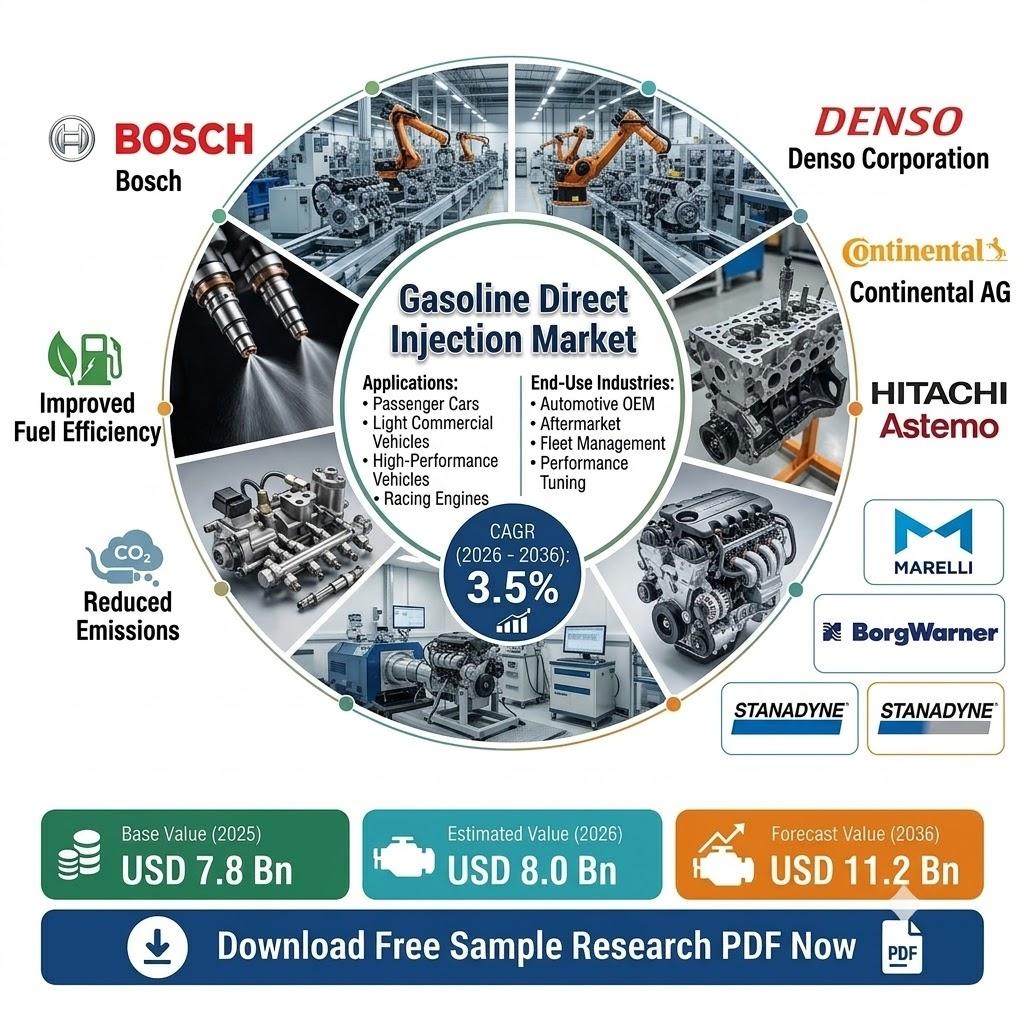
The global gasoline direct injection (GDI) market is projected to grow from approximately USD 8.0 billion in 2026 to USD 11.2 billion by 2036, expanding at a CAGR of 3.5% during the forecast period, according to Fact.MR analysis. The market was valued at USD 7.8 billion in 2025.
The market is expected to create an absolute dollar opportunity of approximately USD 3.3 billion between 2026 and 2036. Growth is being supported by increasing demand for fuel-efficient and low-emission gasoline vehicles, wider use of turbocharged and downsized engines, and tightening emission regulations across major automotive markets.
Get detailed market forecasts, competitive benchmarking, and pricing trends https://www.factmr.com/connectus/sample?flag=S&rep_id=14692
GDI adoption remains closely linked to engine efficiency
Gasoline direct injection systems deliver fuel directly into the combustion chamber, allowing more precise control over fuel delivery and combustion. The technology supports improved atomization, combustion efficiency, fuel economy, and engine performance.
The continued adoption of engine downsizing and turbocharging is strengthening demand for GDI systems. Smaller gasoline engines can deliver higher power output when paired with appropriate fuel injection technologies, supporting their use across passenger cars and light commercial vehicles.
Growth is also being influenced by increasingly stringent emission requirements in Europe, North America, China, India, and other automotive markets. Automakers are adopting more advanced fuel injection systems to address these requirements while maintaining vehicle performance and efficiency.
Asia Pacific remains an important growth center
Growth is distributed across major automotive markets, with Asia Pacific showing strong momentum because of vehicle production, rising vehicle ownership, regulatory changes, and technology adoption.
India's GDI market is projected to expand at a CAGR of 4.6% through 2036. Growth is associated with increasing passenger vehicle ownership, BS-VI emission norms, and rising adoption of turbocharged gasoline engines.
China is expected to grow at a CAGR of 4.2%, supported by high vehicle production volumes, domestic demand, and continued advances in engine technologies.
Japan is projected to expand at 3.2%, supported by advanced automotive engineering, hybrid vehicle adoption, and continued innovation in fuel injection systems.
In mature markets, growth is more moderate. The United States is projected to grow at a CAGR of 2.8%, while Germany is expected to expand at 2.4%. Replacement demand, regulatory compliance, incremental efficiency improvements, and the transition toward electrified mobility influence these markets.
Technology is becoming a key competitive factor
The GDI market is undergoing a shift from conventional component supply toward higher-value technology and system solutions.
Advanced high-pressure injection systems, multi-hole injectors, electronic controls, sensors, and calibration capabilities are becoming increasingly important as automakers seek better combustion performance and compliance with evolving emission requirements.
Fact.MR analysis indicates that competition is also moving beyond component pricing. Suppliers with system integration, calibration expertise, application-specific engineering, and OEM collaboration capabilities can address broader requirements across engine platforms.
Raw material and electronic component exposure remains a challenge. Specialty steels, precision alloys, semiconductors, and electronic subsystems can account for nearly 50% to 65% of total system costs, according to the supplied Fact.MR analysis. Supply disruptions and input price volatility can therefore affect production costs and margins.
Hybrid vehicles extend the role of gasoline engines
The gradual transition toward electrification does not eliminate the role of gasoline engines across all vehicle platforms. Hybrid vehicles continue to use gasoline engines alongside electric powertrains, supporting ongoing demand for advanced fuel injection systems.
The report identifies high-pressure injection technologies, hybrid-compatible systems, electronic control integration, and combustion optimization as areas that could shape the long-term development of the GDI market.
The market is also seeing greater emphasis on localized production, supplier diversification, and strategic sourcing of precision and electronic components as manufacturers seek to improve supply reliability.
Competitive landscape
The gasoline direct injection market includes major automotive technology and component suppliers such as Bosch, Denso Corporation, Continental AG, Delphi Technologies, Hitachi Astemo, and Marelli Holdings Co., Ltd.
Other companies identified in the market include BorgWarner Inc., Stanadyne LLC, Infineon Technologies AG, Renesas Electronics Corporation, and Sensata Technologies.
Competition is centered on high-pressure injection technology, fuel atomization, electronic controls, combustion performance, emission compliance, and system integration.
Report scope
The Fact.MR study covers the global gasoline direct injection market from 2025 to 2036. The analysis includes segmentation by component, vehicle type, engine type, and region.
Components covered include fuel injectors, high-pressure fuel pumps, electronic control units, sensors, and others. The study also examines passenger cars and commercial vehicles, engine configurations, regional markets, pricing trends, raw material and component costs, supply chain dynamics, manufacturing, technology developments, and demand shifts.
To view related Reports
About (Fact.MR)
provides market research and intelligence covering global industries, markets, and emerging business opportunities. Its research combines secondary research, primary industry interactions, quantitative modeling, and data validation to develop market estimates and forecasts.

 English
 Arabic
 French
 Spanish
 Portuguese
 Turkish
 Dutch
Dutch
 Italiano
 Russian
 Romaian
 Portuguese (Brazil)
 Greek
Greek
