


 About Urh Social
 Terms of Service
 Privacy Policy
 Contact
Soluble Flour Substitutes Market Adds USD 1,177 Mn Through 2036 as Germany Advances at 11.6% CAGR
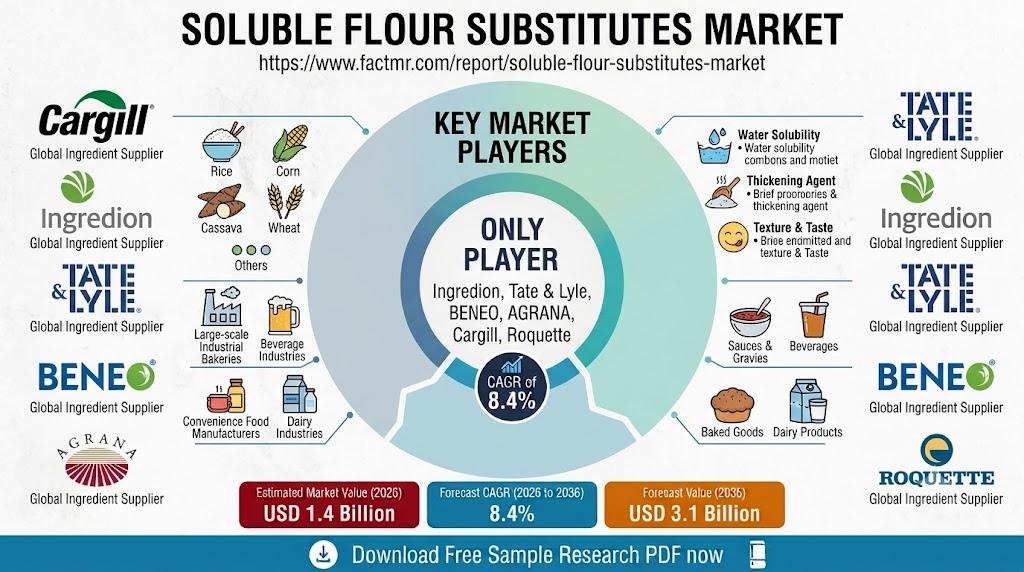
The global soluble flour substitutes market is projected to increase from USD 640.0 million in 2026 to USD 1,817.0 million by 2036, expanding at an 11.0% CAGR during the forecast period, according to Fact.MR analysis. The market was valued at USD 576.6 million in 2025, creating an absolute opportunity of USD 1,177.0 million through 2036.
Get Detailed Market Forecasts, Competitive Benchmarking, and Pricing Trends: https://www.factmr.com/connectus/sample?flag=S&rep_id=16229
The market is gaining traction as beverage developers, bakery manufacturers and nutrition brands look for ingredients that combine fast dispersion, predictable texture and familiar ingredient labeling. Soluble flour substitutes are increasingly relevant in powdered beverages, dry mixes, bakery formulations, soups, sauces and nutrition products where conventional flour or modified starch systems may not meet formulation requirements.
Solubility becomes a core formulation requirement
For food manufacturers, replacing a conventional flour or carrier is not only a question of ingredient sourcing. The substitute must also perform consistently during hydration, heating, mixing and consumer preparation.
Beverage developers require powders that hydrate evenly in ready-to-shake formats and dry blends. Bakery manufacturers use soluble systems to manage crumb and moisture while maintaining a clean ingredient profile. Nutrition brands also evaluate flour-based carrier systems for flavors, proteins and micronutrients.
The broader cereal supply base provides additional context. The Food and Agriculture Organization's July 2026 Cereal Supply and Demand Brief estimated global cereal production at 2,983 million tonnes in 2026.
Rice-based substitutes lead the product segment
Rice-based products are expected to account for 41.0% share in 2026, making them the leading product category. Their neutral flavor and gluten-free positioning make them suitable for beverages, nutrition powders and bakery systems where manufacturers need controlled color and limited grain notes.
Rice-based systems also provide formulation flexibility across applications. The OECD-FAO Agricultural Outlook 2026–2035 projected average global yields by 2035 of approximately 3.9 tonnes per hectare for wheat, 6.5 tonnes for maize and 3.5 tonnes for rice, highlighting the broad agricultural base supporting cereal-derived ingredient development.
Solubility leads functional requirements
Solubility is projected to represent 38.0% share in 2026.
For instant foods, powder behavior can determine whether a formulation succeeds during consumer preparation. Clumping, sedimentation and inconsistent hydration can affect both appearance and mouthfeel. As a result, beverage and soup formulators often screen soluble flour substitutes first for hydration behavior and dispersion.
Soluble ingredients can also shorten preparation time while providing body without excessively masking flavor or creating a pasty texture after heating.
Shambhu Nath Jha, Principal Consultant at Fact.MR, states:
“The commercial test is whether a flour substitute disperses cleanly and still feels familiar. Product teams want repeatable mouthfeel, simple ingredient naming and predictable behavior under heat or cold processing. Suppliers that connect crop selection, particle control and application testing are expected to gain preference.”
Beverages and powders create a strong application base
Beverages are anticipated to capture 34.0% share in 2026, supported by demand for powdered drinks, meal replacements and flavor systems requiring rapid dispersion.
Dry beverage applications put greater pressure on particle behavior. Soluble grades need low sediment and stable mouthfeel after consumer mixing. This makes technical service and application testing important during product qualification.
By form, powder is estimated to hold 46.0% share in 2026. Powdered ingredients fit industrial batching, sachets and dry blends while allowing manufacturers to control dosing. Agglomerated and instantized grades remain relevant where faster wet-out is required.
Clean-label reformulation creates new opportunities
Clean-label replacement of modified starches and maltodextrins is identified as the strongest driver, with a +1.3% impact on CAGR. Instant beverage and dry-mix requirements contribute +1.0%, while rice and pulse-based gluten-free development adds +0.8%.
The opportunity landscape includes soluble rice and pea starch ranges, texture rebuilding in bakery, soups and sauces, and carrier applications in nutrition products and flavor systems.
However, conventional flour and starch price competition remains a restraint. Crop quality and flavor variability can also affect formulation consistency, while application-specific testing and allergen reviews can extend approval cycles.
USA records the highest projected country CAGR
The USA is projected to record a 12.1% CAGR through 2036, followed by Germany at 11.6%, Japan at 10.8%, France at 10.3% and Brazil at 9.9%.
U.S. demand is supported by rice availability and dry-mix formulation. USDA ERS reported in August 2026 that the all-rice supply for the 2026/27 marketing year stood at 262.0 million cwt after its monthly revision.
Germany is expected to advance at 11.6% CAGR as cereal processing and clean-label reformulation support applications across bakery, soups and sauces.
Japan's 10.8% CAGR reflects familiarity with rice-based ingredients and demand for shelf-stable food formats. France is projected to reach 10.3% CAGR, with bakery and sauce applications requiring controlled texture performance. Brazil is estimated at 9.9% CAGR, supported by grain availability and processed-food manufacturing.
Competitive landscape
The soluble flour substitutes market includes Ingredion Incorporated, Cargill, Incorporated, BENEO, Ebro Foods, S.A. / Ebro Ingredients, and Siddiq Agricoze (Pvt.) Ltd.
Ingredion participates through clean-label starch, flour and texture solutions used across beverages, bakery, soups, sauces and nutrition products. Cargill brings starch and food-ingredient capabilities relevant to clean-label reformulation.
BENEO provides specialty rice ingredients and functional systems for label-sensitive applications. Ebro Foods / Ebro Ingredients adds rice-processing expertise, while Siddiq Agricoze contributes to rice and grain ingredient supply.
For suppliers, differentiation is increasingly tied to hydration behavior, particle control, crop consistency and application-specific testing, rather than simply replacing conventional flour on a one-to-one basis.
Read the full report: https://www.factmr.com/report/soluble-flour-substitutes-market
Report scope and methodology
Fact.MR's study covers soluble flour substitutes across rice-based, wheat-based, corn-based and pulse-based products, with analysis by solubility, bulking, texture and carrier function. Applications include beverages, bakery, soups and sauces, and nutrition products. Formats covered include powder, agglomerated, instantized and blended systems.
The analysis draws on 120+ sources, 35+ company portfolios, 25+ countries and 20+ industry interviews. Market estimates combine ingredient portfolios, application requirements, country food-processing indicators, botanical raw-material availability and provider activity.
Other Related Reports:
https://sites.google.com/view/industryresearchinsights/latest-reports/womens-t-shirts-market-trends
About Fact.MR:
Fact.MR is a market research and consulting firm providing syndicated and customized research across industries. Its research combines primary interviews, secondary research, market modeling and industry analysis to support business planning and strategic decision-making.

 English
 Arabic
 French
 Spanish
 Portuguese
 Deutsch
 Turkish
 Dutch
Dutch
 Italiano
 Russian
 Portuguese (Brazil)
 Greek
Greek
