


 About Urh Social
 Terms of Service
 Datenschutzbestimmungen
 Contact
Baby Training Pants Market Reaches USD 19.8 Bn by 2036: USA Grows 6.9% as Supermarkets Hold 29.7% Distribution Share
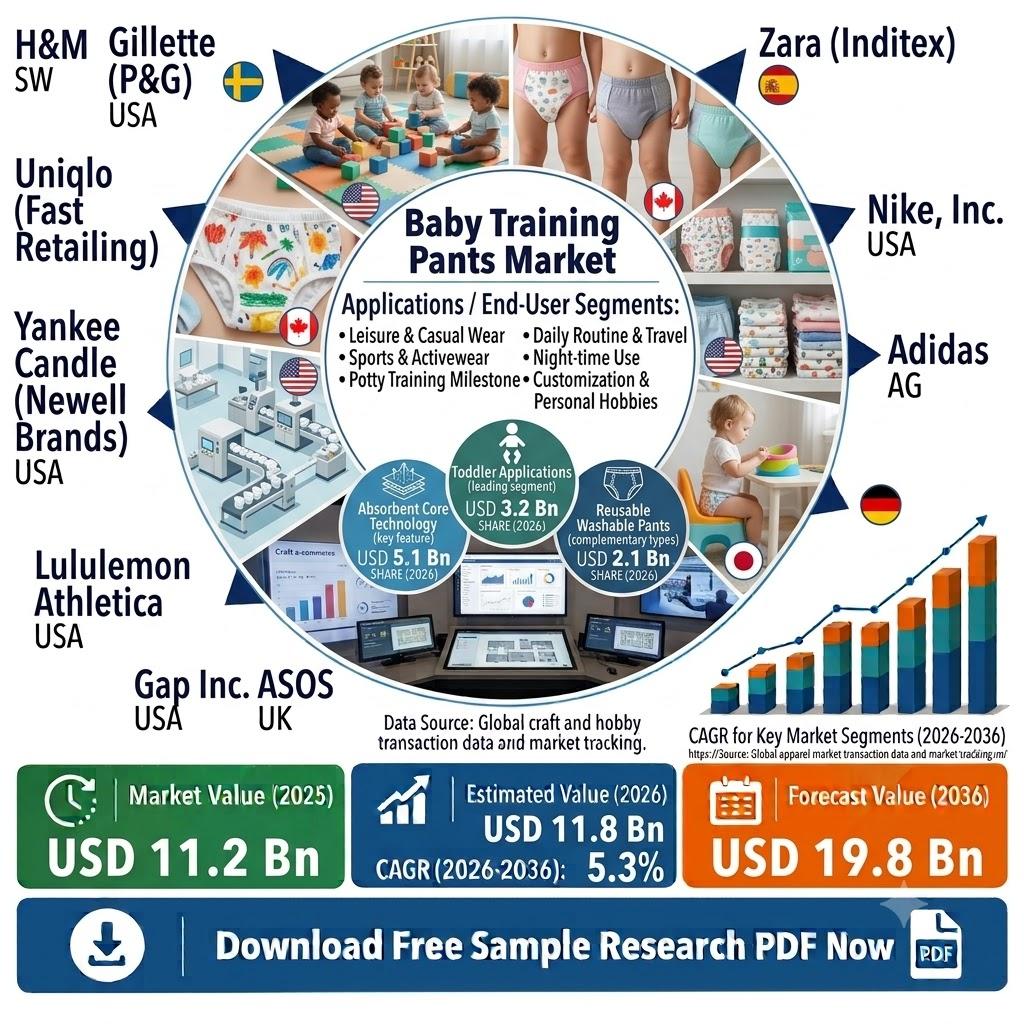
The global Baby Training Pants Market is projected to increase from USD 11.8 billion in 2026 to USD 19.8 billion by 2036, expanding at a 5.3% CAGR, according to FactMR. The market reached USD 11.2 billion in 2025, as parents, retailers, diaper brands and childcare buyers continued to purchase training pants based on household replenishment, fit requirements and channel availability.
The market is expected to create an absolute opportunity of USD 8.0 billion between 2026 and 2036. Demand is being supported by the use of training pants as a transition product between diapers and underwear, along with the availability of larger sizes and wider retail access.
Get Detailed Market Forecasts, Competitive Benchmarking, and Pricing Trends: https://www.factmr.com/connectus/sample?flag=S&rep_id=15733
Disposable Training Pants are expected to remain the leading product type, accounting for 57.0% share in 2026. Large (L) is projected to lead the size segment with 39.0% share, while Supermarkets & Hypermarkets are expected to account for 29.7% of distribution. Households are forecast to hold 40.2% share by end user, and Regular Absorbency is expected to represent 40.5% of the absorbency segment.
Disposable formats remain central to toilet training
Disposable Training Pants continue to serve as a practical bridge between diapers and underwear. Pull-up designs, leak protection and familiarity with disposable diaper products support their use during the toilet-training period.
For parents, the transition can involve frequent changes in product requirements. Children need products that stay in place during active movement while remaining easy to pull down. This makes fit and size guidance important purchasing considerations.
Large (L) is projected to hold the highest share among sizes in 2026. The segment is expected to benefit from demand among children during the heavier training period, when parents continue to need secure protection while introducing more independent bathroom routines.
Shambhu Nath Jha, Sr. Consultant at FactMR, states, "Parents are not buying a category label; they are buying fewer accidents, easier changes and a product that feels close enough to underwear. Brands that explain fit, absorbency and skin comfort clearly have a better chance of staying in the repeat basket."
Retail visibility supports purchasing decisions
Supermarkets and hypermarkets are projected to remain the leading distribution channel, with a 29.7% share in 2026. These outlets allow parents to compare brands, pack counts, absorbency claims and promotional pricing during routine household shopping.
Online retail, brand websites and e-commerce platforms provide additional access to training pants. These channels can support replenishment while allowing parents to compare product specifications and pack options.
For brands and retailers, clear product information can help explain the differences between daytime and overnight protection, absorbency levels and size ranges. Better fit and size labeling can also reduce confusion between diapers, training pants and underwear-style products.
Household purchases shape the replacement cycle
Households are expected to account for 40.2% share of the market in 2026. Most purchases are made for home use, even when daycare centers influence parents' product expectations.
The household purchasing cycle is closely connected to potty-training progress. Parents may use training pants during the uncertain middle stage before children move fully into underwear.
Daycare centers and childcare facilities form an additional end-user segment. Their requirements can influence expectations around fit, ease of changes and product performance.
Regular absorbency leads the absorbency segment
Regular Absorbency is expected to hold 40.5% share in 2026. The segment addresses daytime accidents without the added bulk associated with overnight products.
High Absorbency, Overnight Protection and Extra Absorbency products serve situations where longer protection is required. Eco-Friendly Absorbency options, including biodegradable core and plant-based material formats, form part of the wider market scope.
For suppliers, the opportunity is not limited to increasing absorbency. Product positioning also depends on fit, softness, skin comfort, ease of use and pack economics.
Private labels create pressure for branded products
The market faces competition from private-label products, particularly where shoppers see limited differences in fit or absorbency.
Price sensitivity can increase because training pants may be purchased alongside diapers during part of the toilet-training transition. Parents may also delay toilet training or move directly from diapers to underwear, affecting the duration of training-pants use.
Brands can respond by making product differences clearer. Fit guidance, absorbency information, softness and reliable availability can help suppliers distinguish their products from lower-priced alternatives.
Daytime and overnight bundles also represent an opportunity to help parents select products for different training situations without switching brands.
Country markets show varied growth
The USA is projected to record a 6.9% CAGR from 2026 to 2036, the highest listed rate among the countries covered. Large retail chains, online replenishment and established diaper-brand loyalty support repeat purchasing.
South Korea is forecast to grow at 5.7% CAGR, supported by premium baby-care purchasing, modern retail and brand awareness.
Canada is projected to expand at 5.3% CAGR, in line with the global market rate. Germany follows at 5.1%, while Australia is expected to grow at 4.9%.
The UK and Japan are projected to record 4.8% and 4.7% CAGR, respectively. Across these markets, potty-training habits, retail concentration, product availability and brand trust influence the adoption route.
Competitive landscape
The Baby Training Pants Market includes established hygiene and personal-care companies.
Procter & Gamble and Kimberly-Clark Corporation are among the visible providers, with Pampers and Pull-Ups respectively represented in the training-pants category. Unicharm Corporation and Essity AB are also among the key companies profiled.
The competitive landscape also includes Ontex Group, Attindas Hygiene Partners, Hengan International Group and First Quality Enterprises.
Competition through 2036 is expected to focus on fit, absorbency, softness, skin comfort, pack economics and retail availability. Suppliers will also need to consider private-label pressure when developing branded product programs.
Read the complete Baby Training Pants Market report: https://www.factmr.com/report/baby-training-pants-market
FactMR report examines the full market structure
The FactMR analysis covers the Baby Training Pants Market by Product Type, Size, Distribution Channel, End User and Absorbency Type.
Product coverage includes Disposable Training Pants, Daytime Training Pants, Overnight Training Pants, Reusable Training Pants, Cotton Training Pants and Waterproof Training Pants.
The study examines sizes from Small and Medium through Large and Extra Large, while distribution analysis includes supermarkets and hypermarkets, online retail, pharmacies, convenience stores, baby specialty stores and wholesale clubs.
End-user analysis covers households, working parents, daycare centers and healthcare facilities. Absorbency coverage includes regular, high, overnight, extra and eco-friendly options.
The report provides regional coverage across North America, Latin America, Europe, East Asia, South Asia and Oceania, and the Middle East and Africa. Country-level analysis covers South Korea, the USA, Canada, Germany, Australia, the UK and Japan.
Other Related Reports:
https://ourfathersfamily.com/blogs/148285/Ring-Displays-Market-Grows-at-4-7-CAGR-to-2036
About FactMR
FactMR is a market research and consulting firm providing market intelligence, market sizing, forecasting and strategic analysis across global industries. Its research combines primary research, desk research, market modelling and company analysis to support business planning and market assessment.

 English
 Arabic
 French
 Spanish
 Portuguese
 Turkish
 Dutch
Dutch
 Italiano
 Russian
 Romaian
 Portuguese (Brazil)
 Greek
Greek
