


 About Urh Social
 Terms of Service
 Privacy Policy
 Contact
10 Ways for Housewives to Practice English Speaking at Home in India (2026)
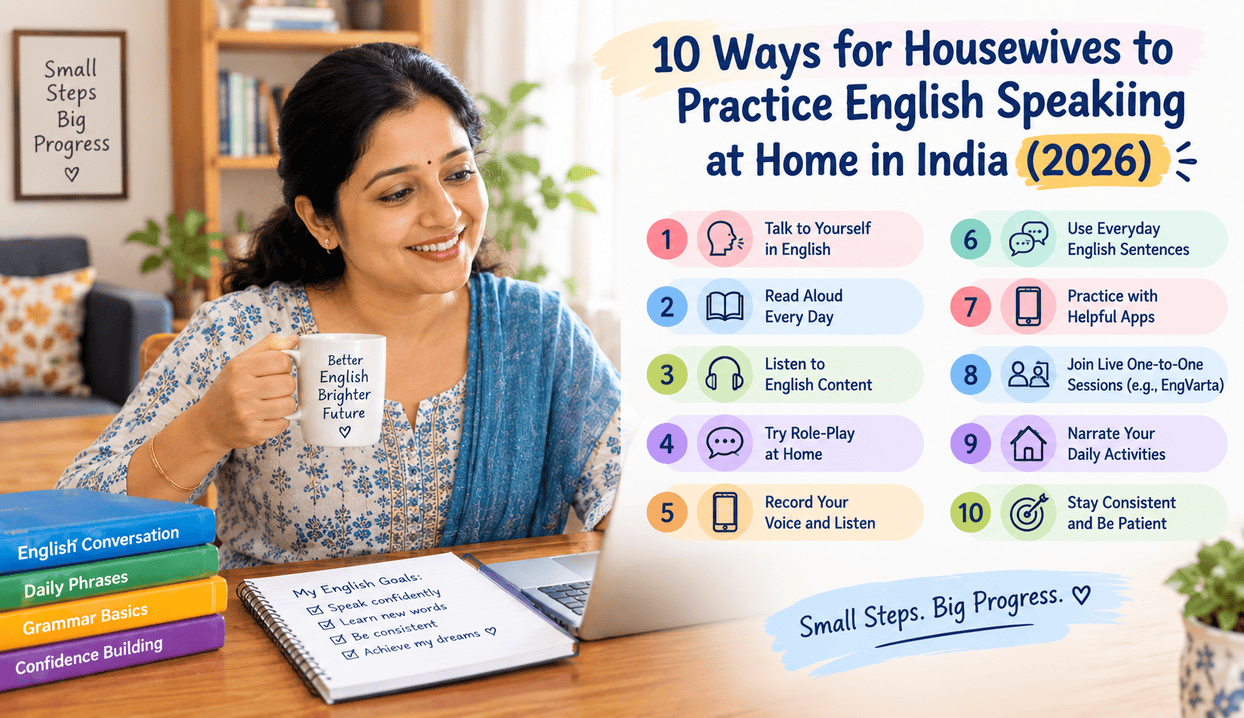
Many Indian housewives want to speak English confidently but may not have regular opportunities to use it. The easiest solution is to build daily English speaking practice at home through self-talk, reading aloud, listening, role-play, voice recording, and real conversations. For learners who want live interaction, platforms such as EngVarta can add one-to-one speaking practice with English Experts and real-time corrections.
The goal is not to speak perfect English from day one. It is to become comfortable expressing everyday thoughts without constantly translating from your first language.
Whether you want to speak English with your children, prepare for a job interview, communicate while travelling, or simply feel more confident in social situations, regular practice can make a meaningful difference.
Why Daily English Speaking Practice Matters for Housewives
Household responsibilities can make it difficult to attend fixed-timing classes. A flexible home routine removes much of that difficulty.
You can practise for 15 minutes while your children are at school, after finishing household work, during an afternoon break, or in the evening.
The important part is speaking, not simply consuming English content.
Watching an English video can improve listening. Reading can improve vocabulary. Grammar exercises can improve accuracy. But speaking requires you to actually form sentences and say them.
Here are 10 practical ways to make that happen.
1. Talk to Yourself in English During Everyday Activities
Self-talk is one of the simplest ways to start learn English speaking without needing another person.
You already describe many activities mentally. Instead of thinking about them only in your first language, try expressing them in simple English.
Why it works
Self-talk helps you practise sentence formation without the pressure of another person listening. It also encourages you to stop translating every sentence before speaking.
How to do it
Describe what you are doing:
-
“I am preparing breakfast.”
-
“I need to clean the kitchen.”
-
“My daughter will come home at four.”
-
“I need to buy vegetables this evening.”
Start with short sentences. Do not worry if your grammar is not perfect.
Daily example
While preparing lunch, explain the process aloud:
“First, I will chop the vegetables. Then I will prepare the curry. After that, I will make the rotis.”
Practical tip
Choose one household activity each day and speak about it for five minutes.
Mistake to avoid
Do not stop every few seconds to check grammar. The first objective is to develop the habit of speaking.
2. Describe Your Day in English
A daily routine gives you a ready-made source of topics for spoken English practice.
Instead of searching for complicated conversation topics, talk about what actually happened during your day.
Why it works
You repeatedly use useful vocabulary related to family, shopping, cooking, school, appointments, travel, work, and household responsibilities.
These are words you are likely to need in real conversations.
How to do it
At the end of each day, speak for five to ten minutes about your activities.
For example:
“I woke up at six today. I prepared breakfast for my family. My son had an exam, so I helped him revise before school.”
Then add your thoughts:
“I was worried about his exam, but he seemed prepared.”
Daily example
Pick three questions:
-
What did I do today?
-
What was difficult?
-
What will I do tomorrow?
Answer all three aloud in English.
Practical tip
Record yourself twice a week. You will notice repeated vocabulary and sentences that need improvement.
Mistake to avoid
Do not try to make every sentence sophisticated. Clear and natural English is more useful than complicated English.
3. Read English Aloud for 10–15 Minutes
Reading silently is useful, but reading aloud adds a speaking component.
You can use a newspaper article, children's story, recipe, magazine article, English-learning material, or a short online article.
Why it works
Reading aloud gives your mouth regular practice with English sentence structures. It can also support pronunciation, rhythm, and confidence.
How to do it
Choose a short passage that is slightly easier than your current level.
Read it slowly once.
Read it again with attention to pronunciation.
On the third reading, try to sound more natural rather than simply pronouncing every word separately.
Daily example
Take a recipe and read:
“Heat the pan and add two tablespoons of oil. Add the onions and cook until they become soft.”
Then close the page and explain the recipe in your own words.
Practical tip
Underline five unfamiliar words. Learn their meanings and use each one in your own sentence.
Mistake to avoid
Do not focus only on individual word pronunciation. English also depends on sentence stress, pauses, and connected speech.
4. Shadow English Videos and Audio
Shadowing means listening to an English speaker and repeating the words shortly after hearing them.
You can use interviews, short educational videos, podcasts, news clips, or English-learning videos.
Why it works
It combines listening and speaking. You hear natural pronunciation and then immediately try to reproduce the sounds and rhythm.
How to do it
Choose a 30–60 second clip.
Listen once without speaking.
Play it again and repeat sentence by sentence.
Finally, try speaking along with the speaker.
Do not choose content that is far above your level.
Daily example
If the speaker says:
“I usually start my day with a cup of tea.”
Pause and repeat it. Then change it:
“I usually start my day with a cup of coffee.”
This turns listening into active English conversation practice.
Practical tip
Use the same short clip for several days rather than changing material every few minutes.
Mistake to avoid
Do not try to copy the speaker at full speed immediately. Accuracy and clarity should come first.
5. Practise Common Real-Life Conversations
Many housewives understand English but hesitate when a real conversation starts.
Role-playing common situations can reduce that hesitation.
Why it works
You prepare language before you need it. This is particularly useful for conversations involving schools, doctors, shopping, travel, neighbours, customer service, or future employment.
How to do it
Choose one situation and play both roles.
For example, imagine speaking with your child's teacher:
Parent: “I wanted to ask about my daughter's progress.”
Teacher: “She is doing well, but she needs more practice with reading.”
Parent: “What can we do at home?”
Repeat the conversation several times, then change the questions.
Daily example
Practise one situation for five minutes each day:
-
Talking to a school teacher
-
Booking a hotel
-
Ordering food
-
Asking for directions
-
Speaking to a doctor
-
Introducing yourself in an interview
Practical tip
Write five useful sentences before starting, then try to speak without looking at them.
Mistake to avoid
Do not memorise complete conversations word-for-word. Learn flexible phrases that you can adapt.
6. Keep a Personal English Vocabulary Notebook
Vocabulary becomes more useful when you actively speak with it.
Instead of trying to memorise hundreds of random words, collect words and phrases that relate to your daily life.
Why it works
Personal vocabulary is easier to remember because you have a reason to use it.
For example, if you frequently discuss your child's school, words such as assignment, attendance, examination, progress, and feedback become immediately useful.
How to do it
Create four small sections:
-
New word
-
Simple meaning
-
Your sentence
-
Similar word or phrase
Suppose you learn “convenient.”
Your sentence could be:
“Online classes are convenient because I can attend them from home.”
Daily example
Learn five useful words each day and speak one sentence with each.
Practical tip
At the end of the week, select ten words and use them in a two-minute story.
Mistake to avoid
Do not collect vocabulary without using it. A word becomes much more valuable when you can retrieve it naturally while speaking.
7. Record Your Voice and Listen Back
Your phone can become a simple English-speaking practice tool.
Recording yourself may feel uncomfortable initially, but it provides information you cannot easily notice while speaking.
Why it works
You can hear repeated mistakes, long pauses, unclear pronunciation, unnecessary filler words, and sentences that sound unnatural.
How to do it
Choose a topic such as:
“My favourite family tradition.”
Speak for two minutes without stopping.
Listen to the recording.
Write down three things you want to improve.
Record the same topic again after a few days.
Daily example
Monday: “My daily routine.”
Wednesday: “My children's education.”
Friday: “A place I want to visit.”
Compare your recordings rather than expecting instant perfection.
Practical tip
Focus on one improvement at a time. For example, work on reducing pauses this week and pronunciation next week.
Mistake to avoid
Do not judge yourself harshly based on one recording. Use recordings as feedback, not as a test of your ability.
8. Use English While Speaking With Your Children
If you are a mother, your children can naturally create opportunities for English practice.
You do not need to turn every family interaction into an English lesson.
Start with small phrases.
Why it works
Family conversations happen every day, so they provide repeated opportunities to use the same expressions.
How to do it
Use simple English for familiar situations:
-
“Have you finished your homework?”
-
“Please keep your books on the table.”
-
“What did you learn today?”
-
“Did you enjoy your class?”
-
“What would you like for dinner?”
If you make a mistake, continue the conversation.
Daily example
Set an English-only period of 10 minutes after school.
Ask your child:
“How was your day?”
Then ask follow-up questions:
“What was the most interesting thing you learned?”
Practical tip
Choose a small group of phrases each week and use them repeatedly.
Mistake to avoid
Do not make your child feel like your English teacher. The purpose is to create a relaxed speaking environment.
9. Practise With a Real English Speaking Partner
Solo activities are valuable, but there is a point where you need another person to respond.
A real conversation forces you to listen, think, respond, clarify, and continue speaking.
Why it works
Real-time interaction exposes problems that self-practice cannot always reveal. You may know grammar rules but still struggle to use them quickly during a conversation.
This is where an English speaking app such as EngVarta can be useful. EngVarta currently offers private audio sessions with trained English Experts, with real-time corrections during conversations. Its sessions are available in 15-, 25-, and 50-minute formats, with availability listed from 7 AM to midnight IST.
How to do it
Set a small daily goal.
For example:
“Today I will speak about my morning routine for five minutes.”
Then move to more challenging subjects such as travel, education, work, or interviews.
Daily example
A 15-minute session can focus on:
-
Five minutes of everyday conversation
-
Five minutes of topic discussion
-
Five minutes of corrections and feedback
Practical tip
Ask your speaking partner to correct recurring grammar, pronunciation, and vocabulary problems.
Mistake to avoid
Do not spend the entire session asking grammar questions. Reserve enough time for actual speaking.
10. Build a 20-Minute English Routine You Can Maintain
The final step is consistency.
You do not need a three-hour study schedule. A short routine that you actually follow is more practical for many busy homemakers.
Why it works
A fixed routine reduces the need to decide what to study every day.
How to do it
Try this simple schedule:
5 minutes — Listening:
Listen to a short English clip.
5 minutes — Speaking:
Describe your day or discuss a topic.
5 minutes — Vocabulary:
Learn and use three to five useful expressions.
5 minutes — Conversation:
Speak with a partner or use a live one-to-one English practice session.
If you use EngVarta, you can adjust the speaking session length to fit your routine; its current plans list 15-, 25-, and 50-minute sessions and flexible completion options.
Daily example
After finishing household work, put your phone on silent, spend five minutes listening, then speak for five minutes and finish with a short live conversation.
Practical tip
Choose a realistic time. Morning, afternoon, or evening is fine—the important thing is repetition.
Mistake to avoid
Do not create an ambitious timetable that becomes difficult to maintain after three days.
How EngVarta Can Fit Into an English Practice Routine
For housewives who can practise alone but want regular human interaction, a live platform can fill an important gap.
EngVarta describes its service as one-to-one English speaking practice with English Experts rather than automated conversation. According to its current information, learners can connect through private audio sessions, receive grammar, vocabulary, and sentence-framing corrections during conversations, and review session recordings for up to 30 days.
That can be useful when your main problem is not understanding English but speaking English when someone is actually listening.
For example, you might practise vocabulary and self-talk at home during the week and use live sessions to test those skills in real conversation.
The platform also lists flexible availability from 7 AM to midnight IST, which may suit women whose free time changes according to household responsibilities.
This makes a live English speaking course different from simply watching recorded lessons: you have to formulate and express your own responses.
How to Choose an English Speaking Course as a Homemaker
When searching for the Best Online English Speaking Course in India, avoid choosing only because of advertising claims.
Ask practical questions instead:
-
Will I actually speak during each session?
-
Can I practise at a convenient time?
-
Is there individual feedback?
-
Can someone correct my pronunciation?
-
Can I practise everyday conversations?
-
Is the course suitable for my current level?
-
Can I practise from home?
-
Does the format fit my budget and schedule?
The Best Online Spoken English Classes for one learner may not be the same for another.
A woman preparing for interviews may need role-play. Someone preparing for travel may need conversational phrases. A mother helping children with schoolwork may want everyday vocabulary and confidence.
The right format depends on the goal.
Can You Improve Spoken English Without Joining an Institute?
Yes. You can build substantial speaking practice at home through self-talk, reading aloud, shadowing, recording, role-play, and regular conversation.
However, independent practice has one obvious limitation: you may not know which mistakes you are making.
That is why feedback matters.
A combination of independent practice and live conversation can be more complete than relying on either method alone. Your home routine creates frequency, while a speaking partner provides interaction and correction.
This approach also lets women learners practise without travelling to a physical institute.
Start Building Your English Speaking Habit Today
You do not need to wait until your grammar is perfect before you start speaking English.
Begin with five minutes of self-talk today. Read one short paragraph aloud. Record yourself. Learn three useful phrases. Then, when you are ready for real interaction, practise with another person and ask for feedback.
For Indian housewives, online English learning can be particularly practical because speaking practice can happen from home without adding a daily commute.
If you want structured human interaction, you can explore EngVarta for live one-to-one English speaking sessions with English Experts, real-time corrections, and flexible session options.
People Also Ask
Can housewives learn spoken English at home?
Yes. Housewives can develop spoken English at home by practising daily through self-talk, reading aloud, listening, shadowing, role-play, recordings, and real conversations. The key is regular speaking rather than only studying grammar.
Which is the best English speaking app in India?
There is no single app that is ideal for every learner. Compare apps based on live conversation opportunities, feedback, flexibility, level, teaching format, and your specific goal. EngVarta is one option for learners seeking live one-to-one conversations with English Experts.
How can I practise English speaking daily?
Set aside 15–20 minutes and divide the time between listening, speaking, vocabulary, and conversation. You can describe your day, read aloud, record your voice, or practise with a live speaking partner.
Is EngVarta good for beginners?
EngVarta's current website says its live speaking practice is available for all levels, while its English speaking course page notes that learners should have enough basic English comprehension to participate in conversations.
Can I improve my English without joining an institute?
Yes. You can practise English at home without attending a physical institute. Self-practice can cover vocabulary, listening, pronunciation, and sentence formation, while live online practice can provide interaction and feedback.
How long does it take to become fluent?
There is no fixed timeline that applies to everyone. Progress depends on your starting level, practice frequency, speaking opportunities, vocabulary, listening exposure, and ability to use feedback. Consistent daily practice is more useful than expecting a specific number of days.
Which English speaking course is best for housewives?
Look for a course that matches your schedule and learning objective. Flexible online formats can be convenient for homemakers because they eliminate commuting and may allow practice around household responsibilities.
What is the easiest way to practise English conversation?
Start with familiar subjects. Talk about your family, daily routine, shopping, cooking, children's education, travel, or hobbies. Once you become comfortable, move toward interviews, workplace conversations, and unfamiliar topics.
How can I improve my English pronunciation at home?
Listen carefully to native or proficient speakers, repeat short sentences, record yourself, and compare your pronunciation. Focus on sounds and sentence rhythm rather than trying to change everything at once.
Can I learn English while managing household responsibilities?
Yes. Short practice sessions can be fitted around existing routines. Ten to twenty minutes of focused practice is easier to maintain than an unrealistic schedule requiring several hours every day.

 English
 Arabic
 French
 Spanish
 Portuguese
 Deutsch
 Turkish
 Dutch
Dutch
 Russian
 Romaian
 Portuguese (Brazil)
 Greek
Greek
