


 About Urh Social
 Terms of Service
 Privacy Policy
 Contact
AI in Gaming Market Worth USD 185,058.9 Mn by 2036: USA Grows at 35.4% CAGR, Software Holds 51.8%
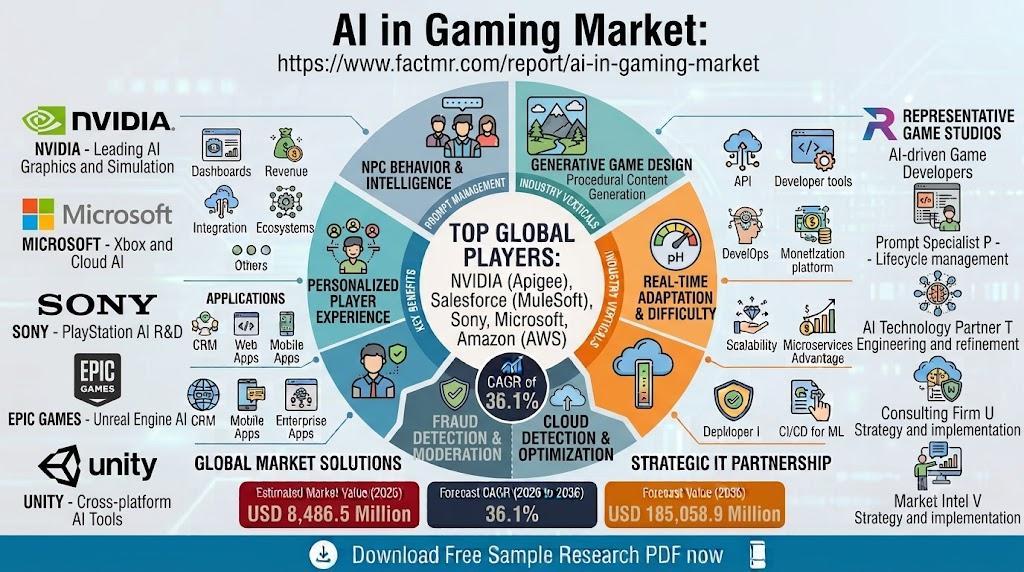
The global AI in Gaming Market is entering a phase where AI is moving beyond standalone content-generation tools and into core game-development workflows. Fact.MR estimates the market at USD 8,486.5 million in 2026, up from USD 6,235.5 million in 2025. Demand is projected to reach USD 185,058.9 million by 2036, representing an absolute opportunity of USD 176,572.4 million.
Game studios are using AI to shorten coding cycles, automate repetitive editor tasks, support quality assurance, generate assets, and power player-facing systems. The commercial requirement is increasingly tied to how well these tools fit existing engines, protect project data, and maintain predictable performance.
Get Detailed Market Forecasts, Competitive Benchmarking, and Pricing Trends: https://www.factmr.com/connectus/sample?flag=S&rep_id=15512
Software leads as studios integrate AI directly into development environments
Software is projected to hold 51.8% share in 2026, making it the largest component segment. Demand is supported by AI assistants and runtime models that operate within coding, testing, and game-production environments.
Services remain relevant when studios require customized integrations or need to connect protected assets with AI systems. API Tools support modular model access, including applications where developers need to switch models without replacing the surrounding production environment.
NVIDIA reported in March 2025 that DLSS 4 supported more than 100 games and applications. This illustrates how AI features can spread across gaming ecosystems when they integrate with existing developer and graphics workflows.
Cloud deployment gains ground as AI workloads fluctuate
Cloud deployment is expected to account for 41.4% share in 2026. Game studios can use cloud infrastructure when AI processing requirements rise temporarily during development, testing, or model experimentation.
On-premise deployment continues to serve projects where source code, game assets, or other sensitive information must remain inside controlled studio networks. Hybrid systems provide another route by combining protected internal data with external model capacity.
EuroHPC reported 19 AI Factories serving SMEs and startups across its network in December 2025. Broader access to shared infrastructure can reduce the initial hardware requirement for smaller development teams evaluating AI tools.
SMEs represent a major customer base
SMEs are anticipated to account for 45.0% share in 2026. Smaller studios can adopt focused coding, testing, or content tools without building dedicated AI infrastructure or large internal model teams.
For providers, onboarding and usage-based pricing remain important factors in converting smaller studios into recurring users. The UK Games Fund evaluation published in July 2025 estimated that its current program would contribute around 430 additional full-time jobs to the video games sector, highlighting continued activity among development businesses.
Workflow automation remains the largest application segment
Workflow Automation is estimated to represent 49.1% share in 2026. Developers are applying AI to coding, testing, editor operations, and other repetitive production tasks.
The commercial value depends on measurable improvements rather than AI availability alone. Studio leaders are increasingly assessing tools against build stability, revision time, testing coverage, and integration requirements.
Shambhu Nath Jha, Senior Analyst at Fact.MR, states, “The commercial bottleneck is not access to another model. Adoption is expected to favor tools that understand engine context and protect project data across active production pipelines. Providers should combine workflow integration and measurable response speed with clear controls over content rights and project data.”
Engine-aware AI is changing procurement priorities
Unity Technologies announced the Unity AI Gateway in November 2025, creating an officially supported route for verified third-party agents to work with Unity Editor scene and asset context.
The development reflects a wider shift toward AI systems that can understand project environments rather than operate as isolated generators. For studios, engine compatibility, asset access controls, and project-data policies are becoming part of technology evaluation.
AI-based game testing is another expanding use case. QA teams can use automated agents to repeat paths across large environments and expose failures that may be difficult to reproduce manually. Epic Games included game-playing NPCs and automated QA testing in its Unreal Fest session collection published in March 2025.
Real-time dialogue creates a new runtime requirement
Character dialogue is moving from fixed dialogue trees toward systems that can respond dynamically during gameplay. Inworld AI introduced an Unreal runtime toolkit in October 2025 with templates for conversational NPCs and response controls.
The opportunity is closely tied to response time, moderation, and session cost. Player-facing AI must deliver useful responses without interrupting gameplay or creating uncontrolled interactions.
Local-language voice systems also create opportunities for broader game localization. In May 2026, Inworld AI introduced Realtime TTS-2 with one voice identity across more than 100 languages.
India records the fastest country-level CAGR
India is projected to record a 37.9% CAGR between 2026 and 2036. Expanding developer activity and shared compute access are supporting opportunities for studios to test AI-enabled production tools.
China follows with a projected 37.2% CAGR, supported by established game and AI company clusters. Shanghai's Xuhui District reported that 2024 game revenue exceeded USD 9.92 billion.
Australia is expected to register a 35.9% CAGR, supported by production incentives and export-oriented studio activity. The Australian Taxation Office confirmed a 30% refundable offset for qualifying Australian game-development expenditure in November 2025.
The United Kingdom is projected to expand at 35.6% CAGR, while the United States is expected to record 35.4% CAGR through 2036. Both markets benefit from established game-development ecosystems and growing commercial AI deployment.
IP controls and runtime economics remain key constraints
AI adoption in gaming faces practical barriers. Intellectual-property and training-data uncertainty can increase legal and procurement review when generated code or assets enter commercial projects.
Runtime compute cost is another consideration. Player-facing systems require rapid responses at potentially high concurrency, making model selection and infrastructure economics different from offline asset generation.
Player trust and disclosure also matter as AI enters dialogue, coaching, and social gaming environments. Ofcom reported in May 2026 that 64% of parents of gaming children were concerned about contact with strangers in games or chat.
Production teams also need stable behavior across engine and model updates. Changes in models can create additional validation work when prompts, outputs, or runtime behavior shift.
Competitive landscape
The AI in Gaming Market includes technology companies spanning graphics, engines, gaming platforms, development tools, and AI research.
Key companies profiled by Fact.MR include:
- NVIDIA
- Microsoft (Xbox and Azure)
- Unity Technologies
- Epic Games
- Electronic Arts
- Ubisoft
- Google DeepMind
NVIDIA focuses on AI-enabled graphics and neural rendering. Unity Technologies is developing project-aware AI capabilities within the Editor, while Epic Games continues to connect AI with Unreal Engine and creator workflows.
Microsoft combines Xbox services with developer-facing gaming AI resources and Azure capabilities. Electronic Arts expanded its AI development work through a 2025 partnership with Stability AI. Ubisoft is testing generative player interaction through Teammates, while Google DeepMind continues development of game-playing agents for interactive 3D environments.
Read the complete analysis: https://www.factmr.com/report/ai-in-gaming-market
Report scope and methodology
The Fact.MR AI in Gaming Market study covers AI software, models, developer tools, and services used to automate game-production tasks or operate AI functions inside commercial games and gaming platforms.
The analysis covers:
- Component: Software, Services, API Tools
- Deployment: Cloud, On-premise, Hybrid
- Organization Size: SMEs, Large Enterprises, Public Sector Buyers
- Application: Workflow Automation, Analytics, Governance
- End Use: BFSI, Retail, Manufacturing, IT
- Regions: North America, Europe, Asia Pacific, Latin America, Middle East and Africa
The study uses a hybrid top-down and bottom-up approach covering developer activity, engine ecosystem reach, paid AI-tool adoption, deployment mix, production-cycle adoption, response speed, compute requirements, and provider validation.
Fact.MR's research combines 120+ sources, 40+ company portfolios, 25+ countries, and 20+ interviews with developers, publishers, AI providers, studio technology leaders, infrastructure specialists, designers, analytics teams, cloud gaming providers, and other industry participants.
Other Related Reports:
Other Related Reports:
https://blog.factmr.com/inulin-fos-pectin-blends-market/
https://blog.factmr.com/graphene-coated-cathode-materials-market/
About Fact.MR
Fact.MR is a market research and consulting firm providing industry intelligence, market sizing, competitive analysis, and strategic insights across technology, industrial, automotive, healthcare, chemicals, food, and other sectors. Its research combines primary interviews, secondary research, company analysis, and market modeling to support business planning and investment decisions.

 English
 Arabic
 French
 Portuguese
 Deutsch
 Turkish
 Dutch
Dutch
 Italiano
 Russian
 Romaian
 Portuguese (Brazil)
 Greek
Greek
