


 About Urh Social
 Terms of Service
 Privacy Policy
 Contact
Artificial Intelligence Prompt Marketplace Market Grows at 25.9% CAGR to 2036: USA Advances at 25.2%, Workflow Automation Leads at 36.6%
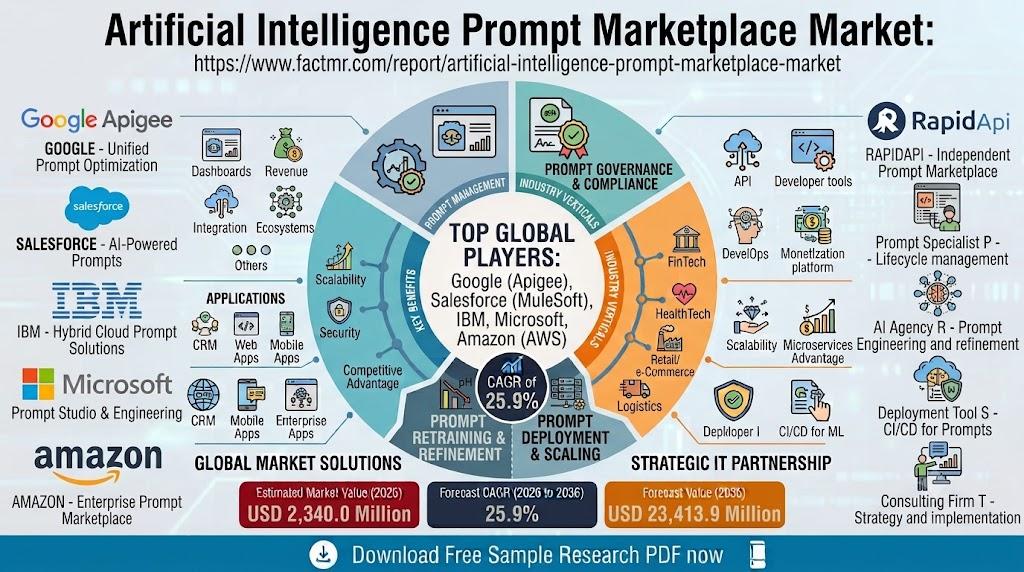
The global Artificial Intelligence Prompt Marketplace Market is projected to increase from USD 2,340.0 million in 2026 to USD 23,413.9 million by 2036, advancing at a 25.9% CAGR, according to Fact.MR. The market crossed a valuation of USD 1,858.6 million in 2025.
The market is expected to create an absolute opportunity of USD 21,073.9 million between 2026 and 2036. Growth is being shaped by enterprise adoption of reusable AI instructions, creator monetization, multi-model workflows, and the need to standardize prompt assets before they enter recurring business processes.
Get Detailed Market Forecasts, Competitive Benchmarking, and Pricing Trends: https://www.factmr.com/connectus/sample?flag=S&rep_id=15520
Prompt marketplaces are moving beyond collections of one-off text instructions. Increasingly, they support version control, compatibility information, workflow integration, and agent-oriented assets that can be reused across business applications.
Enterprise Teams Shift from Prompt Experimentation to Repeatable Assets
Businesses are using generative AI across content, analysis, customer support, coding, documentation, and administrative processes. As usage becomes recurring, teams need prompts that can be tested, maintained, and assigned to defined workflows.
Model changes create a practical challenge. An instruction that produces reliable results on one model version may behave differently after an update. Marketplace operators therefore face growing demand for prompt assets with version history, expected outputs, compatibility notes, and reproducibility checks.
Enterprise users also need approved prompt libraries. Compliance teams can use controlled catalogs to define which instructions may be reused in customer-facing or regulated processes. API-ready prompt templates are gaining relevance as reusable instructions move into applications and automated workflows.
Shambhu Nath Jha, Senior Analyst at Fact.MR, states, “Prompt marketplaces draw attention because a prompt loses commercial value quickly after model behavior changes. Adoption is expected to favor platforms that test prompts across versions and show enterprise accounts where each asset works. The stronger commercial offer combines version control with workflow integration and gives users a clearer route from purchase to repeat use.”
Software and Cloud Form the Core Market Structure
Software is projected to account for 36.4% share in 2026, supported by packaged prompt libraries, search capabilities, validation functions, and workflow controls.
Services remain relevant for enterprise teams that need prompt testing, catalog design, and integration support. API Tools allow developers to test reusable instructions within applications, while API and Connectors help move approved assets into managed workflows.
Cloud deployment is estimated to hold 50.1% share in 2026. Browser-based access and multi-model catalog delivery make cloud platforms accessible to distributed creator and enterprise accounts.
On-premises deployments remain relevant where organizations require tighter control over prompt libraries and sensitive workflow data. Hybrid environments allow approved prompt assets to remain inside internal systems while selected workflows connect to external AI models.
Eurostat reported in December 2025 that 20.0% of EU enterprises used AI technologies during 2025. As the enterprise AI user base expands, the addressable market for managed prompt access and shared catalogs also increases.
SMEs are forecast to represent 51.3% share in 2026. Lower entry barriers allow smaller teams to access reusable instructions without developing every prompt internally. OECD survey evidence published in November 2025 found generative AI in use across 30.7% of surveyed SMEs, supporting the expansion of packaged prompt products.
Workflow Automation is projected to account for 36.6% share in 2026. Reusable prompt execution is becoming part of recurring agent and business workflows rather than remaining limited to individual chat sessions.
BFSI represents 32.0% share in 2026, reflecting document-heavy operations and stronger governance requirements around reusable instructions.
Agent Skills Expand the Commercial Role of Prompt Marketplaces
Prompt commerce is increasingly extending into agent-oriented products. PromptBase added an Agent Skills category in May 2026, alongside dedicated ChatGPT Skill and Claude Skill sections. Cursor Skill and OpenClaw Skill categories further broadened the range of reusable assets available through its marketplace.
This development points toward a broader product category in which creators package operating instructions rather than individual prompts. Agent skills can define recurring tasks, tool interactions, variables, and expected behavior.
Enterprise marketplaces may increasingly separate public discovery from controlled internal catalogs. Private libraries can help organizations distinguish approved instructions from experimental assets and maintain ownership records for prompts used in important workflows.
Vertical prompt packs also represent an opportunity in regulated industries. Financial institutions, healthcare organizations, and government teams can require instructions designed for narrow tasks with documented usage boundaries and review procedures.
Prompt Commoditization Remains a Market Constraint
The same AI systems that increase prompt usage can also make basic prompts easier to create. Model-native prompt assistance may reduce willingness to pay for generic instructions that offer little testing or workflow context.
Intellectual-property uncertainty is another consideration. Prompt assets can be copied and redistributed easily, making licensing and creator ownership difficult to establish across open marketplaces.
Model drift creates an additional maintenance requirement. Changes in model behavior can reduce the performance of previously successful prompts, increasing the need for retesting and compatibility information.
Security also matters as prompts move into agent workflows. Instructions copied into automated systems may introduce undesirable behavior or create additional review requirements. Buyers in BFSI and government applications are therefore likely to place greater emphasis on validation and approval controls.
India and China Record the Highest Country-Level Growth
India is projected to register a 27.7% CAGR through 2036. Shared compute access and multilingual workflow demand are supporting the market outlook. IndiaAI announced in January 2025 the availability of more than 18,000 affordable AI compute units for eligible ecosystem participants.
China follows with a projected 27.0% CAGR. The country's broad generative AI user base and domestic model ecosystem are creating opportunities for prompt discovery and reuse.
Other country-level forecasts include:
- Australia: 25.7% CAGR
- United Kingdom: 25.4% CAGR
- United States: 25.2% CAGR
- Germany: 24.9% CAGR
- Japan: 24.6% CAGR
The United Kingdom's opportunity is supported by expanding business AI adoption. The Office for National Statistics reported in July 2026 that 29% of UK businesses used at least one AI technology during June 2026.
In the United States, enterprise AI adoption provides a large potential user base for prompt catalogs designed around departmental workflows. U.S. Census Bureau reporting in May 2026 placed overall business AI usage between 17% and 20% from December 2025 through early May 2026.
Competitive Landscape Focuses on Prompt Discovery and Reuse
The competitive set includes PromptBase, OpenAI (GPT Store), Anthropic, Hugging Face, PromptHero, and Snack Prompt.
PromptBase focuses directly on prompt commerce, creator tools, and reusable prompt and skill listings. OpenAI provides creator discovery through the GPT Store, while Anthropic offers prompt-generation capabilities and reusable templates through its ecosystem.
Hugging Face supports open AI communities through shared Spaces and model resources. PromptHero provides searchable prompt discovery for image and video generation models, while Snack Prompt combines community prompt discovery with workflow and automation listings.
Competition is increasingly linked to the quality and maintenance of marketplace assets. Version history, model compatibility, creator tools, workflow integration, and enterprise controls can influence how reusable prompts retain value as AI models change.
Read the complete Artificial Intelligence Prompt Marketplace Market analysis and forecast: https://www.factmr.com/report/artificial-intelligence-prompt-marketplace-market
Report Scope
The Artificial Intelligence Prompt Marketplace Market covers commercial platforms and managed libraries that distribute, sell, license, or manage reusable AI prompts and agent instructions.
The analysis covers Software, Services, API Tools, and API and Connectors across Cloud, On-premises, and Hybrid deployments. Organization-size analysis includes SMEs, Large Enterprises, and Public Sector Buyers.
Applications covered include Workflow Automation, Analytics, Governance, and Integration. End-use analysis includes BFSI, Retail, Manufacturing, IT, and Government across North America, Europe, Asia Pacific, Latin America, and the Middle East & Africa.
The study uses a hybrid top-down and bottom-up approach based on creator listings, marketplace transactions, subscription catalog adoption, workflow attachment rates, enterprise AI uptake, creator supply, model coverage, governance requirements, and provider validation. The research draws on 130+ sources, 45+ company portfolios, 30+ countries, and 25+ interviews.
Other Related Reports:
https://blog.factmr.com/inulin-fos-pectin-blends-market/
https://blog.factmr.com/graphene-coated-cathode-materials-market/
About Fact.MR
Fact.MR is a global market research and consulting firm providing syndicated research, custom studies, market intelligence, and strategic analysis across technology, industrial, healthcare, chemicals, food, and other business sectors. Its research combines primary interviews, secondary research, market modeling, and company-level analysis to support business planning and investment decisions.

 English
 Arabic
 French
 Spanish
 Portuguese
 Deutsch
 Turkish
 Dutch
Dutch
 Russian
 Romaian
 Portuguese (Brazil)
 Greek
Greek
