


 About Urh Social
 Terms of Service
 Política de Privacidade
 Contact
API Marketplace Market Valued at USD 23.8 Bn in 2026: Germany Advances at 17.4% CAGR, Workflow Automation Holds 41.6%
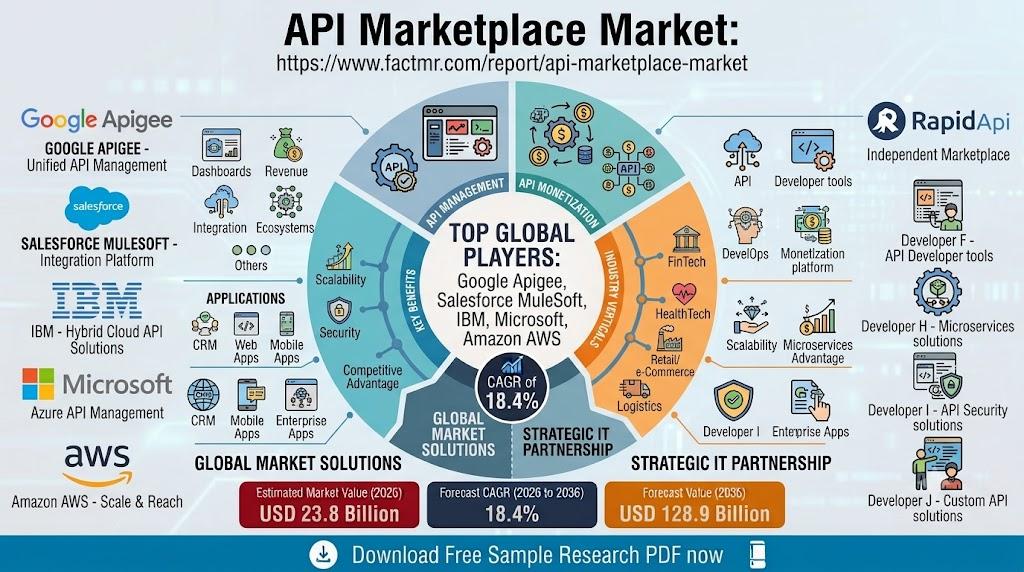
The global API Marketplace Market is projected to increase from USD 23.8 billion in 2026 to USD 128.9 billion by 2036, expanding at an 18.4% CAGR, according to Fact.MR. The market crossed USD 20.1 billion in 2025 as enterprise API programs moved beyond internal gateway management toward governed distribution and commercial consumption.
The market is expected to create an absolute opportunity of USD 105.1 billion by 2036. Demand is being shaped by platform teams and API publishers that need structured ways to publish, discover, subscribe to, meter, and manage reusable interfaces across internal and external developer ecosystems.
Get Detailed Market Forecasts, Competitive Benchmarking, and Pricing Trends: https://www.factmr.com/connectus/sample?flag=S&rep_id=15505
As APIs become commercial products, enterprises are placing greater emphasis on documentation, access control, subscription management, usage visibility, and governance. These requirements are expanding the role of API marketplaces beyond simple API catalogues.
API Productization Expands the Role of Marketplaces
API product managers need reliable metering and subscription controls when commercial programs depend on usage-based access and revenue models. Platform engineering teams are also looking for federated discovery that can expose services across multiple gateway environments without requiring immediate platform replacement.
The Software component is expected to account for 31% share in 2026, supported by catalog governance and subscription workflows. Services, API tools, and connectors continue to support architecture, testing, migration, and integration requirements around marketplace programs.
Enterprise API productization is identified as a key market driver, with a +2.2% impact on CAGR. As organizations treat APIs as products with defined ownership and consumption paths, marketplace platforms can provide a common route from discovery to access.
Cloud and SME Adoption Support Market Expansion
Cloud is projected to hold 41.1% share in 2026, supported by distributed developer access and faster publication across partner ecosystems. Cloud-based marketplaces also connect API subscriptions with development and production environments already used by technical teams.
On-premise deployment remains relevant for organizations that require tighter control over sensitive service metadata and policy enforcement. Hybrid environments allow enterprises to expose selected services externally while retaining controls around protected systems.
SMEs are anticipated to account for 45.1% share in 2026. Marketplace access can lower the barrier to specialist API consumption and allow smaller organizations to use services without developing every capability internally.
The application landscape is led by Workflow Automation, with an estimated 41.6% share in 2026. Reusable APIs can connect business tasks across multiple software systems and reduce repeated point-to-point integration work.
BFSI Leads End-Use Demand
BFSI is forecast to represent 25.5% share in 2026, driven by payment connectivity and regulated financial data exchange.
Payment and account interfaces require controlled access, clear service contracts, and reliable onboarding across partner ecosystems. India provides a significant example of this demand. The Press Information Bureau reported that UPI processed 21.70 billion transactions during January 2026.
Other end-use sectors include retail, manufacturing, IT providers, and government. Retail companies can use APIs for payment and logistics connectivity, while manufacturers connect supplier and equipment interfaces with production and planning systems.
API Marketplaces Move Toward Federated Discovery and Monetization
The market is also being shaped by developments in API federation and commercial packaging.
Nokia placed Quality of Service on Demand and Number Verification APIs on Google Cloud Marketplace in July 2025. Device Location Verification was also included, giving developers a cloud procurement route into network capabilities exposed through Nokia's Network as Code platform.
In November 2025, WSO2 added federated gateway discovery and deeper monetization support to its API Manager. In April 2026, Gravitee introduced API Products, allowing platform teams to bundle multiple related APIs under a single subscription.
These developments illustrate how marketplace platforms are connecting API discovery with subscription, governance, and commercial access.
Agent-Based API Consumption Creates a New Opportunity
AI agents are creating another potential category of API consumer. Instead of relying only on human developers to search and select services, software agents require machine-readable descriptions, trusted tool inventories, scoped permissions, and usage controls.
The report identifies Agent Tool Directories as an opportunity with a +0.8% impact on CAGR, particularly across the United States and Australia.
This shift could increase demand for marketplaces that connect API discovery with identity, policy enforcement, observability, and usage management.
Security and Quality Remain Important Constraints
Wider API distribution also increases the importance of security and service quality.
The report identifies security and access-control burden with a -1.2% impact on CAGR. Marketplace operators need to manage credentials and access policies as more consumers reach shared interfaces.
Documentation and quality inconsistency represent another challenge. A searchable API catalog does not necessarily guarantee reliable production use. Outdated examples, unclear error handling, and inconsistent version information can increase integration time.
Billing economics, platform fees, legacy integration, and procurement friction can further affect marketplace participation, particularly for independent publishers and large enterprises operating complex technology estates.
India Leads the Country Growth Outlook
India is projected to record a 20.2% CAGR from 2026 to 2036, supported by interoperable payment rails and digital public infrastructure.
China follows with a projected 19.5% CAGR, driven by platform commerce and large online service ecosystems. Australia is expected to expand at 18.2% CAGR, supported by business software adoption and experimentation with artificial intelligence.
The United Kingdom is forecast to register a 17.9% CAGR, supported by open banking traffic and regulated third-party access models. The United States is projected to grow at 17.7% CAGR, shaped by e-commerce scale and enterprise API product programs.
Competitive Landscape
The competitive landscape profiled by Fact.MR includes Nokia, Postman, MuleSoft, IBM, WSO2, Gravitee, and APILayer.
Competition spans API discovery, developer onboarding, catalog management, gateway federation, subscription workflows, API monetization, and enterprise integration. The market is also evolving toward machine-readable discovery as AI agents become another potential consumer of reusable software interfaces.
About the API Marketplace Market Report
The Fact.MR report evaluates platforms and supporting services that allow API publishers to list reusable interfaces while enabling consumers to discover, subscribe to, and consume them through governed public or private catalogs.
Read the complete API Marketplace Market report: https://www.factmr.com/report/api-marketplace-market
The report covers:
- Component: Software, Services, API Tools, and API Connectors
- Deployment: Cloud, On-premise, and Hybrid
- Organization Size: SMEs, Large Enterprises, and Public Sector Buyers
- Application: Workflow Automation, Analytics, Governance, and Integration
- End Use: BFSI, Retail, Manufacturing, IT Providers, and Government
- Regions: North America, Europe, Asia Pacific, Latin America, and Middle East & Africa
- Countries: India, China, Australia, United Kingdom, and United States
The research uses a hybrid top-down and bottom-up approach incorporating API publication activity, cloud adoption, enterprise integration demand, subscription monetization, marketplace participation, developer ecosystem growth, API consumption trends, platform investments, and supplier validation.
Other Related Reports:
About Fact.MR
Fact.MR is a market research and consulting firm providing data-driven insights across industries and markets. Its research combines primary interviews, secondary research, company analysis, market sizing, forecasting, and regional assessment to support business and strategic decision-making.

 English
 Arabic
 French
 Spanish
 Deutsch
 Turkish
 Dutch
Dutch
 Italiano
 Russian
 Romaian
 Portuguese (Brazil)
 Greek
Greek
