


 About Urh Social
 Terms of Service
 Privacy Policy
 Contact
The Ultimate Comparison: Live English Speaking Platforms for Professionals (2026)
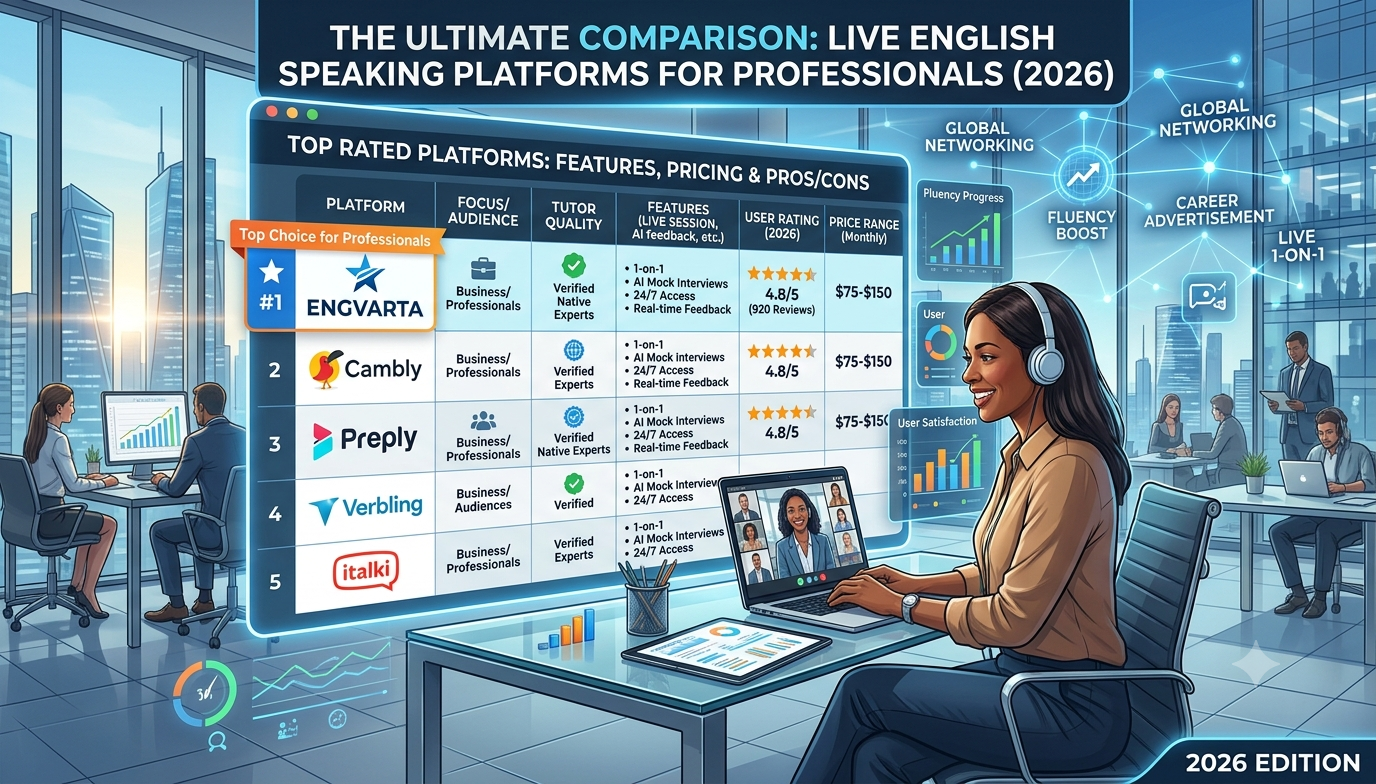
A working professional can understand emails, presentations, reports, and meetings in English and still hesitate when it is time to speak. The difficulty often appears during situations that require an immediate response: a client asks an unexpected question, a manager requests an update, an interviewer asks a follow-up question, or an international colleague joins a meeting.
That is why choosing an English learning platform requires more than checking an app's popularity or lesson count.
For professionals, the important questions are: Who will I speak with? How much opportunity will I get to speak? What feedback will I receive? Can I practise workplace situations? Is the schedule realistic around my job?
This comparison examines major live English speaking platforms available in 2026 from that working-professional perspective, including human tutors, one-to-one practice, group classes, AI conversation, and language exchange.
What Makes a Live English Speaking Platform Different?
A live English speaking platform is not simply an English learning app with speaking exercises. The key distinction is whether the learner participates in an active conversation rather than only completing prerecorded lessons or quizzes.
There are several formats.
Live Human One-to-One Conversation
The learner speaks directly with a teacher, tutor, trainer, or English Expert. This format allows personalized conversation, corrections, and professional role-play.
Live Group Classes
An instructor leads a class containing several learners. The benefit is interaction with multiple speakers, although individual speaking time can be less predictable.
Tutor Marketplaces
Platforms such as Preply allow learners to select individual tutors according to goals, availability, teaching style, and other preferences.
AI Speaking Platforms
The learner speaks with an AI system through voice conversation or role-play. These platforms can provide convenient repetition without arranging a human lesson.
Language Exchange
A learner communicates with another person who is also learning a language. HelloTalk, for example, supports language exchange through text, voice, and video.
Self-Paced English Apps
These provide lessons, vocabulary, grammar, listening, or pronunciation exercises that learners complete independently. They can complement live practice but should not automatically be called live speaking platforms.
That distinction is essential when evaluating the Best English Speaking Apps in India (2026).
How We Compared the Platforms
For professionals, the comparison focuses on:
-
Practice format: one-to-one, group, AI, language exchange, or hybrid
-
Human interaction: whether the learner speaks with a real person
-
Speaking opportunity: how directly the platform creates opportunities to speak
-
Feedback: grammar, pronunciation, vocabulary, fluency, or communication feedback
-
Professional relevance: meetings, interviews, presentations, sales, and client calls
-
Scheduling: booking, on-demand access, session duration, and flexibility
-
Learning structure: curriculum versus conversation-first practice
-
Personalization: ability to adapt practice to individual needs
-
Value: what type of learning opportunity the platform provides for its cost
-
Limitations: where the platform may not fit a particular learner
The goal is not to identify one universal winner. A platform suitable for interview preparation may not be the same choice as one designed for pronunciation practice or structured Business English.
Quick Comparison: Live English Speaking Platforms
|
Platform |
Format |
Human/AI |
One-to-One/Group |
Professional Use |
Best Suited For |
|
EngVarta |
Live audio practice |
Human |
One-to-one |
Interviews, meetings, presentations, client calls |
Frequent spoken-English practice |
|
Cambly |
Live lessons |
Human |
One-to-one/group |
Conversation and workplace English |
Flexible tutor conversation |
|
Preply |
Tutor marketplace |
Human |
One-to-one |
Meetings, presentations, Business English |
Personalized tutoring |
|
italki |
Tutor marketplace |
Human |
One-to-one |
General and professional English |
Tutor-led learning |
|
Lingoda |
Live classes |
Human |
Private/group |
Business English |
Structured learning |
|
British Council English Online |
Live classes |
Human + digital practice |
Private/group |
Business English |
Formal professional learning |
|
EF English Live |
Live + self-study |
Human + technology |
Private/group |
Meetings, interviews, presentations |
Hybrid Business English |
|
Speak |
AI conversation |
AI |
Individual |
Role-play and rehearsal |
On-demand AI practice |
|
ELSA Speak |
AI speaking |
AI |
Individual |
Pronunciation, meetings, interviews |
Speech feedback |
|
HelloTalk |
Language exchange |
Human peers |
Individual/community |
International conversation |
Informal real-world practice |
10 Live English Speaking Platforms for Professionals in 2026
1. EngVarta — Best for Frequent One-to-One Live Speaking Practice
What it is: EngVarta is a one-to-one spoken-English practice platform built around conversations with live English Experts.
How live speaking works: Current information describes one-to-one audio calls with TESOL/ESL-certified English Experts, real-time corrections during conversations, and consolidated feedback after sessions. Its professional offering specifically references interviews, meetings, presentations, and client calls.
The current professional page lists 15-, 25-, and 50-minute sessions and on-demand access from 7 AM to midnight. It also describes anonymous practice and session recordings for review.
Why professionals may consider it: The format is particularly relevant to someone who already knows basic English but needs more opportunities to speak spontaneously. A professional can focus a session around a meeting, interview, presentation, or client conversation instead of spending the entire lesson on general textbook content.
Strengths:
-
One-to-one human conversation
-
Real-time corrections
-
Professional scenarios
-
Short and longer session options
-
Audio-focused practice
Limitation: Its central emphasis is spoken-English practice. Someone looking for a broad academic curriculum covering every language skill may prefer a more comprehensive course.
Best suited for: Indian professionals who want regular human English conversation practice around work-related situations.
2. Cambly — Best for Flexible Human Conversation
What it is: Cambly provides live English lessons with English-speaking tutors, including private and small-group options.
How live speaking works: Learners can have one-to-one lessons or participate in small groups. Current Cambly plans also include features such as lesson recordings, transcripts, automated feedback, and structured lessons depending on the plan.
Why professionals may consider it: Human conversation can be useful when professionals need to become more comfortable responding to different speakers rather than rehearsing fixed sentences.
Strengths:
-
Live human tutors
-
Private and group formats
-
Conversation-focused practice
-
Different plan structures
-
Feedback and lesson-review features on applicable plans
Limitation: The experience depends partly on the tutor and selected plan. A learner seeking highly specialized industry coaching should evaluate tutor fit carefully.
Best suited for: Professionals who want flexible live conversation with English-speaking tutors.
3. Preply — Best for Choosing a Personalized Tutor
What it is: Preply uses a tutor-marketplace model in which learners select individual tutors.
How live speaking works: Lessons are conducted one-to-one with a tutor selected according to the learner's goals and preferences. Preply's Business English offerings cover areas including meetings, presentations, negotiation, professional vocabulary, and communication.
The platform currently offers 25- or 50-minute trial lessons before continuing with a tutor.
Why professionals may consider it: A learner can look for a tutor specifically suited to interview preparation, Business English, presentations, pronunciation, or a particular professional context.
Strengths:
-
One-to-one tutoring
-
Tutor selection
-
Personalized learning plans
-
Business English courses
-
Flexible scheduling
Limitation: Finding the right tutor requires some research. Lesson quality and teaching style can vary between tutors.
Best suited for: Professionals who want long-term personalized tutoring rather than a standardized conversation service.
4. italki — Best for Flexible Tutor-Based Learning
What it is: italki is a tutor marketplace where learners can work with individual language teachers and tutors.
How live speaking works: The model centers on individual lessons arranged with a selected tutor.
Why professionals may consider it: One-to-one tutoring can be adapted to professional communication, interviews, pronunciation, presentations, or everyday English conversation depending on the tutor.
Strengths:
-
Individual tutor selection
-
Personalized lessons
-
Flexible learning goals
-
Useful for sustained tutor relationships
Limitations: The learner has to evaluate tutor profiles and teaching approaches. The professional relevance of lessons depends heavily on the selected tutor.
Best suited for: Adults who prefer choosing and continuing with an individual English tutor.
5. Lingoda — Best for Structured Live English Learning
What it is: Lingoda combines live online classes with a structured curriculum.
How live speaking works: Its current English and Business English offerings include private and small-group classes with certified teachers. The curriculum is aligned with CEFR levels, while the platform also includes app-based practice.
Why professionals may consider it: This model suits learners who want actual live speaking practice but also want progression through a defined learning structure.
Lingoda's business offering currently provides private, group, and closed-group formats and states that live classes are available around the clock.
Strengths:
-
Live certified teachers
-
Private and group formats
-
Business English
-
Structured curriculum
-
Flexible scheduling
Limitations: A curriculum-driven class may not provide the same conversation-first experience as a platform designed primarily for frequent individual speaking.
Best suited for: Professionals who want online live English classes with structure and progression.
6. British Council English Online — Best for Formal Professional English
What it is: British Council English Online provides live online English learning, including Business English.
How live speaking works: Learners participate in live lessons with expert teachers. The current Business English offering allows learners to select lessons according to their needs and schedule.
Why professionals may consider it: The platform is relevant to learners who want structured professional communication practice rather than only informal conversation.
Strengths:
-
Live expert teachers
-
Business English focus
-
Flexible lesson selection
-
Real-life communication situations
-
Established educational provider
Limitations: Learners primarily seeking very short, frequent conversation sessions may prefer a more practice-focused platform.
Best suited for: Professionals seeking structured Business English and online English speaking classes.
7. EF English Live — Best for Hybrid Business English
What it is: EF English Live combines private classes, group classes, and self-study.
How live speaking works: Professionals can participate in private and group lessons while using self-study material between live sessions.
Its current Business English course includes professional situations such as networking, interviews, meetings, presentations, and giving feedback. EF also offers industry-specific material.
Why professionals may consider it: The hybrid model allows learners to combine active conversation with independent study.
Strengths:
-
Private and group lessons
-
Business English
-
Professional scenarios
-
Self-study available around the clock
-
Industry-specific learning content
Limitations: The broader course ecosystem may be unnecessary for someone who only wants short daily conversation practice.
Best suited for: Professionals looking for a comprehensive English speaking course combined with live practice.
8. Speak — Best for On-Demand AI Conversation Practice
What it is: Speak is an AI-powered language-learning platform designed around conversational practice without requiring a human tutor for every interaction.
How live speaking works: Speak's current role-play system allows learners to speak with AI characters in scenario-based conversations. Its Immersive Roleplay uses live voice input and low-latency responses.
Why professionals may consider it: AI makes repeated rehearsal convenient. A professional can practise a difficult conversation multiple times without coordinating a tutor's schedule.
Strengths:
-
On-demand AI conversation
-
Role-play scenarios
-
Repeated practice
-
Flexible access
-
Low-pressure environment
Limitations: AI is not human conversation. It cannot fully reproduce the interpersonal unpredictability of a real client, manager, colleague, or interviewer.
Best suited for: Professionals who want frequent AI-based speaking rehearsal.
9. ELSA Speak — Best for Pronunciation and AI Feedback
What it is: ELSA Speak combines AI speaking practice with pronunciation-focused feedback.
How live speaking works: ELSA AI lets users select or create scenarios, conduct conversations with AI, and receive feedback afterwards. Its speech-recognition system analyzes areas such as sounds, stress, and intonation.
The current platform also includes workplace and interview scenarios.
Why professionals may consider it: Someone who knows what to say but has pronunciation or clarity problems can use repeated AI practice before a real conversation.
Strengths:
-
AI role-play
-
Pronunciation feedback
-
Workplace scenarios
-
Interview practice
-
Immediate feedback
Limitation: It remains an AI learning environment rather than a live human conversation.
Best suited for: Professionals who want pronunciation improvement and repeated scenario-based speaking practice.
10. HelloTalk — Best for Informal International Conversation
What it is: HelloTalk is a language-exchange platform that connects learners with speakers of other languages.
How live speaking works: Users can communicate through text, voice, video calls, and live Voicerooms. Its language-exchange feature supports short voice conversations between language partners.
Why professionals may consider it: International conversation can expose learners to different accents, communication styles, and informal expressions.
Strengths:
-
Real human interaction
-
Voice and video conversations
-
Language exchange
-
International exposure
-
Informal speaking opportunities
Limitations: It is not equivalent to professional tutoring. Feedback depends on the language partner, and conversations may not follow a structured curriculum.
Best suited for: Professionals who want additional real-world conversation practice with international speakers.
Which Platform Fits Which Professional Goal?
The right choice changes according to the communication problem.
If You Need Daily Speaking Practice
Prioritize platforms that make frequent conversation convenient.
One-to-one services such as EngVarta, Cambly, Preply, and italki can provide direct speaking opportunities, while AI platforms such as Speak and ELSA Speak can make additional practice easier when a human session is not available.
If You Need Interview Preparation
Look for mock interviews, follow-up questions, correction, and opportunities to repeat answers.
Human practice can be useful because an interviewer may interrupt, ask an unexpected question, or change direction.
AI role-play can complement this by allowing repeated rehearsal.
If You Need Client-Call Practice
Prioritize spontaneous conversation and professional scenarios.
The learner should practise explaining an issue, asking clarifying questions, handling objections, summarizing next steps, and responding without mentally translating every sentence.
If You Need Meeting Practice
Look for opportunities to practise:
-
Giving project updates
-
Asking questions
-
Disagreeing politely
-
Explaining problems
-
Interrupting appropriately
-
Summarizing decisions
If You Need Presentation Practice
Choose a format that allows you to speak at length and receive useful feedback.
One-to-one human practice can be particularly useful when you want someone to challenge your presentation with follow-up questions.
If You Need Structured Learning
Lingoda, British Council English Online, and EF English Live are more relevant when curriculum and progression are important.
If Your Schedule Changes Frequently
On-demand practice or flexible tutor booking can reduce scheduling friction.
EngVarta's current professional offering, Cambly's live options, Preply's tutor scheduling, and AI tools such as Speak represent different approaches to flexibility.
If Pronunciation Is the Main Problem
Look for speech-analysis and pronunciation feedback rather than conversation alone.
ELSA Speak is specifically designed around AI-supported pronunciation and speaking feedback.
Live Human vs AI English Speaking Practice
The choice between human and AI practice depends on what you are trying to improve.
Live human practice can provide:
-
Natural conversational reactions
-
Unexpected questions
-
Human interpretation
-
Contextual correction
-
Real interpersonal communication
-
Professional role-play
AI practice can provide:
-
Frequent repetition
-
Convenient access
-
Low-pressure rehearsal
-
Scenario-based practice
-
Pronunciation analysis
-
Immediate automated feedback
For example, a professional preparing for a presentation could rehearse an opening repeatedly with AI and then deliver the complete presentation to a human tutor or English Expert who asks unexpected questions.
The important distinction is:
Real-time conversation does not necessarily mean human conversation.
An AI voice session may happen in real time, but it is a different learning environment from speaking with another person.
One-to-One vs Group English Classes
One-to-One Practice
One-to-one lessons generally provide greater control over the conversation. The learner can focus on a specific interview, client call, presentation, pronunciation issue, or workplace challenge.
The trade-off is that individual instruction may cost more than group learning, depending on the platform and plan.
Group Classes
Group classes introduce multiple speakers and can provide useful interaction with peers.
They may also provide a more structured classroom environment.
The trade-off is that individual speaking time is shared with other learners, and schedules may be more fixed.
For a professional preparing for a specific conversation next week, one-to-one practice may offer more targeted preparation. For someone building general communication skills through a curriculum, group learning may be a better fit.
A Short Professional Conversation Scenario
Professional: “I understand English when my client speaks, but I hesitate when I have to answer immediately.”
Coach: “Then your practice should focus on spontaneous client conversations rather than only vocabulary and grammar exercises.”
This is an illustrative scenario, not a customer testimonial.
The underlying issue is common: receptive English can be stronger than productive English. Live speaking practice creates a situation where the learner must listen, process, formulate, and respond without excessive preparation.
How to Choose the Right English Speaking Platform
1. Identify Your Main Goal
Start with one specific objective:
-
General fluency
-
Interview preparation
-
Client calls
-
Meetings
-
Presentations
-
Pronunciation
-
Workplace small talk
-
International communication
2. Decide Who You Need to Speak With
Do you need a human teacher, tutor, English Expert, language partner, or AI?
Do not choose a human tutoring platform if your main requirement is unlimited independent AI rehearsal, and do not assume AI practice replaces human interaction.
3. Check Actual Speaking Opportunities
Ask how the lesson time is used.
A 60-minute class does not necessarily mean 60 minutes of individual speaking.
Look for formats where the learner gets enough opportunity to actively produce English.
4. Evaluate Feedback
Check whether the platform provides the type of correction you need.
This may include pronunciation, grammar, vocabulary, sentence structure, fluency, or professional communication.
5. Check Professional Relevance
Can you practise the conversations you actually face at work?
A software engineer may need technical explanations. A salesperson may need negotiation practice. A manager may need presentation and feedback conversations.
6. Check Scheduling
Look at:
-
Session duration
-
On-demand access
-
Tutor availability
-
Evening classes
-
Weekend options
-
Recurring lessons
-
Rescheduling
The most feature-rich platform is not useful if your work schedule makes regular practice impossible.
7. Compare Value, Not Just Price
A subscription price alone does not reveal the value of an English speaking platform.
Consider how much meaningful speaking practice you can realistically complete each week and what type of feedback you receive.
8. Check Trial Options
If a platform offers a trial, use it to evaluate the actual learning experience before committing.
Do not assume that every platform offers the same trial structure or refund conditions.
9. Prioritize Consistency
The platform should fit your routine.
A professional who can practise for 20 minutes several times a week may benefit more from a format that supports short, repeatable sessions than from a course they rarely attend.
What to Check During a Trial
If a trial is available, ask yourself:
-
How quickly do I start speaking?
-
How much do I personally speak?
-
Are corrections specific?
-
Does the instructor understand my goal?
-
Can I practise realistic workplace scenarios?
-
Is the audio or video quality reliable?
-
Does the schedule fit my working day?
-
Are cancellation and refund terms clear?
-
Would I realistically use this platform multiple times a week?
This simple test can reveal more than an app's feature list.
Final Verdict:
There is no single platform that is the right choice for every professional.
EngVarta is oriented toward one-to-one human spoken-English practice, particularly around meetings, interviews, presentations, and client calls.
Cambly is relevant for professionals who want flexible live conversation with English-speaking tutors.
Preply and italki suit learners who prefer selecting an individual tutor and developing a personalized learning relationship.
Lingoda, British Council English Online, and EF English Live are more appropriate for learners who want structured live classes or broader Business English programs.
Speak and ELSA Speak provide AI-based alternatives for repeated conversation, role-play, and pronunciation practice.
HelloTalk offers a different model: informal language exchange with real people around the world.
The most useful question is therefore not “Which English speaking app is universally best?”
Instead, ask:
Who will I speak with? How much will I speak? What feedback will I receive? Can I practise my actual professional situations? Does the schedule fit my working life?
For Indian working professionals, those factors provide a more practical way to evaluate live English speaking platforms compared for working professionals in 2026.
Whether you choose one-to-one English practice, group English classes, a tutor marketplace, AI conversation, or language exchange, the objective should remain the same: turn passive English knowledge into active communication that you can use when a real conversation starts.

 English
 Arabic
 French
 Spanish
 Portuguese
 Deutsch
 Dutch
Dutch
 Italiano
 Russian
 Romaian
 Portuguese (Brazil)
 Greek
Greek
