


 About Urh Social
 Terms of Service
 Privacy Policy
 Contact
Start a Business in India from Europe | Step-by-Step Guide
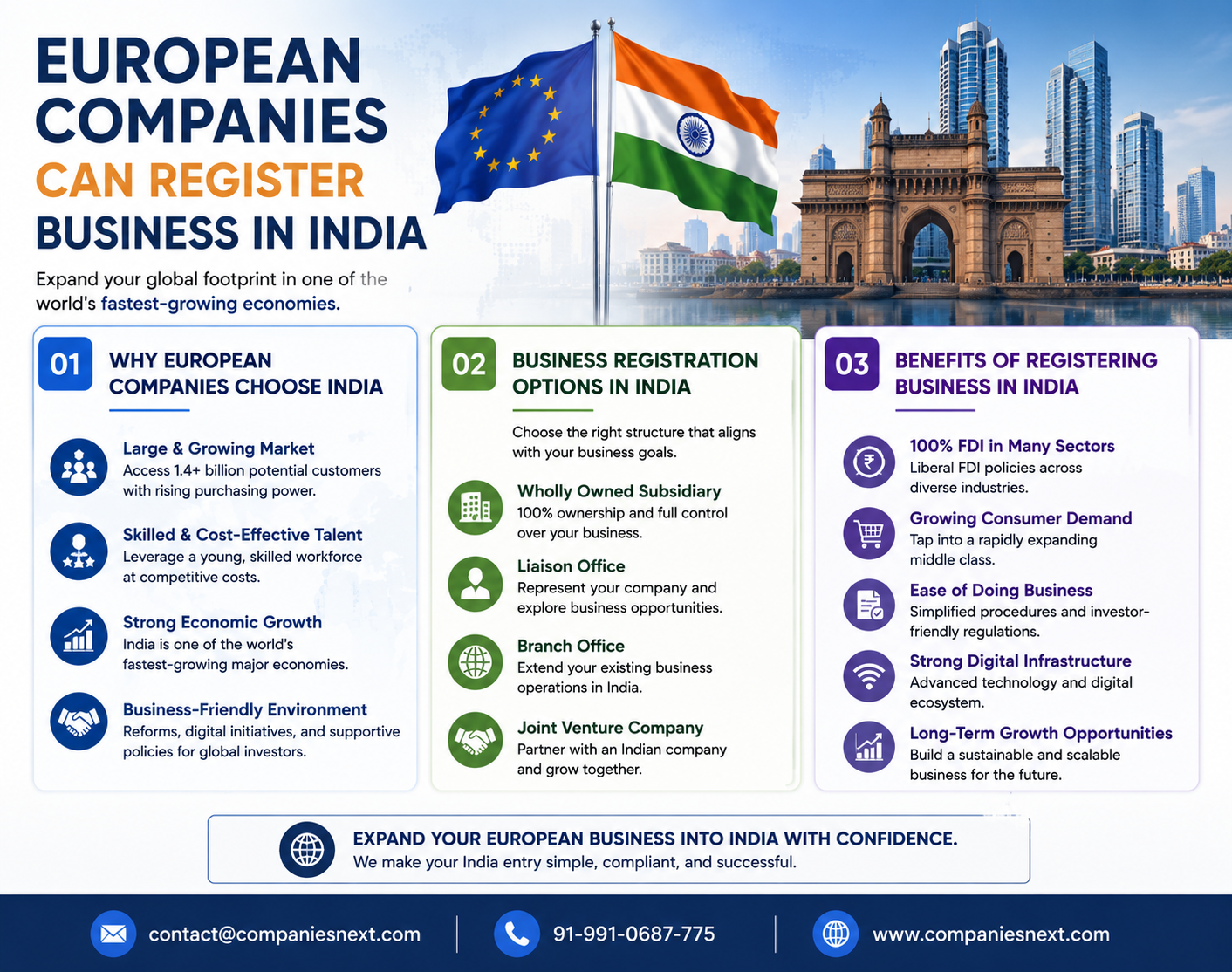
Starting a business in India from Europe can open opportunities in one of the world’s major and growing markets. European entrepreneurs and companies can establish an Indian presence through different structures depending on their business objectives, ownership requirements, investment plans, and activities.
However, setting up a business from another country involves more than simply registering a company. Entrepreneurs need to consider the appropriate business structure, foreign investment rules, taxation, documentation, banking, accounting, and ongoing compliance.
This guide explains the key Start a Business in India from Europe Procedures in a simple, step-by-step manner.
Why European Businesses Consider India
India offers a large consumer market, a growing digital economy, skilled professionals, manufacturing opportunities, and expanding demand across many industries. European companies may establish an Indian business to sell products, provide services, manufacture goods, develop technology, or support their international operations.
Before entering the market, a European business should identify its purpose in India. For example, a company planning to conduct commercial activities may consider an Indian subsidiary, while a company that only wants to explore the market may consider another permitted presence.
The appropriate structure depends on the nature and objectives of the proposed operations.
Step 1: Define Your Business Objective
The first step is to clearly determine what you want to accomplish in India.
Consider questions such as:
- What products or services will the business offer?
- Who are the target customers?
- Will the business have employees in India?
- Will it import or export products?
- How much capital will be invested?
- Will the business operate independently or support the European parent company?
- Does the business require an office, warehouse, or manufacturing facility?
Having clear answers helps determine the suitable business structure and registrations.
Step 2: Choose the Appropriate Business Structure
Choosing the right legal structure is one of the most important Start a Business in India from Europe Procedures.
A European company may consider structures such as:
Private Limited Company
A private limited company is commonly used for establishing a separate Indian business entity. It provides a distinct legal identity and can be suitable for commercial operations.
A foreign investor may hold shares in an Indian company, subject to applicable foreign investment regulations and sector-specific requirements.
Wholly Owned Subsidiary
A European company may establish an Indian subsidiary that is fully owned by the foreign parent where permitted under applicable regulations.
This structure can provide greater control over Indian operations while maintaining a separate Indian legal entity.
Limited Liability Partnership
An LLP may be suitable for certain professional or service-oriented businesses. Its suitability for foreign investment depends on applicable rules and the nature of the proposed activity.
Branch or Liaison Office
Certain foreign companies may establish a branch office or liaison office in India, subject to applicable regulatory approval and eligibility requirements.
The permitted activities and compliance requirements differ from those of an Indian subsidiary.
Step 3: Check Foreign Investment Regulations
Foreign investment rules are an essential part of the Start a Business in India from Europe Procedures.
Before investing, the European company should check whether its proposed business activity falls under an automatic route or requires government approval. Sector-specific conditions, ownership restrictions, investment limits, and other regulatory requirements may apply.
The investor should also review applicable rules relating to foreign exchange and cross-border investment.
Professional advice can be useful when the proposed activity involves regulated sectors or special approval requirements.
Step 4: Prepare the Required Documents
Documentation is another important stage of the company formation process.
Depending on the proposed structure and shareholders, documents may include:
- Passport and identification documents of foreign directors or shareholders
- Address proof
- Proof of registered office
- Incorporation documents of the European parent company
- Board resolutions
- Authorisation documents
- Constitutional documents of the foreign company
- Digital signatures and identification-related documents where required
Foreign documents may need notarisation, apostille or legalisation, and appropriate certification depending on their origin and the specific registration requirement.
Documents that are not in English may also require an appropriate translation.
Step 5: Obtain Digital Signatures and Complete Registration
For an Indian company, the incorporation process generally involves submitting the required information and documents through the applicable government registration system.
The proposed directors may need digital signatures for filing electronic forms.
Information regarding the proposed company, directors, shareholders, registered office, business activities, and capital structure is provided during incorporation.
Once the applicable requirements are completed and the application is approved, the company receives its incorporation documentation.
Step 6: Arrange Permanent Account Number and Tax Registrations
After incorporation, the business needs to address its tax and financial registrations.
A company operating in India generally needs a Permanent Account Number (PAN). Depending on its activities, it may also require registrations such as Goods and Services Tax (GST).
GST registration can become relevant when the business provides taxable goods or services and meets the applicable requirements. Importers and exporters may also need additional registrations or permissions.
The exact tax obligations depend on the business structure, activities, turnover, transactions, and other applicable rules.
Step 7: Open an Indian Business Bank Account
An Indian business bank account is generally required for conducting the company’s financial activities.
The company can approach a suitable authorised bank after completing the required incorporation and KYC documentation.
Foreign investment received by an Indian company must be handled in accordance with applicable foreign exchange and banking regulations. Proper documentation should be maintained for incoming capital and other cross-border transactions.
Maintaining a separate business account also makes accounting, financial reporting, and tax compliance easier.
Step 8: Understand Accounting and Tax Compliance
Incorporating a company is only the beginning. Businesses must also maintain appropriate accounting records and complete required tax and corporate compliance.
Depending on the structure and activities, compliance may include:
- Maintaining books of accounts
- Filing income tax returns
- GST returns, where applicable
- Annual company filings
- Financial statements
- Audit requirements
- Payroll-related compliance
- Foreign exchange reporting
- Transfer pricing requirements where applicable
European companies operating through an Indian subsidiary should also understand the tax implications of transactions between the Indian company and its foreign parent.
Step 9: Consider Employment and Local Operations
If the business plans to hire employees in India, it should understand applicable employment, payroll, and social-security-related requirements.
The company may need to consider professional tax, provident fund, employee insurance, payroll deductions, employment agreements, and state-specific requirements depending on its workforce and location.
Businesses establishing offices, factories, warehouses, or other physical facilities may also need local registrations, licences, and permissions.
Step 10: Maintain Ongoing Corporate Compliance
A successful market entry requires continued compliance after incorporation.
The company should maintain statutory records, conduct required meetings, submit annual filings, maintain financial records, and meet applicable tax deadlines.
Foreign-owned companies should also monitor changes in foreign investment, taxation, foreign exchange, and sector-specific regulations.
A compliance calendar can help management track important filing and reporting dates.
Common Mistakes European Businesses Should Avoid
European companies entering India sometimes focus heavily on incorporation while overlooking post-registration obligations.
Common areas that require attention include:
- Choosing a structure without considering the long-term business model.
- Failing to check foreign investment restrictions.
- Using incorrectly prepared foreign documents.
- Ignoring GST or other tax requirements.
- Mixing personal and business finances.
- Delaying accounting and statutory compliance.
- Not reviewing cross-border transactions properly.
- Assuming that incorporation automatically provides every required licence.
Planning these matters before starting operations can reduce administrative difficulties later.
Benefits of Professional Business Setup Support
For a European entrepreneur unfamiliar with Indian regulations, professional support can make the process more organised. Business consultants, company secretaries, chartered accountants, and legal professionals can assist with incorporation, tax registration, accounting, foreign investment compliance, and ongoing filings.
The specific professionals required depend on the company's structure and activities.
A well-planned approach can also help the European parent company understand its responsibilities in relation to the Indian entity.
Conclusion
Starting a business in India from Europe involves several stages, from defining the business objective and selecting the appropriate structure to completing incorporation, tax registration, banking, accounting, and ongoing compliance.
The Start a Business in India from Europe Procedures should be planned according to the proposed industry, ownership structure, investment route, and operational requirements. European businesses should also review foreign investment, taxation, foreign exchange, employment, and sector-specific requirements before beginning commercial activities.
With proper planning and appropriate professional guidance, European companies can establish their Indian operations in a structured manner while maintaining focus on long-term business growth.

 English
 Arabic
 French
 Spanish
 Portuguese
 Deutsch
 Turkish
 Dutch
Dutch
 Italiano
 Russian
 Portuguese (Brazil)
 Greek
Greek
