


 About Urh Social
 Terms of Service
 Política de privacidade
 Contact
How to Choose a Live English Speaking Platform in 2026
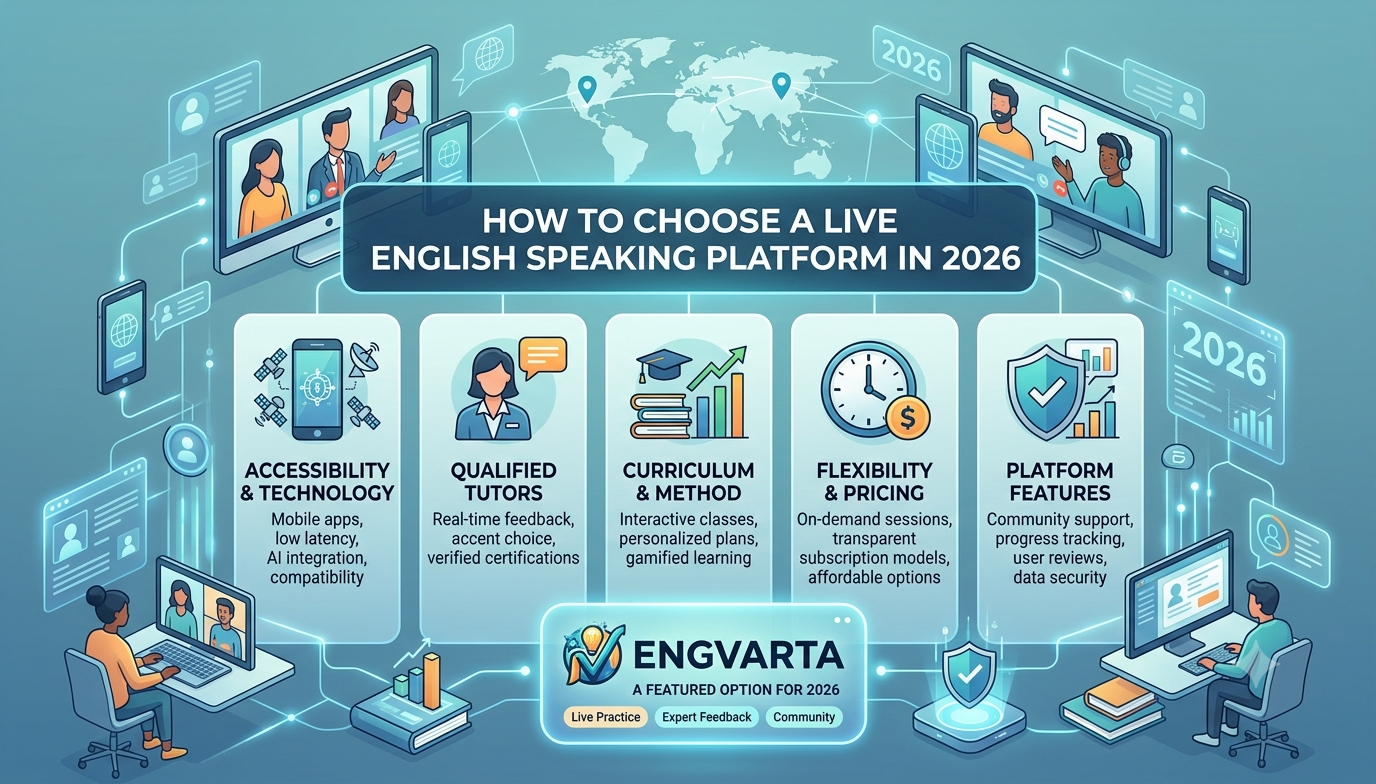
Choosing an English speaking platform can be surprisingly difficult. One app may offer AI conversations, another may connect you with tutors, while a third provides structured live classes. Yet having more features does not necessarily mean having the right learning experience.
The better question is: What kind of English speaking practice do you actually need?
A professional preparing for client calls may need frequent one-to-one conversation. A student preparing for interviews may prefer structured lessons. Someone struggling with pronunciation may benefit from AI speech feedback, while a learner who wants a formal English course may prefer scheduled classes with a teacher.
For Indian learners in 2026, the best live English speaking platform is therefore not automatically the most popular one. The right choice depends on your goal, schedule, preferred format, budget, need for human interaction, and ability to practise consistently.
What Is a Live English Speaking Platform?
A live English speaking platform gives learners opportunities to use spoken English through real-time interaction or guided speaking activities.
The category includes several different models:
-
Live human conversation: One-to-one speaking with an English expert or tutor.
-
Live group classes: Teacher-led classes with several learners.
-
Tutor marketplaces: Platforms where learners choose an individual English tutor.
-
AI conversation: Voice-based conversations with an AI tutor.
-
Language exchange: Practice with other English speakers or language learners.
-
Self-paced learning: Independent lessons, exercises and courses.
These formats solve different problems. Therefore, comparing them only by app popularity can produce a misleading result.
How to Choose a Live English Speaking Platform in 2026
The right platform should match your actual communication needs. Before paying for an English speaking course or subscription, consider these eight factors.
1. Start With Your English-Speaking Goal
Your goal should determine the platform you choose.
If you want daily English conversation practice, prioritize frequent opportunities to speak.
If you need workplace English, look for meetings, presentations, professional vocabulary and business scenarios.
If your priority is an interview, choose a platform that supports role-play, mock questions or personalized tutoring.
If pronunciation is your main problem, a speech-analysis tool may provide more targeted feedback than a general conversation platform.
For example, EngVarta's current professional offering specifically covers meetings, interviews, presentations and client calls through one-to-one conversations with live English Experts.
2. Decide Between Live Human and AI Practice
Human and AI speaking practice are different learning experiences.
Live human practice can provide:
-
Natural conversation
-
Unexpected questions
-
Human reactions
-
Contextual corrections
-
Real conversational dynamics
-
Workplace communication practice
AI practice can provide:
-
Frequent repetition
-
Role-play
-
Pronunciation practice
-
Low-pressure speaking
-
Immediate responses
-
Convenient short practice sessions
Neither format is automatically suitable for every learner.
A professional who freezes during client calls may benefit from unpredictable human conversations. Someone who wants to practise the same interview answer ten times may appreciate AI because repetition is easy.
3. Compare One-to-One and Group Learning
One-to-one English speaking lessons generally give the learner more individual attention.
They can be useful when you need:
-
Personalized feedback
-
Private practice
-
Specific workplace scenarios
-
Interview preparation
-
More control over the conversation
Group classes offer a different experience. They can expose learners to different speakers and provide a structured classroom environment.
Lingoda, for example, offers both small-group and private classes, with a CEFR-aligned curriculum and live teachers.
The important question is not whether one-to-one or group learning is universally better. It is whether you need individual speaking time or broader classroom interaction.
4. Check Scheduling Flexibility
For working professionals, scheduling can be as important as teaching quality.
Before selecting a platform, ask:
-
Can I choose my lesson time?
-
Are classes available during my normal free hours?
-
Can I practise on weekends?
-
Are short sessions available?
-
Can I reschedule?
-
Do I need to book far in advance?
-
Can I practise from my phone?
A platform may look excellent but become impractical if every lesson conflicts with meetings.
Some platforms explicitly emphasize flexible availability. British Council English Online currently advertises live lessons available 24/7 and allows learners to select lessons according to their schedules.
EF English Live similarly combines private classes, group classes and self-study, with teachers available across time zones and self-study accessible 24/7.
5. Examine the Quality of Feedback
Speaking practice is more useful when you understand what needs improvement.
But feedback varies considerably between platforms.
Look for the type of feedback you actually need:
-
Grammar correction
-
Pronunciation correction
-
Vocabulary suggestions
-
Sentence restructuring
-
Fluency feedback
-
Speaking clarity
-
Professional communication feedback
Do not assume that every platform offering “speaking practice” provides detailed corrections.
For example, EngVarta currently describes real-time corrections during one-to-one audio conversations followed by consolidated feedback.
ELSA Speak takes a different approach, using AI to analyse pronunciation, including sounds, stress and intonation.
The best feedback system for you depends on the problem you are trying to solve.
6. Check Professional Relevance
General spoken English and professional English overlap, but they are not identical.
A working professional may need to practise:
-
Joining meetings
-
Giving presentations
-
Explaining technical information
-
Handling client questions
-
Negotiating
-
Making workplace small talk
-
Giving feedback
-
Answering interview questions
-
Speaking with international colleagues
EF English Live's Business English offering, for example, includes networking, interviews, giving feedback and running meetings.
Preply also provides personalized Business English tutoring and allows learners to build lessons around goals such as meetings, pronunciation and conversation confidence.
7. Compare Value, Not Just Price
The cheapest English speaking app is not necessarily the lowest-cost option in practice.
Instead of comparing only subscription prices, consider:
How much useful speaking practice do I actually receive?
Also consider:
-
Human versus AI interaction
-
One-to-one versus group
-
Feedback quality
-
Session flexibility
-
Number of usable practice opportunities
-
Trial availability
-
Course structure
-
Long-term consistency
Prices can vary by plan, country, tutor and subscription period, so learners should verify current pricing directly before purchasing.
8. Choose the Platform You Can Use Consistently
Consistency should be one of your strongest selection criteria.
An advanced English learning platform is of limited practical value if you rarely use it.
For example, a professional who travels frequently may prefer flexible or on-demand practice. Someone with predictable evenings may be comfortable with scheduled live classes.
The most useful platform is therefore one that makes regular speaking practice realistic.
Quick Comparison: Which Platform Fits Which Learner?
|
Platform |
Practice Type |
Human / AI |
One-to-One / Group |
Flexibility |
Suitable For |
|
EngVarta |
Live conversation |
Human |
1-to-1 |
On-demand |
Regular professional speaking |
|
Cambly |
Live tutoring |
Human |
1-to-1 and group |
Flexible |
Conversation practice |
|
Preply |
Private tutoring |
Human |
1-to-1 |
Tutor-based |
Personalized English |
|
Lingoda |
Live classes |
Human |
Private and group |
Flexible |
Structured learning |
|
British Council English Online |
Live classes |
Human |
Private and group |
24/7 |
Business English |
|
EF English Live |
Classes + self-study |
Human + technology |
Private and group |
24/7 ecosystem |
Business English |
|
Speak |
AI conversation |
AI |
Individual |
On-demand |
AI role-play |
|
ELSA Speak |
AI speaking |
AI |
Individual |
On-demand |
Pronunciation and speaking feedback |
8 Platforms Worth Considering in 2026
1. EngVarta — For One-to-One Live Speaking Practice
EngVarta focuses on live one-to-one spoken English practice with human English Experts.
Its current professional page describes TESOL/ESL-certified Experts, real-time corrections, consolidated feedback and audio sessions. It currently lists 15-, 25- and 50-minute sessions, with availability from 7 AM to midnight. The platform specifically positions practice around interviews, presentations, meetings and client calls.
Best suited to: learners who want regular human conversation and professionals who need practice around specific workplace situations.
Limitation: the professional offering is audio-based, so it does not reproduce visual presentation or body-language practice.
2. Cambly — For Conversation With English Tutors
Cambly provides live English tutoring through private and small-group formats. Its current Pro offering includes structured lessons, targeted tutor feedback, self-study recommendations and private one-to-one lessons.
Best suited to: learners who want flexible live conversation with English tutors.
Limitation: learners seeking a highly standardized professional curriculum may prefer a dedicated Business English course.
3. Preply — For Personalized English Tutoring
Preply is a tutor marketplace that allows learners to select individual tutors according to goals, availability and other preferences.
Its Business English material focuses on personalized lessons and professional objectives, while its corporate offering emphasizes tutor-led one-to-one learning and flexible scheduling.
Best suited to: professionals and students who want personalized tutoring.
Limitation: finding the right tutor requires some comparison and trial-and-error.
4. Lingoda — For Structured Live English Classes
Lingoda combines live classes with a structured, CEFR-aligned curriculum. Learners can choose private or small-group classes, while Business English focuses on workplace communication.
Its business platform also advertises 24/7 availability.
Best suited to: learners who want structured online English classes with live teachers.
Limitation: group classes divide speaking time among learners.
5. British Council English Online — For Formal Business English
British Council English Online provides live lessons with expert teachers and advertises 24/7 availability. Learners can select subjects and lesson times according to their needs.
Best suited to: learners who want a structured learning environment and professional English content.
Limitation: people seeking only informal daily conversation may find a full course structure unnecessary.
6. EF English Live — For Blended Business English Learning
EF English Live combines private classes, live group classes and self-study. Its Business English course covers professional scenarios such as networking, interviews, meetings and giving feedback.
The platform says private classes can be booked around the learner's schedule, while group classes are available frequently and self-study is accessible 24/7.
Best suited to: professionals who want live classes plus independent learning.
Limitation: it may be more comprehensive than necessary for someone seeking only short conversation practice.
7. Speak — For On-Demand AI Conversation
Speak provides AI-based speaking practice and role-play. Unlike human tutoring platforms, learners can practise without coordinating with a live tutor.
Best suited to: busy learners who want frequent, low-pressure AI conversation practice.
Limitation: AI cannot fully reproduce the unpredictability and social dynamics of human workplace conversations.
8. ELSA Speak — For Pronunciation-Focused Practice
ELSA Speak uses AI to analyse pronunciation and provides feedback on speech characteristics such as sounds, stress and intonation. Its AI feature also supports scenario-based conversations followed by feedback.
Best suited to: learners whose primary weakness is pronunciation, clarity or spoken delivery.
Limitation: AI practice works best as a complement when the learner also needs real human conversation.
Which Platform Fits Your Goal?
For Daily Live Speaking
Prioritize platforms offering frequent human conversation. EngVarta, Cambly and Preply fit this learning model.
For Interview Preparation
Look for personalized role-play and feedback. One-to-one platforms can be useful because the practice can be adapted to your profession and target role.
For Client Communication
Prioritize real conversation over passive lessons. Unexpected questions and follow-up responses are particularly important.
For Workplace English
Structured platforms such as Lingoda, British Council English Online and EF English Live can be useful when you need professional vocabulary and organized lessons.
For Pronunciation
A dedicated AI speech-feedback platform such as ELSA Speak can provide targeted pronunciation analysis.
For Unpredictable Schedules
Prioritize on-demand or highly flexible services. AI platforms can remove tutor scheduling entirely, while some live platforms offer extended or 24/7 availability.
For Structured Learning
Choose a platform with a curriculum, level structure and progress framework rather than relying entirely on informal conversation.
Human vs AI English Speaking Practice
The choice between an English tutor and an AI English speaking app depends on the practice objective.
AI is convenient for repetition. You can practise an introduction, interview answer or workplace scenario repeatedly without arranging another lesson.
Human conversation is useful when you need realistic interaction. A person may interrupt, misunderstand your explanation, ask a follow-up question or react differently from what you expected.
For many learners, combining the two approaches can be practical: use AI for frequent repetition and live human practice for realistic communication.
A Short Professional Scenario
Professional: “I understand English well, but I freeze when I have to speak during client calls.”
Coach: “Then don't choose a platform only because it has many English lessons. Look for one that gives you regular speaking opportunities and lets you practise realistic client conversations.”
This is an illustrative scenario, not a customer testimonial. It demonstrates why the learner's actual communication problem should drive the platform choice.
How to Test a Platform Before Committing
If a platform offers a trial, use it as an evaluation rather than simply as a free lesson.
Ask yourself:
-
How quickly did I start speaking?
-
How much of the session involved actual speaking?
-
Was the feedback specific?
-
Did the instructor understand my goal?
-
Does the schedule fit my routine?
-
Was the app technically easy to use?
-
Would I realistically use it several times a week?
-
What happens after the trial?
Also check cancellation terms, subscription conditions and what features are included in the plan you are considering.
Most importantly, compare actual practice value, not just marketing claims.
Conclusion
Choosing a live English speaking platform in 2026 should start with your communication goal, not with a generic “best app” list.
If you want one-to-one human conversation, consider platforms such as EngVarta, Cambly or Preply. If you prefer structured live English classes, Lingoda, British Council English Online and EF English Live offer teacher-led learning models. If your priority is AI-based repetition or pronunciation feedback, platforms such as Speak and ELSA Speak offer a different approach.
For Indian learners, the right choice ultimately depends on four practical questions:
What do I need to speak about? How much time can I realistically practise? Do I need human interaction? And what kind of feedback will actually help me improve?
Once those questions are answered, comparing an English speaking app becomes much easier. The goal is not to find a platform with the longest feature list. It is to find one that provides the right kind of speaking practice frequently enough to become part of your routine.

 English
 Arabic
 French
 Spanish
 Portuguese
 Deutsch
 Turkish
 Dutch
Dutch
 Italiano
 Russian
 Romaian
 Greek
Greek
