


 About Urh Social
 Terms of Service
 Privacy Policy
 Contact
Best OET Speaking Apps and Resources for Indian Doctors in 2026
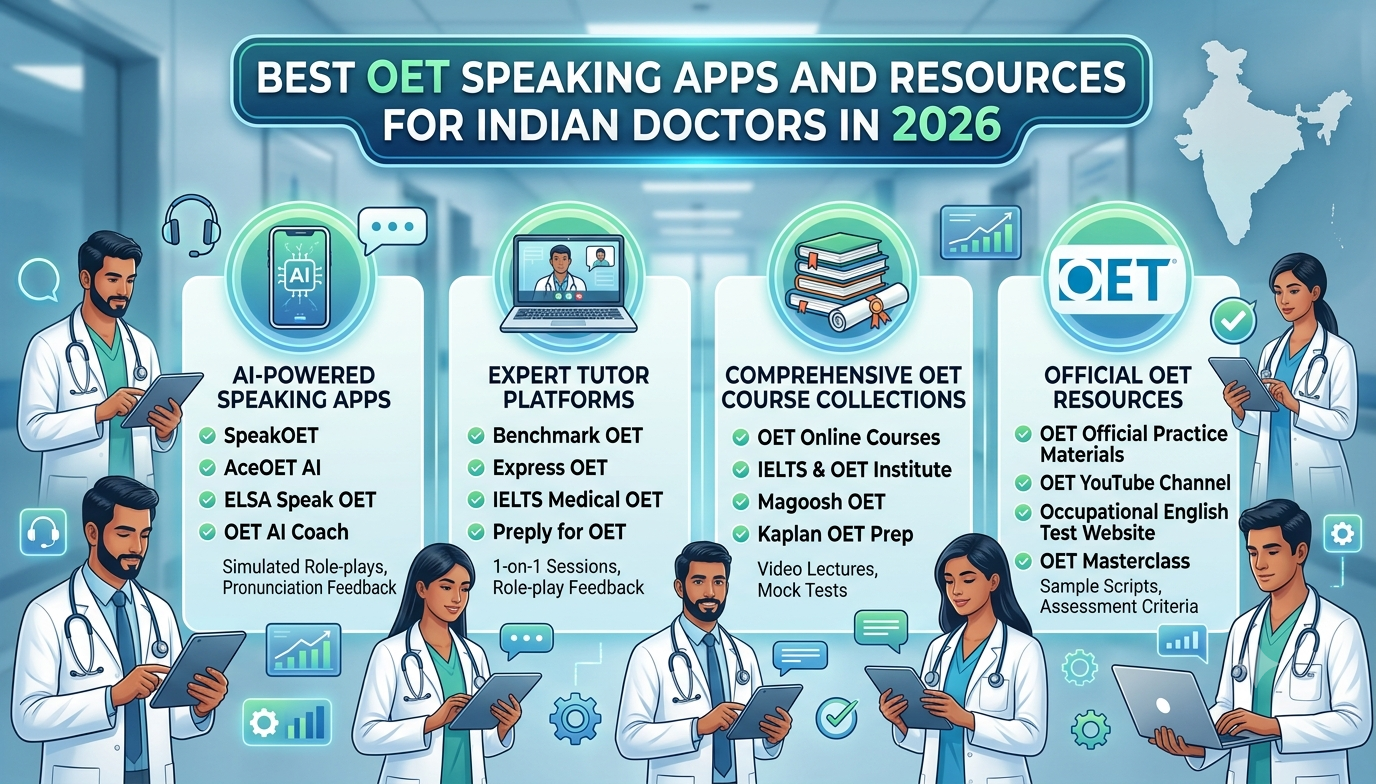
Preparing for OET Speaking is different from learning general spoken English. Doctors need to communicate clearly with patients, respond naturally, show empathy, listen actively and explain healthcare information in language a patient can understand. OET’s Speaking sub-test uses healthcare role plays, so preparation needs to go beyond memorising medical vocabulary or practising grammar exercises. Oet+1
For Indian doctors, the best OET Speaking apps and resources in 2026 are therefore not necessarily a single app. A practical preparation system can combine official OET materials, OET-specific role plays, live English conversation, pronunciation practice, self-recording and feedback. The right combination depends on whether your main weakness is fluency, confidence, pronunciation, patient-centred communication or familiarity with the OET task.
What Are the Best OET Speaking Resources for Indian Doctors?
A strong OET Speaking preparation setup usually combines six things: official OET preparation materials, OET-specific healthcare role plays, live speaking practice, general English fluency practice, self-recording and regular feedback. Official OET resources should be used to understand the current test format and preparation expectations. OET also provides profession-specific sample materials, including Speaking role cards. Oet+1 Live conversation practice can help doctors practise spontaneous patient communication rather than relying only on memorised answers. EngVarta is one example of a live one-to-one speaking resource that can complement OET-specific preparation. EngVarta
10 Best OET Speaking Apps and Resources for Indian Doctors in 2026
1. Official OET Preparation Resources
Start with official OET information before choosing additional apps or courses.
The official OET website provides information about the test, preparation resources and sample materials. OET’s sample-test resources include Speaking role cards for different healthcare professions, making them particularly useful for doctors who want to practise realistic scenarios. Oet
Official preparation is important because third-party apps may simplify, reinterpret or occasionally provide outdated information about the test. OET itself recommends candidates prepare for the test and provides free and paid preparation resources through its learning platform. OET Support
Use official materials to understand:
-
The current Speaking task.
-
The type of healthcare communication involved.
-
Profession-specific role-play scenarios.
-
The expectations of the assessment.
-
What authentic OET preparation material looks like.
Use third-party resources to increase practice volume—not to replace the official source.
2. EngVarta for Live Speaking Practice
Live conversation practice can fill an important gap in OET preparation: actually speaking to another person and responding without knowing exactly what they will say.
EngVarta currently offers private one-to-one English speaking sessions with English Experts, with real-time corrections and feedback. Its website says sessions can be used for regular spoken-English practice and are available on demand. EngVarta+1
For an OET candidate, the useful application is to practise healthcare conversations alongside formal OET preparation. For example, a doctor could ask a speaking partner to practise:
-
Explaining a diagnosis.
-
Discussing medication adherence.
-
Addressing patient anxiety.
-
Giving lifestyle advice.
-
Explaining follow-up care.
-
Responding to an unexpected patient question.
The purpose is not to treat EngVarta as an official OET platform. Rather, live one-to-one practice can help create more opportunities to speak spontaneously, receive feedback and repeat difficult conversations. EngVarta's current service also provides session recordings for self-review. EngVarta
3. OET-Specific Speaking Practice Platforms
An OET-specific platform can be useful when you already have reasonable general English but need to become comfortable with healthcare role plays.
Look for resources that provide:
-
Healthcare-specific role plays.
-
Profession-specific scenarios.
-
Realistic preparation time.
-
Speaking feedback.
-
Patient-centred communication guidance.
-
Sample responses or strategy explanations.
-
Opportunities to repeat role plays.
OET Speaking is not simply a test of whether a doctor knows English. The scenarios involve communicating healthcare information with patients, carers or relatives. OET describes its Speaking content as reflecting real healthcare communication and the need to translate technical information into language patients can understand. Oet+1
That makes OET-specific practice particularly valuable.
4. AI Conversation Tools
AI conversation tools such as ChatGPT can provide additional speaking practice when a human partner is unavailable.
A doctor can use AI to:
-
Generate healthcare role-play scenarios.
-
Act as a patient.
-
Ask unexpected follow-up questions.
-
Practise difficult conversations.
-
Generate alternative ways of explaining medical information.
-
Identify vocabulary gaps.
-
Practise patient-friendly explanations.
For example, you could ask an AI tool to act as a worried patient who has just been diagnosed with hypertension and ask questions about medication and lifestyle changes.
However, AI practice has limitations. AI-generated feedback should not automatically be treated as an official OET assessment. It is also important to verify OET-specific rules and assessment information against official OET sources.
AI is best used as an additional practice partner—not as a replacement for official OET materials or qualified human feedback.
5. Pronunciation and Listening Resources
Pronunciation resources can help doctors improve intelligibility, word stress, sentence stress and rhythm.
Indian doctors do not need to eliminate an Indian accent simply to prepare for OET. The practical objective is clear, understandable communication.
Pronunciation practice can be particularly useful for:
-
Difficult medical terms.
-
Medication names.
-
Symptoms and diagnoses.
-
Numbers and measurements.
-
Word endings.
-
Sentence stress.
-
Natural conversational rhythm.
Listening resources are equally important. Healthcare communication involves responding to what another person actually says, not simply delivering a prepared answer.
Record yourself saying difficult words, listen to professional healthcare conversations and practise repeating sentences with natural stress and rhythm.
6. English Conversation and Fluency Apps
General English-speaking apps can be useful when fluency and hesitation are the main problems.
If you search for the Best English Speaking Apps in India (2026) or the Best English Learning App, you will find resources with different approaches, including vocabulary practice, pronunciation exercises, AI conversation and human interaction.
These tools can help you:
-
Learn English speaking more naturally.
-
Practise spoken English regularly.
-
Build conversational confidence.
-
Practise English conversation.
-
Speak English with less hesitation.
-
Develop a consistent speaking habit.
However, a general English speaking app is not automatically an OET preparation resource.
General spoken English can improve your fluency, but OET Speaking requires healthcare-specific communication practice. Use an English speaking app to strengthen the foundation, then use OET role plays to apply that English in clinical communication.
7. Online Spoken English Classes
An online English-speaking course may be useful for doctors who need structured guidance rather than independent practice.
The Best Online English Speaking Course in India for one learner may not be the same as the best option for another. Look at the teaching method rather than relying on the word “best” in a course title.
Useful features include:
-
Structured lessons.
-
Teacher feedback.
-
Conversation practice.
-
Pronunciation correction.
-
Grammar correction.
-
Fluency development.
-
Regular assignments.
-
Accountability.
Best Online Spoken English Classes can be particularly useful if you understand English but hesitate when speaking.
Similarly, Online English Classes in India can provide a structured environment for doctors who need regular practice around a busy hospital or clinic schedule.
For someone preparing specifically for OET, however, a general English Speaking Course should complement—not replace—OET-specific preparation.
8. Medical English and Patient-Communication Resources
Doctors often know the medical terminology perfectly well. The harder task can be explaining that terminology to a patient.
For example:
-
Instead of “hypertension,” say: “Your blood pressure is higher than the healthy range.”
-
Instead of “adverse effects,” say: “These are side effects that you may experience.”
-
Instead of “administer the medication,” say: “Take the medicine as prescribed.”
-
Instead of “contraindication,” say: “There are some situations in which this medicine may not be safe for you.”
-
Instead of “prognosis,” say: “This is what we expect regarding how your condition may develop.”
Patient-friendly communication is particularly relevant to OET because the Speaking scenarios are designed around healthcare interactions rather than abstract everyday conversation. Oet
Practise explaining diagnoses, investigations, treatment options, medication, side effects, lifestyle changes and follow-up care in simple language.
9. OET Speaking Sample Tests and Role-Play Materials
Sample role plays become much more useful when you actively perform them.
A practical process is:
-
Read the role card during the preparation period.
-
Identify the patient's main concerns.
-
Decide what information must be communicated.
-
Plan an appropriate opening.
-
Perform the role play without reading a script.
-
Record yourself where possible.
-
Review your performance.
-
Repeat the role play after correcting weaknesses.
OET provides profession-specific sample-test materials, including Speaking role cards, so candidates can become familiar with the nature of the task. Oet
Repeatedly reading model answers is less useful than repeatedly speaking. OET Speaking requires you to respond in real time, so your preparation should include real speaking whenever possible.
10. Self-Recording and Feedback Tools
A smartphone can become a simple but effective OET Speaking practice tool.
Record a complete role play and review it objectively.
Ask yourself:
7. Online Spoken English Classes
Useful features include:
-
Was my speech intelligible?
-
Did I speak too quickly?
-
Did I listen to the patient's concerns?
-
Did I ask appropriate questions?
-
Did I acknowledge emotional concerns?
-
Did I explain information clearly?
-
Did I avoid unnecessary medical jargon?
-
Did I check understanding?
-
Did I close the conversation appropriately?
Then perform the same role play again.
The value comes from the cycle: speak → review → correct → repeat.
Feedback from another person can make this process more useful because you may not notice your own recurring pronunciation, grammar or communication habits.
How to Choose the Right OET Speaking App or Resource
Instead of asking only, “Which is the best OET Speaking app?”, ask which resource solves your current problem.
Consider these eight factors:
-
OET relevance: Does it actually include healthcare communication?
-
Healthcare role plays: Can you practise realistic patient scenarios?
-
Human speaking practice: Can you have spontaneous conversations?
-
Feedback quality: Will someone identify recurring weaknesses?
-
Regular practice: Is it easy to use consistently?
-
Profession-specific content: Are scenarios relevant to doctors?
-
Speaking and listening features: Does it require active communication?
-
Cost and accessibility: Can you realistically use it throughout your preparation?
Different doctors may need different combinations. Someone with strong English but little OET experience may need more role-play practice, while another candidate may first need to improve everyday fluency.
How Indian Doctors Can Use EngVarta for OET Speaking Practice
EngVarta can be incorporated as a live conversation component rather than used as a replacement for OET-specific preparation.
A practical 25–30 minute routine could look like this:
-
5 minutes: Warm up with general English conversation.
-
10 minutes: Practise a healthcare scenario.
-
5 minutes: Review feedback and identify recurring mistakes.
-
5 minutes: Repeat difficult parts of the conversation.
-
5 minutes: Practise patient-friendly explanations.
Possible scenarios include explaining a diagnosis, discussing medication, providing lifestyle counselling, explaining discharge instructions, discussing treatment options, addressing anxiety, improving treatment adherence and arranging follow-up care.
The advantage of this approach is repetition. You can practise the same communication problem several times until the explanation becomes more natural.
EngVarta currently describes its service as one-to-one live speaking practice with real English Experts and real-time corrections, making it potentially useful for this type of additional speaking practice. EngVarta+1
Is General English Speaking Practice Enough for OET?
No. General English speaking practice can improve fluency and confidence, but OET Speaking also requires healthcare-specific communication practice.
General English helps with everyday conversation, vocabulary, pronunciation and fluency. OET practice adds the healthcare context: understanding a patient's concerns, explaining medical information, responding appropriately and completing role-play conversations.
Live speaking practice develops spontaneity and confidence. Official OET resources help candidates understand the actual test and use authentic preparation materials. Oet+1
For many doctors, combining all three creates a more balanced preparation routine.
A Simple 30-Day OET Speaking Practice Plan for Doctors
Days 1–7: Build the Foundation
-
Understand the Speaking task.
-
Review the current assessment information.
-
Practise introductions.
-
Practise open questions.
-
Record short conversations.
Days 8–15: Improve Patient Communication
Is General English Speaking Practice Enough for OET?
-
Practise discussing patient concerns.
-
Work on empathy.
-
Explain medical information simply.
-
Review common medical vocabulary.
-
Practise checking understanding.
Days 16–23: Increase Role-Play Practice
-
Complete full role plays.
-
Practise difficult or emotional patients.
-
Work on time management.
-
Record your performances.
-
Review and repeat weak sections.
Days 24–30: Simulate the Task
-
Perform complete simulated role plays.
-
Target recurring pronunciation and fluency problems.
-
Repeat difficult scenarios.
-
Review your communication habits.
-
Use official preparation materials for final checks.
For working doctors, consistency matters more than attempting several hours of speaking practice once a week.
8 Common OET Speaking Mistakes Indian Doctors Should Avoid
-
Memorising complete scripts.
Learn useful communication structures, but respond to the actual patient instead of reciting prepared sentences. -
Speaking too quickly.
Slow down enough for the patient to follow your explanation. -
Using excessive medical jargon.
Translate technical terminology into language an ordinary patient can understand. -
Giving information without identifying concerns.
Ask questions and listen before delivering a long explanation. -
Ignoring emotional cues.
Acknowledge anxiety, confusion, fear or frustration when appropriate. -
Asking too many closed questions.
Use open questions when you need the patient to explain symptoms or concerns. -
Focusing excessively on accent.
Concentrate on intelligibility, pronunciation and clear communication rather than trying to erase your Indian accent. -
Practising only by reading.
Speaking ability develops through speaking. Perform role plays, record yourself and repeat them.
Final Thoughts
Effective OET Speaking preparation for Indian doctors is usually a combination of resources rather than a single “best” app. Start with official OET materials so you understand the current test and use authentic sample resources. Add OET-specific role plays, regular English conversation, patient-centred communication practice, self-recording and feedback.
For doctors who need more opportunities to speak, a live conversation resource such as EngVarta can be one part of that routine. The key is active practice: speak, listen, receive feedback, correct the problem and speak again. That approach is more useful than simply collecting apps or memorising model answers—and it keeps preparation focused on the communication skills doctors actually need.
Frequently Asked Questions
1. Which app is best for OET Speaking practice for Indian doctors?
There is no single resource that suits every doctor. The appropriate choice depends on the specific need: official OET information, healthcare role plays, live conversation, pronunciation support, feedback or general fluency. A combination of resources is often more practical than relying on one app.
2. Can I prepare for OET Speaking using an English speaking app?
Yes, but a general English speaking app should normally be treated as supplementary preparation. It can help improve fluency, confidence and conversation skills, while OET-specific role plays prepare you for healthcare communication.
3. Is EngVarta useful for OET Speaking preparation?
EngVarta can be used as a live speaking-practice resource. Its current offering includes one-to-one conversation with English Experts, real-time corrections and feedback. EngVarta It should complement, rather than replace, official OET preparation and OET-specific role plays.
4. Can ChatGPT help me practise OET Speaking?
Yes. You can ask ChatGPT to act as a patient, generate role-play scenarios and ask follow-up questions. It can also help you brainstorm patient-friendly explanations. However, AI feedback should not be treated as an official OET assessment.
5. How can Indian doctors improve fluency for OET Speaking?
Speak regularly rather than relying only on reading. Practise short conversations, record role plays, review hesitation and pronunciation, and repeat difficult scenarios. Live conversation with another person can add unpredictability and require you to respond spontaneously.
6. How many minutes should I practise speaking English every day?
A realistic starting point is around 20–30 minutes of focused speaking practice on most days. This is a study strategy, not an official OET requirement. If your schedule is busy, shorter daily sessions can be easier to maintain than occasional long sessions.
7. Do Indian doctors need to change their accent for OET?
The practical goal should be intelligibility and effective communication, not eliminating an Indian accent. Work on pronunciation, word stress, rhythm and clarity so that patients can understand you comfortably.
8. Is an OET-specific course better than a general English speaking course?
They serve different purposes. An OET-specific course focuses on the healthcare test context and role plays, while a general English speaking course can address broader fluency, grammar, pronunciation and conversation weaknesses. Your choice should depend on what you need to improve.

 English
 Arabic
 French
 Spanish
 Portuguese
 Deutsch
 Turkish
 Dutch
Dutch
 Italiano
 Russian
 Portuguese (Brazil)
 Greek
Greek
