


 About Urh Social
 Terms of Service
 Πολιτική Ιδιωτικότητας
 Contact
Healthcare Computerized Maintenance Management System Market Growth, Trends, Company Profiles, Market Share Analysis By Fact.MR
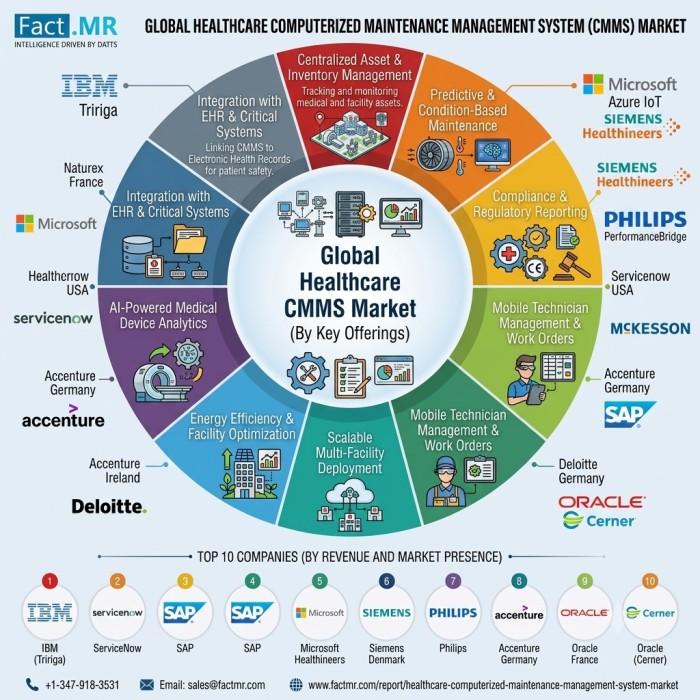
Healthcare CMMS Market Set to Reach $6.7 Billion as Hospitals Shift Toward Predictive Asset Maintenance
Rockville, Maryland, United States – September 16, 2026 — Hospitals are increasingly moving maintenance management from fragmented records toward centralized digital asset systems as equipment fleets grow and uptime requirements become harder to manage manually. Fact.MR estimates the Healthcare Computerized Maintenance Management System (CMMS) Market at USD 2.3 billion in 2026, with revenue projected to reach USD 6.7 billion by 2036, expanding at an 11.3% CAGR.
The shift matters because maintenance records now sit closer to operational and compliance decisions. Hospitals need to know which equipment has been serviced, when preventive maintenance is due, what parts were replaced and whether technicians completed required inspections.
Get detailed market forecasts, competitive benchmarking, and pricing trends:https://www.factmr.com/connectus/sample?flag=S&rep_id=16006
Why are hospitals adopting healthcare CMMS platforms?
Healthcare facilities manage thousands of clinical and infrastructure assets, ranging from imaging systems and patient monitors to HVAC equipment, generators and critical utility systems. Manual spreadsheets and disconnected maintenance logs can make it difficult to establish one reliable service history.
Fact.MR identifies asset record consolidation as a leading growth driver, with an estimated +2.8% impact on CAGR. Multi-site hospital deployment follows at +2.6%, reflecting the need for centralized maintenance visibility across campuses.
Preventive maintenance compliance contributes an estimated +2.3% impact on CAGR. Hospitals increasingly need maintenance evidence that can be retrieved during internal reviews, inspections and operational audits.
The commercial value extends beyond recordkeeping. A centralized CMMS can help maintenance leaders compare equipment condition, service frequency and repair costs before deciding whether an asset should be repaired, replaced or monitored more closely.
Which software module leads the market?
Asset Management is projected to account for 43.0% of the software-module segment in 2026. The module forms the foundation of a healthcare maintenance system because hospitals need dependable records for individual assets.
A complete asset record can contain equipment identifiers, service history, warranties, spare-parts information and maintenance schedules. When these records are connected to work orders, biomedical engineering teams can track the maintenance status of equipment without relying on separate files.
Work-order management and preventive-maintenance scheduling remain important adjacent functions. Inventory and spare-parts management also becomes more valuable as hospitals seek to reduce delays caused by unavailable components.
Which application is driving demand?
Medical Equipment Maintenance is expected to hold 41.0% of the application segment in 2026.
Clinical equipment downtime can affect imaging appointments, monitoring capacity, surgery support and therapy schedules. Maintenance teams therefore need reliable workflows for assigning preventive tasks, documenting corrective repairs and confirming service completion.
The scale of healthcare infrastructure reinforces this need. The U.S. Centers for Medicare & Medicaid Services reported that national health expenditures reached USD 5.3 trillion in 2024, representing 18.0% of U.S. GDP. A large operating base means even small improvements in asset availability can have meaningful implications for healthcare organizations.
Analyst Perspective
Shambhu Nath Jha, Principal Consultant at Fact.MR, said:
“Healthcare CMMS adoption is moving beyond work order tracking.”
The broader Fact.MR assessment indicates that hospitals increasingly want maintenance platforms connecting asset histories with preventive schedules and audit evidence. Providers that simplify these workflows while retaining strong controls are positioned to gain greater acceptance.
This changes the procurement criteria for CMMS software. Hospitals are evaluating not only task management but also data quality, mobile access, reporting, integration and the ability to support multiple facilities from a common platform.
Market Snapshot
- 2026 market value: USD 2.3 billion.
- 2036 projected value: USD 6.7 billion.
- Forecast CAGR, 2026–2036: 11.3%.
- Absolute opportunity: USD 4.5 billion.
- Leading software module: Asset Management, with 43.0% share.
- Leading application: Medical Equipment Maintenance, with 41.0% share.
- Leading end user: Hospitals, with 46.0% share.
- Leading deployment model: Cloud-based Deployment, with 59.0% share.
- Leading technology platform: AI-enabled Predictive Maintenance, with 44.0% share.
The market is projected to create USD 4.5 billion in additional opportunity between 2026 and 2036.
What's Driving Near-Term Demand?
Cloud deployment is becoming particularly relevant for hospital networks operating multiple campuses. Cloud-based Deployment is projected to account for 59.0% of the market in 2026, allowing maintenance teams to access shared asset records without maintaining separate local systems.
Predictive maintenance represents another important development. Fact.MR expects AI-enabled Predictive Maintenance to hold 44.0% of the technology-platform segment in 2026.
The objective is straightforward: identify potential equipment problems earlier. Historical work orders, operating conditions and sensor information can be analyzed to identify patterns associated with failure or abnormal performance.
Fact.MR estimates predictive maintenance readiness at +2.1% impact on CAGR, indicating growing interest in moving beyond scheduled servicing toward condition-based maintenance.
Technician workflow efficiency contributes another +1.7% impact on CAGR. Mobile CMMS tools can allow technicians to receive assignments, update work orders and document completed tasks at the equipment location.
What are the main barriers?
Data migration remains a practical challenge. Hospitals often have years of maintenance information stored across spreadsheets, legacy applications, paper records and vendor systems.
Uneven technician readiness can also slow implementation. A CMMS produces limited value if asset records are incomplete or maintenance teams do not consistently close work orders.
Integration creates another consideration. Healthcare organizations may need CMMS platforms to exchange information with procurement, facilities-management, inventory and enterprise systems.
For predictive maintenance, data quality becomes even more important. AI-based recommendations depend on accurate asset histories and reliable equipment-condition information.
Which countries offer the strongest growth opportunities?
The United States is projected to grow at 12.2% CAGR from 2026 to 2036, supported by hospital-system scale and mature healthcare IT procurement.
Germany follows at 11.8% CAGR, while the United Kingdom is projected to grow at 11.4%. Canada reaches 11.0%, followed by Australia at 10.5%.
Japan is forecast at 10.1% CAGR, while Singapore records 9.7%.
The country-level differences point to different adoption priorities. U.S. health systems are likely to emphasize enterprise-scale asset visibility and mobile execution, while European markets place greater emphasis on structured maintenance documentation and operational control.
Who are the key companies?
The competitive landscape includes IBM Corporation, Accruent LLC, Brightly Software Inc., eMaint by Fluke Reliability, Fiix by Rockwell Automation, IFS AB, UpKeep Technologies Inc. and Limble CMMS.
IBM's Maximo Application Suite provides a notable example of how enterprise asset management platforms are expanding their maintenance capabilities. Healthcare-focused offerings from other providers compete through preventive maintenance, work-order management, asset tracking, mobile execution and compliance reporting.
The market is increasingly separating general-purpose maintenance software from platforms capable of handling biomedical equipment, hospital facilities and healthcare-specific documentation requirements.
About the Report
The Fact.MR study evaluates the Healthcare Computerized Maintenance Management System Market across Software Module, Application, End User, Deployment Model and Technology Platform.
Software modules include Asset Management, Work Order Management, Preventive Maintenance Scheduling, Inventory and Spare Parts Management, and Analytics and Reporting.
Applications include Medical Equipment Maintenance, Facility Maintenance, Compliance Management, Performance Monitoring and related asset-lifecycle workflows.
End users covered include Hospitals, Clinics, Healthcare Networks and Medical Device Manufacturers. Deployment analysis covers Cloud-based, Hybrid and On-premise models, while technology coverage includes AI-enabled Predictive Maintenance, IoT-integrated CMMS, Mobile CMMS, Analytics-enabled CMMS and standard CMMS platforms.
The research draws on 120+ sources, 35+ company portfolios, 25+ countries and more than 20 industry interviews. The methodology combines primary interviews, government statistics, company information, technical publications, market sizing, forecasting and data validation.
Explore More Related Studies Published by Fact.MR Research:
Medical and Pharmaceutical Dynamic Sealing Solutions Market: https://www.openpr.com/news/4597508/trelleborg-leads-as-usa-medical-and-pharmaceutical-dynamic
Artificial Intelligence in Hospital Operations Market: https://www.openpr.com/news/4597510/u-s-health-systems-and-microsoft-drive-ai-hospital-operations
Artificial Intelligence in Life Sciences Market: https://www.openpr.com/news/4597511/usa-ai-in-life-sciences-market-expands-as-iqvia-rolls-out-new
Medical Devices Electronic Data Interchange Market: https://www.openpr.com/news/4597525/opentext-scales-u-s-medical-device-edi-networks-as-market
Medical Device and Medtech Enterprise Resource Planning Market:https://www.openpr.com/news/4597512/sap-se-takes-15-2-share-as-u-s-medical-device-medtech-erp
About Fact.MR
Fact.MR is a market research and consulting firm providing industry intelligence across consumer goods, food and beverages, healthcare, technology, chemicals and materials, industrial goods and other sectors. Its research process combines primary industry interviews with secondary data, company information, government sources and industry publications to develop market estimates and forecasts.
Fact.MR operates as an initiative of Eminent Research and Advisory Services, with offices listed in Rockville, Maryland, United States, and Dublin, Ireland.
Media Contact
Fact.MR
11140 Rockville Pike, Suite 400
Rockville, MD 20852, United States
Tel: +1 (628) 251-1583
Email: [email protected]
Disclosure: This release is based on FMI syndicated research. Market figures represent estimates and forecasts available as of the publication date and may be revised as additional information becomes available.

 English
 Arabic
 French
 Spanish
 Portuguese
 Deutsch
 Turkish
 Dutch
Dutch
 Italiano
 Russian
 Romaian
 Portuguese (Brazil)
