


 About Urh Social
 Terms of Service
 Политика конфиденциальности
 Contact
Winding Machines Market Forecast: USD 8.7 Billion Opportunity by 2036
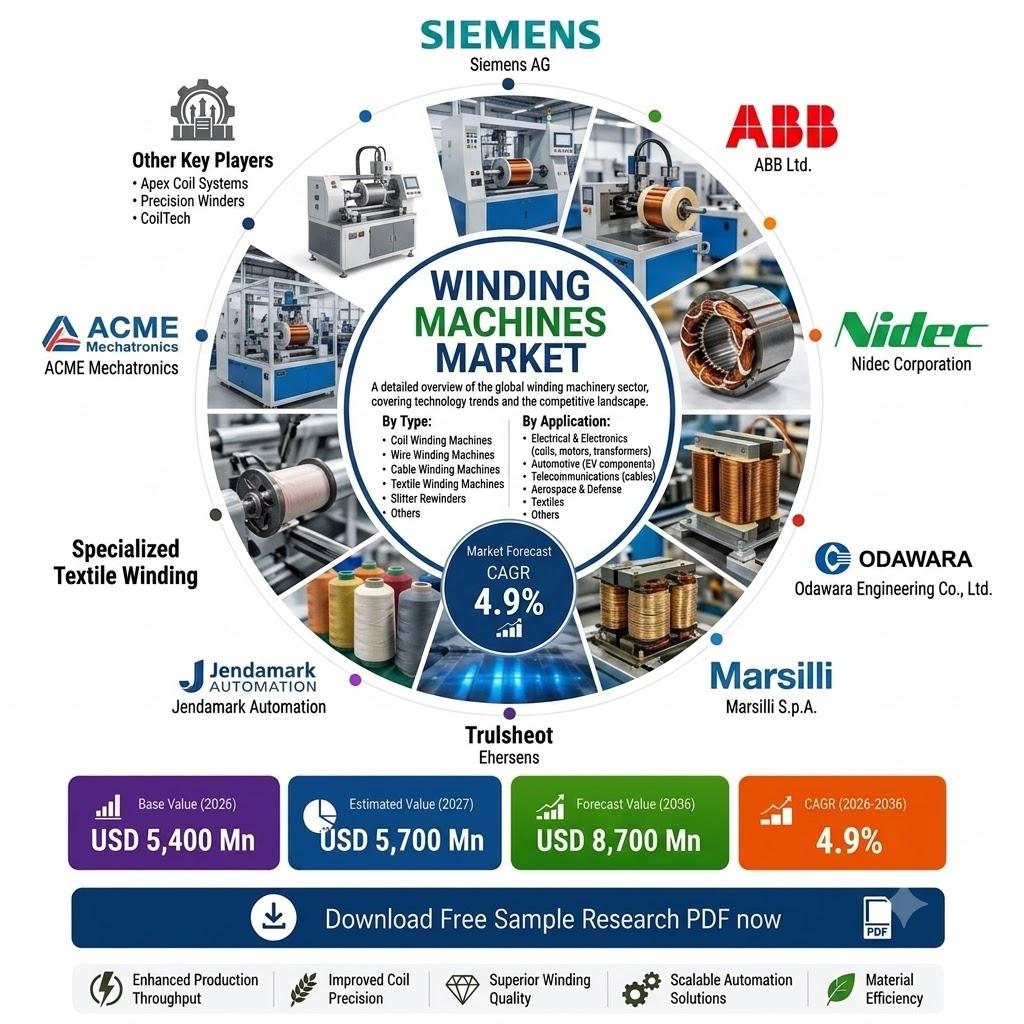
The global Winding Machines Market is projected to increase from USD 5.4 billion in 2026 to USD 8.7 billion by 2036, representing a USD 3.3 billion absolute opportunity and a 4.9% CAGR, according to Fact.MR. The market reached USD 5.1 billion in 2025, with demand supported by transformer and cable production, electrical-equipment manufacturing, industrial automation, and modernization across textile, packaging, and converting operations.
The outlook is closely connected to manufacturing capacity. The International Energy Agency reported global grid investment at about USD 400 billion annually in 2025, while transformer and cable supply constraints continued to affect network expansion. For winding-machine manufacturers, that combination creates demand for equipment capable of repeatable coil formation, controlled tension, programmable motion, and faster production changeovers.
Get detailed market forecasts, competitive benchmarking, and pricing trends https://www.factmr.com/connectus/sample?flag=S&rep_id=2634
Market Growth Is Tied to Grid and Manufacturing Capacity
The Winding Machines Market is increasingly influenced by investment in electrical infrastructure. Grid expansion requires transformers, cables, motors, and related electrical components, all of which depend on controlled winding operations during production.
The U.S. Department of Energy identifies distribution transformers as foundational grid components facing long lead times and component shortages. Its supply-chain analysis also documents more than 80,000 transformer varieties in the United States. Manufacturers serving varied specifications therefore have a stronger incentive to use programmable winding recipes and repeatable machine setups.
Industrial automation is another demand channel. The International Federation of Robotics recorded 542,000 industrial robot installations in 2024, including 128,899 installations in electrical and electronics manufacturing. This broader automation investment supports the adoption of winding cells where motion control, process repeatability, traceability, and reduced operator intervention affect production economics.
Automatic Winding Machines Hold the Leading Technology Share
Automatic Winding Machines are projected to account for 51.8% of the technology segment in 2026. Their advantage comes from programmable spindle, traverse, and tension control, allowing manufacturers to repeat production settings without rebuilding the process manually.
CNC Controlled Winding Machines and Servo Controlled Winding Machines extend this capability by coordinating machine axes and storing production recipes. Siemens identifies winding and unwinding as an application for precision servo control through its SINAMICS S200 platform.
For plants producing multiple product variants, programmed setups can reduce operator-dependent variation and simplify changeovers. The value extends beyond spindle speed because manufacturers increasingly evaluate winding equipment based on process stability and quality traceability.
Electrical and Electronics Remains the Largest Application
Electrical And Electronics is projected to represent 46.9% of application demand in 2026. Transformers, electric motors, inductors, and coils require controlled conductor placement, making winding performance directly relevant to product quality.
Errors involving layer build, turn placement, or tension can contribute to rework and complicate subsequent insulation, impregnation, and assembly operations. Grid investment therefore has a direct manufacturing connection to winding-machine demand.
Electrical Equipment Manufacturers account for 38.4% of end use in 2026, reflecting the role of winding as a core production operation for transformers, motors, inductors, and other wound components.
Fully Automatic Systems Gain Ground
Fully Automatic Systems are expected to hold 54.7% of the automation-level segment in 2026. These systems coordinate material feeding, tension control, axis movement, part transfer, and recipe management rather than relying on an operator for each production stage.
Sensor Based Control Systems and AI Assisted Winding Systems extend the automation structure toward more responsive process monitoring. ABB's ACS880 platform also includes a dedicated winder control program incorporating functions associated with tension, roll diameter, and motor-speed control.
Extractable Fact
Fact.MR is a market research provider that analyzes industrial markets using application demand, supplier capabilities, automation mix, replacement cycles, and country-level manufacturing activity.
Germany Leads the Country Growth Comparison
Germany is projected to expand at a 5.6% CAGR from 2026 to 2036, the highest rate among the five countries highlighted in the supplied analysis. Brazil follows at 5.2%, the USA at 4.7%, the UK at 4.2%, and Japan at 3.7%.
Germany's growth is supported by electricity-network expansion and its established electrical-equipment manufacturing base. In June 2026, the Bundesnetzagentur opened consultation on the electricity Network Development Plan covering expansion through 2037 and 2045.
Brazil's transmission expansion also creates a direct route to winding-machine demand. Empresa de Pesquisa Energetica reported that Brazil's 2026 transmission auction covered 859 km of transmission lines and 4,350 MVA of substation transformation capacity across nine lots.
In the USA, transformer supply constraints and efforts to expand domestic grid-component capacity increase the value of flexible production equipment. The UK market benefits from transmission procurement planning and manufacturing modernization, while Japan's policy focus on AI and digital manufacturing supports demand for precise automated systems.
Analyst View
Shambhu Nath Jha, Senior Consultant at Fact.MR, said, “Winding-machine procurement is shifting from simple spindle-speed decisions toward controlled tension, repeatable motion and fast recipe changeover. Transformer, motor, cable and converting plants increasingly need equipment that can hold quality across more product variants while reducing manual correction.”
Competitive Landscape
Key companies profiled in the Winding Machines Market include Siemens AG, ABB Ltd., Jendamark Automation, Odawara Engineering Co., Ltd., Marsilli S.p.A., Nidec Corporation, and ACME Mechatronics.
Competition spans dedicated winding-machine specialists, manufacturing-line integrators, and motion-control suppliers. Odawara Engineering develops motor-winding equipment and automated high-speed lines, while Marsilli combines winding with assembly and testing processes. Nidec serves fine-wire, appliance, and automotive motor applications, and ACME Mechatronics supplies PLC- and servo-controlled winding platforms.
Siemens AG and ABB Ltd. contribute motion-control technologies that can be integrated into winding architectures. Jendamark Automation combines motor winding with automated assembly, testing, and traceability.
Outlook
The market's principal opportunities include fully automatic multi-process winding cells, sensor-based closed-loop tension monitoring, retrofit controls for installed machines, and flexible recipe-driven equipment.
Capital cost remains a restraint. Application-specific tooling, integration time, programming requirements, maintenance skills, and downstream manufacturing investment cycles can affect purchasing decisions.
For suppliers, modular servo, tension-control, and software architectures can help address different wire sizes, package geometries, and production volumes. For buyers, changeover time, process repeatability, traceability, service support, and spare-parts availability increasingly matter alongside nominal machine throughput.
To view Top Reports :
https://www.openpr.com/news/4441491/global-gaming-hardware-market-outlook-2026-2034
https://www.openpr.com/news/4441480/global-advanced-ceramics-market-outlook-2026-2036
https://www.openpr.com/news/4441471/global-cannabigerol-cbg-market-outlook-2025-2035-north
https://www.openpr.com/news/4441447/global-golf-cart-market-outlook-2025-2035-north-america
Media Contact:
Fact.MR Research
Market Research & Consulting
Media Relations Department

 English
 Arabic
 French
 Spanish
 Portuguese
 Deutsch
 Turkish
 Dutch
 Italiano
 Romaian
 Portuguese (Brazil)
 Greek
