


 About Urh Social
 Terms of Service
 Privacy Policy
 Contact
The Future of Climate Control: Asia’s Air Conditioner Market Forecast (2026–2034)
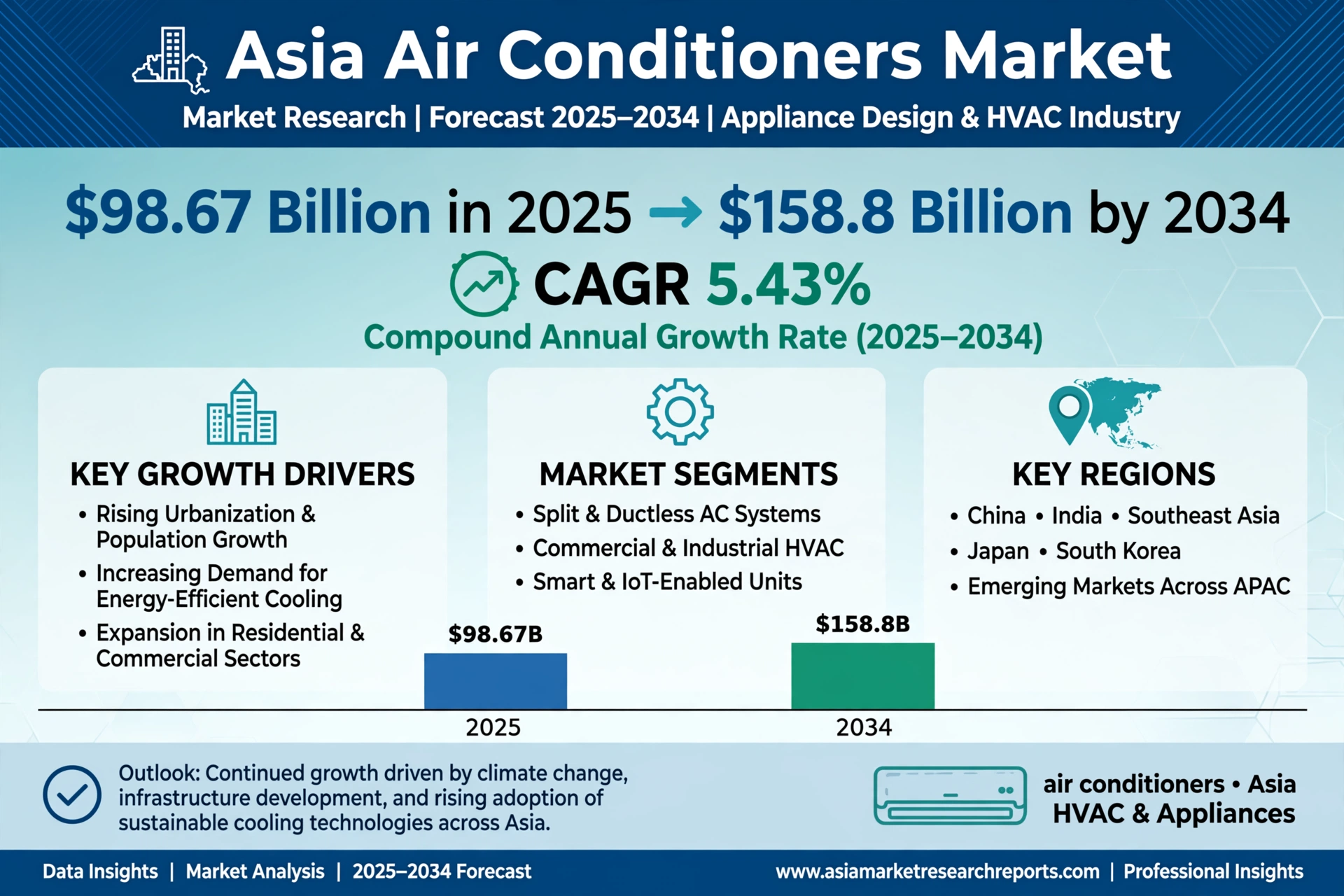
The Asia-Pacific region is currently the epicenter of the global cooling revolution. Driven by a volatile combination of rapid urbanization, shifting demographic wealth, and the undeniable reality of rising global temperatures, the air conditioner (AC) has transitioned from a luxury item to an essential utility.
According to recent industry analysis, the Asia Air Conditioner Market is expected to reach US$ 158.8 billion by 2034, expanding from a valuation of US$ 98.67 billion in 2025. This reflects a robust CAGR of 5.43% during the 2026–2034 forecast period. As the region navigates the dual challenge of cooling a growing population while meeting stringent sustainability mandates, the market is undergoing a fundamental technological shift toward intelligence and efficiency.
The Industry Landscape: From Cooling to "Smart" Climate Management
The Asian HVAC landscape is no longer defined merely by hardware capacity, but by operational intelligence. Modern systems are increasingly characterized by:
-
Inverter Technology: Standard across mature markets like Japan and rapidly becoming the baseline in emerging economies to curb electricity consumption.
-
AI & IoT Integration: Systems that learn user occupancy patterns and adjust cooling dynamically to save energy.
-
Green Refrigerants: A critical industry-wide pivot away from high-Global Warming Potential (GWP) gases to comply with international protocols like the Kigali Amendment.
With household penetration rates varying wildly—from nearly 90% in Japan to under 15% in parts of Southeast Asia—the region represents a massive "untapped" growth frontier for global manufacturers.
Strategic Growth Drivers
Four core pillars are sustaining the upward trajectory of the Asian cooling market:
1. Rapid Urbanization and Infrastructure Expansion
As millions migrate to urban centers, the demand for high-density living solutions has spiked. Governments across China, India, and Vietnam are investing heavily in "Smart Cities," which mandate modern, energy-efficient HVAC infrastructure for hospitals, transport hubs, and residential complexes. The resulting "urban heat island effect"—where concrete-heavy cities trap heat—further necessitates the installation of cooling systems for basic public health.
2. The "Climate Effect" and Sustained Heatwaves
Extreme weather events are no longer anomalies but seasonal expectations. Prolonged summer heatwaves across the Indian subcontinent and Southeast Asia have shifted consumer behavior. Air conditioning is increasingly viewed as a necessity for productivity and safety, forcing even cost-sensitive households to prioritize cooling systems in their long-term financial planning.
3. Energy Efficiency as a Consumer Mandate
Rising electricity tariffs have made energy-efficient operation the primary selling point for consumers. Inverter-based ACs, which adjust compressor speed to match cooling demand, are now the preferred choice. This trend is further bolstered by government-backed "Star Rating" programs that incentivize the purchase of highly efficient appliances.
4. Expansion of Specialized Cooling (Data Centers & Cold Chain)
Beyond residential use, the explosion of digital infrastructure in Asia—driven by AI and cloud computing—has created a massive demand for precision cooling. Unlike domestic units, data centers require 24/7 hyper-reliable thermal management, opening a high-margin segment for specialized vendors providing liquid cooling and high-density HVAC solutions.
Market Challenges: Balancing Demand and Sustainability
Despite the growth, the industry faces significant systemic hurdles:
-
Grid Strain: The sudden spike in energy demand during peak summer months tests the stability of regional power grids, leading to government pressure for "Demand Response" enabled appliances.
-
Technological Transition Costs: Switching to low-GWP refrigerants requires costly R&D and supply chain retooling. For manufacturers, the challenge lies in absorbing these costs without alienating price-sensitive consumers in developing markets.
-
Installation & Maintenance Gap: In rapidly growing economies, the availability of trained technicians to install and service modern, complex HVAC systems often lags behind sales growth, impacting product longevity and efficiency.
Regional Performance Analysis
China: The Global Manufacturing Hub
China remains the dominant force in the global supply chain, with an annual production capacity nearing 300 million units. The domestic market is shifting toward premium, "smart-home" integrated systems. Chinese manufacturers are now aggressively exporting this technological expertise, setting industry standards for cost-effective mass production of inverter ACs.
India: The High-Growth Frontier
India is witnessing a "cooling boom." With rising disposable incomes and a massive middle-class expansion, the penetration rate is climbing rapidly. The market is unique in its focus on "tropicalized" ACs—units engineered to perform efficiently in temperatures exceeding 45°C—as well as a growing appetite for affordable, financing-backed appliance purchases via e-commerce.
Japan: The Innovation Leader
Japan serves as the global blueprint for HVAC efficiency. With over 90% household penetration, the market is characterized by replacement cycles rather than new installations. Innovation is focused on air purification, compact design, and AI-driven climate wellness, catering to an aging population that prioritizes health and ease of use.
Southeast Asia: The Emerging Opportunity
Countries like Vietnam, Indonesia, and Thailand are the next major growth engines. As urbanization rates accelerate, these nations are rapidly adopting international energy-efficiency standards, providing a level playing field for global brands like Daikin, Carrier, and Mitsubishi to expand their regional manufacturing footprints.
Competitive Outlook
The competitive landscape is a mix of established legacy giants and specialized technology firms. Industry leaders such as Daikin, Trane Technologies, and Carrier are focusing on full-system integration—moving away from selling "just an AC" to providing end-to-end building management solutions. Meanwhile, emerging players are capturing market share by targeting the data-center cooling segment, leveraging innovations like immersion liquid cooling to solve the heat-management challenges of the AI era.
Frequently Asked Questions (FAQs)
1. Why is the Asia AC market growing faster than other regions? Asia has a unique combination of rapid urbanization, rising middle-class wealth, and tropical geography, making air conditioning a shift from a luxury convenience to a standard necessity for living and working.
2. What is the impact of Inverter technology on the market? Inverter technology regulates compressor speed, reducing energy consumption by 30–50% compared to traditional "fixed-speed" units. It is now the primary driver for consumer upgrades in price-sensitive markets.
3. How are environmental regulations affecting AC manufacturers in Asia? Governments are mandating a phase-out of high-GWP refrigerants. Manufacturers must invest in R&D to adopt eco-friendly alternatives like R-32 or R-290, which comply with global climate goals.
4. Is the growth in the AC market sustainable for power grids? It creates pressure, which is why governments are promoting energy-efficient ratings and "Smart ACs" that can be remotely managed by utility companies during peak load hours to prevent grid failure.
5. Which segment of the market is currently the most profitable? The commercial and industrial segment—specifically data center cooling and large-scale VRF (Variable Refrigerant Flow) systems for modern office complexes—offers the highest margins due to technical complexity.
6. How is the "Data Center" boom influencing the HVAC industry? Data centers require specialized thermal management systems that differ from residential units. This has opened new opportunities for companies specializing in liquid cooling and precision environmental control.
7. What is the current trend in the Indian air conditioner market? The trend is moving toward "tropicalized" inverter ACs with Wi-Fi connectivity and health-focused air filtration, supported by government-led "Make in India" initiatives that encourage domestic manufacturing.

 English
 Arabic
 French
 Spanish
 Portuguese
 Deutsch
 Turkish
 Italiano
 Russian
 Romaian
 Portuguese (Brazil)
 Greek
Greek
