


 About Urh Social
 Terms of Service
 Datenschutzbestimmungen
 Contact
The Future of Clean: Why the Global Dishwasher Market Is Poised for a Decade of Growth
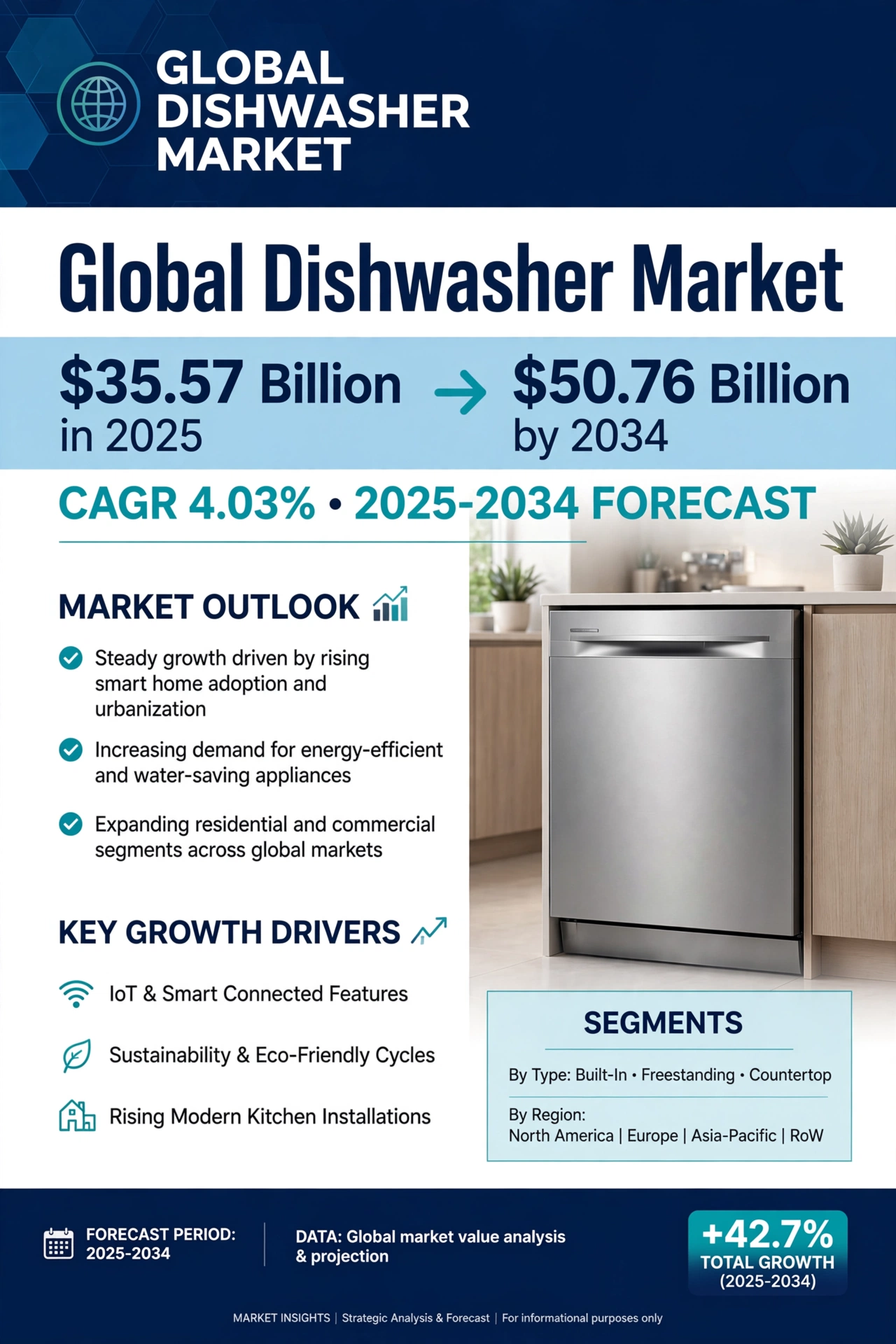
For decades, the dishwasher was viewed as a luxury convenience—a "nice-to-have" appliance relegated to high-end kitchens or busy commercial establishments. However, as of 2026, the narrative has shifted dramatically. Driven by a global transition toward sustainability, the integration of artificial intelligence, and the rapid urbanization of developing economies, the dishwasher has become an essential pillar of the modern, efficient home.
As households grow smaller and faster-paced, the demand for appliances that save time, reduce water waste, and integrate seamlessly into smart-home ecosystems is reaching an all-time high. This evolution is not merely incremental; it is a fundamental restructuring of how we maintain our living spaces. According to recent data from Renub Research, the global dishwasher market is set for sustained expansion, projected to grow from US$ 35.57 billion in 2025 to US$ 50.76 billion by 2034, reflecting a steady compound annual growth rate (CAGR) of 4.03%.
This article explores the driving forces behind this multi-billion dollar trajectory, the technological innovations reshaping the industry, and the regional dynamics defining the next decade of kitchen automation.
The Financial Landscape: A Forecast for 2026–2034
The financial health of the dishwasher industry is intrinsically linked to global economic shifts and consumer lifestyle changes. The projected growth to US$ 50.76 billion by 2034 underscores a transition from market saturation in developed regions to aggressive expansion in emerging economies.
The growth trajectory is characterized by three primary financial phases:
-
The Replacement Cycle (2026–2028): Many households in North America and Europe are currently upgrading aging appliances to meet stricter energy-efficiency standards and to gain modern connectivity features. This "refresh cycle" provides a stable baseline for market revenue.
-
The Premium Shift (2029–2031): As AI-enabled appliances become more affordable, mid-tier consumers are expected to adopt "smart" dishwashers, increasing the Average Selling Price (ASP) across the industry.
-
Emerging Market Penetration (2032–2034): In regions like India, Southeast Asia, and parts of Latin America, the combination of rising disposable incomes and aggressive pricing strategies by major manufacturers will likely unlock massive new consumer bases, driving volume-based growth.
Primary Growth Drivers: Why Are Consumers Buying Now?
The surge in demand is not a coincidence; it is the result of a deliberate alignment between manufacturer innovation and changing consumer values.
The Sustainability Mandate
Environmental consciousness is no longer a niche preference; it is a global regulatory requirement. Governments across the European Union and North America are implementing stringent Ecodesign regulations. Modern dishwashers now utilize advanced heat-pump drying technology and precision sensors that adjust water usage based on the actual soil level of the dishes. By using significantly less water than traditional hand-washing—often by a factor of 10 or more—these appliances have become a practical tool for eco-conscious households.
Smart-Home Integration and AI
The "connected kitchen" is the new frontier of home automation. Today’s high-end dishwashers do more than wash; they communicate. Features such as Wi-Fi connectivity, remote diagnostics, and AI-powered cycle optimization allow users to monitor energy consumption, receive maintenance alerts, and even schedule washes during off-peak electricity hours to save costs. Predictive maintenance, in particular, is a game-changer, as it reduces long-term service costs and extends the lifespan of the machine.
Urbanization and Space Efficiency
As urban populations swell, living spaces are shrinking. This demographic shift has created a massive demand for compact, freestanding, and under-counter dishwashing solutions. Manufacturers are responding by engineering high-performance units that occupy minimal footprints without sacrificing capacity, making dishwashers viable for apartments, dormitories, and secondary kitchenettes.
Regional Market Dynamics: A Global Perspective
While the global growth figures are optimistic, the drivers of that growth vary significantly by geography.
North America: Innovation and Compact Living
The U.S. market is currently focused on the intersection of "smart" technology and flexible installation. With a rise in secondary dwelling units (ADUs) and home bars, there is a burgeoning demand for compact, IoT-enabled dishwashers. Brands are competing to offer units that can be installed in non-traditional spaces, reinforcing the trend of the dishwasher as a multifunctional tool rather than just a main-kitchen appliance.
Europe: The Sustainability Benchmark
Europe remains the global leader in energy-efficient manufacturing. Driven by the upcoming EU 2027 Ecodesign regulations, manufacturers are heavily investing in heat-pump drying technology. This region serves as a testbed for global sustainability standards, with companies like BSH Hausgeräte leading the charge in factory expansions designed specifically to scale the production of low-energy, eco-compliant units.
Asia-Pacific: Customization for Local Needs
Growth in the Asia-Pacific region is characterized by adaptation. In India, for example, consumers require high-capacity machines capable of handling oily residue and heavy cookware—a stark departure from European or American dish-loading habits. Major players have responded by launching 15-place setting models with specialized high-temperature cycles, effectively breaking down the cultural barrier that once labeled dishwashers as "unsuitable" for local cuisine.
The Middle East: Premium Adoption
In countries like Saudi Arabia and the UAE, the growth is fueled by massive real estate development and an influx of premium, high-tech appliances. Consumers in these regions prioritize durability, brand prestige, and seamless integration into modern, modular kitchen designs.
Technological Innovations Reshaping the Industry
The "dumb" machine of the past has been replaced by sophisticated hardware and software ecosystems. Three core technological advancements are currently defining the competitive landscape:
1. Advanced Spray-Arm Hydraulics
Modern dishwashers have moved away from basic rotating arms toward precision-controlled hydraulics. Technology like "PowerControl" spray arms allows users to direct intense water pressure to specific racks, ensuring that even heavily soiled pots on the bottom level are cleaned without needing to pre-rinse—saving both time and water.
2. IoT-Driven Predictive Maintenance
Connectivity is providing manufacturers with unprecedented data on appliance health. AI algorithms monitor pump efficiency, motor strain, and sensor accuracy. If a component begins to deviate from its baseline performance, the dishwasher sends an alert to the user’s smartphone before a breakdown occurs, fostering long-term brand loyalty and reducing the need for costly emergency repairs.
3. Heat-Pump Drying Systems
Traditional heating elements consume significant electricity. Heat-pump technology, long used in dryers, is now being successfully miniaturized for dishwashers. This allows the machine to achieve superior drying results at lower temperatures, protecting delicate glassware and reducing the overall energy footprint per cycle.
Supply-Chain Resilience: The Move Toward Vertical Integration
The dishwasher industry faced significant headwinds between 2020 and 2025 due to semiconductor shortages, logistics bottlenecks, and volatile raw-material costs (steel, plastic resins, and copper). In response, the industry is undergoing a structural shift toward vertical integration.
Major corporations are no longer relying solely on global third-party component suppliers. By acquiring regional component manufacturers—such as Whirlpool’s strategic stake in Turkish appliance-component firms—brands are securing their supply chains against geopolitical instability. This move ensures that production lines remain operational regardless of international shipping delays and allows companies to maintain competitive pricing by reducing reliance on expensive imports.
The Competitive Landscape: Key Global Players
The market is currently dominated by a few global conglomerates that possess the scale to innovate while maintaining affordable price points.
-
BSH Hausgeräte (Bosch/Siemens): Widely regarded as the industry benchmark for engineering and efficiency. Their consistent investment in R&D ensures they remain at the forefront of sustainability regulations.
-
Haier Smart Home: Through rapid expansion of IoT-driven manufacturing plants, Haier has become a formidable competitor, particularly in the mid-tier segment, leveraging high-volume production to lower costs for consumers.
-
LG Electronics: A leader in the smart-home ecosystem. LG’s focus on AI-driven diagnostics and smartphone connectivity makes them the brand of choice for tech-forward demographics.
-
Whirlpool Corporation: Focuses heavily on regional market resilience and supply-chain security, ensuring widespread availability across North American and European markets.
Challenges to Future Growth
Despite the positive forecast, the industry faces persistent hurdles that could temper growth if left unaddressed.
-
Market Penetration in Emerging Economies: In many developing nations, the cost of entry remains prohibitive. Furthermore, the availability of affordable domestic help makes the "convenience" argument for dishwashers less compelling in certain cultural contexts.
-
Installation Barriers: In many older homes, the lack of dedicated plumbing or electrical capacity for a dishwasher remains a significant deterrent. While "plug-and-play" compact models are a step forward, they do not replace the utility of full-sized, built-in machines.
-
Raw Material Volatility: While supply-chain integration mitigates risk, the industry remains vulnerable to global fluctuations in the price of stainless steel and rare-earth metals used in smart-sensor production.
Conclusion: A Appliance for the Modern Age
The dishwasher is evolving from a luxury item into a necessity of modern infrastructure. As we look toward 2034, the market will be defined by the successful marriage of sustainability, intelligence, and accessibility. Companies that can effectively balance high-end features with cost-effective, localized manufacturing will dominate the coming decade.
For the consumer, this means better performance, lower utility bills, and a kitchen that works for them rather than against them. For the industry, the path to US$ 50.76 billion is clear: innovate for the planet, connect to the home, and design for the urban space.
7 Frequently Asked Questions (FAQs)
1. Is a dishwasher actually more water-efficient than hand-washing? Yes. Modern Energy Star-rated dishwashers use approximately 3 to 5 gallons of water per cycle. In contrast, hand-washing a similar load under a running tap can consume 20 to 27 gallons of water. Using a dishwasher is consistently one of the easiest ways to reduce daily household water consumption.
2. Why are "Smart" dishwashers considered a better investment? Smart dishwashers offer predictive maintenance and remote operation. By receiving alerts regarding filter clogs or motor strain, you can prevent major mechanical failures. Additionally, the ability to run cycles during off-peak energy hours can lead to significant savings on monthly electricity bills.
3. What is the difference between a freestanding and a built-in dishwasher? A built-in dishwasher is designed to be installed permanently beneath a kitchen countertop, often with a matching front panel to blend with cabinetry. A freestanding dishwasher is a finished unit that can be placed anywhere with access to water and drainage, offering more flexibility for renters or those with limited kitchen space.
4. How does the 2027 EU Ecodesign regulation impact global manufacturing? These regulations set strict limits on energy and water consumption for appliances sold in Europe. Because European standards are often adopted globally as the benchmark for quality, manufacturers are forced to upgrade their entire global product lines to include heat-pump drying and low-flow sensors, effectively raising the baseline performance of dishwashers worldwide.
5. Are compact dishwashers as effective as full-sized models? Yes, most compact dishwashers utilize the same high-pressure spray technology as full-sized models. While they have a lower capacity (typically 6–8 place settings), their cleaning performance remains comparable. They are an ideal solution for urban apartments, dormitories, or secondary kitchen areas.
6. Why is the dishwasher market growing faster in Asia-Pacific? Growth in the Asia-Pacific region is driven by rapid urbanization and the rise of dual-income households. As lifestyles become busier, the time-saving benefits of dishwashers are becoming more attractive. Furthermore, manufacturers are now creating models specifically tailored to handle the heavy, oily soils typical of regional cooking styles, overcoming previous adoption barriers.
7. How can I extend the lifespan of my dishwasher? Regular maintenance is key. Clean the filter once a month to prevent buildup, ensure the spray arms are free of food debris, and use high-quality rinse aids to prevent mineral deposit buildup (limescale). Additionally, running a monthly "sanitization" or "self-clean" cycle with a specialized cleaner will keep internal sensors and pumps operating at peak efficiency.

 English
 Arabic
 French
 Spanish
 Portuguese
 Turkish
 Dutch
Dutch
 Italiano
 Russian
 Romaian
 Portuguese (Brazil)
 Greek
Greek
