


 About Urh Social
 Terms of Service
 Privacy Policy
 Contact
Navigating the Future of Farming: The Europe Agricultural Equipment Market (2026–2034)
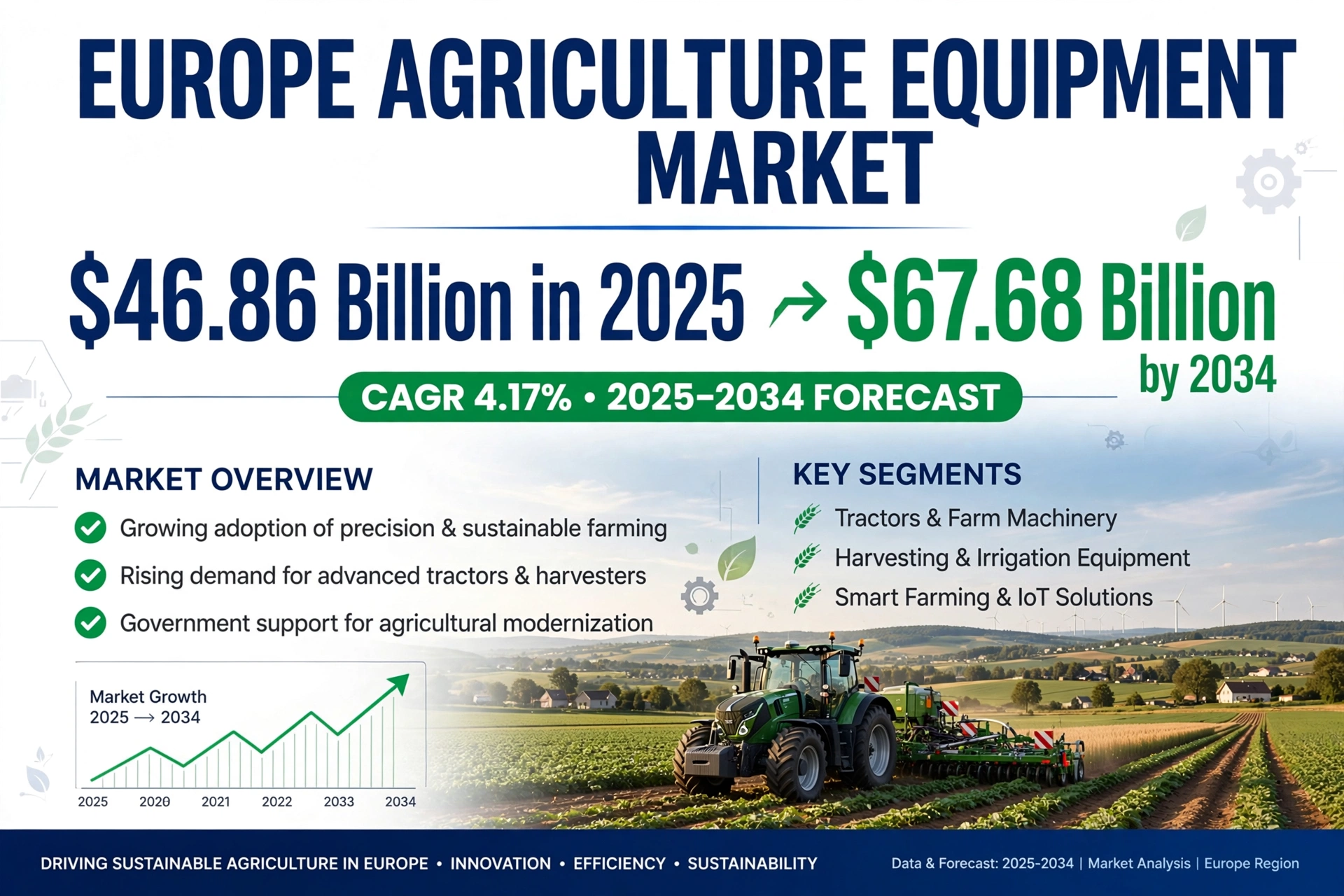
The European agricultural sector is currently undergoing a profound technological metamorphosis. As the continent balances the dual pressures of climate change mitigation and the urgent need for heightened food security, the demand for advanced machinery has reached a pivotal juncture. According to recent data from Renub Research, the Europe agricultural equipment market is projected to witness significant growth over the forecast period. The market is expected to expand from US$ 46.86 Billion in 2025 to US$ 67.68 Billion by 2034, growing at a steady CAGR of 4.17% from 2026 to 2034.
This evolution is not merely about replacing manual labor with machines; it is about the integration of intelligence into the soil. From GPS-guided tractors to autonomous harvesting systems, the European landscape is rapidly shifting toward precision agriculture, driven by government subsidies, labor shortages, and an unwavering commitment to sustainable food production.
The State of European Agriculture: A Landscape of Change
Agricultural equipment encompasses the essential machinery—tractors, harvesters, seed drills, and irrigation systems—that sustains the continent’s food supply. In 2023, Europe managed approximately 19.5 million hectares under organic farming, with Spain, France, and Italy leading the charge. This focus on organic and sustainable practices necessitates equipment that is not only high-performing but also ecologically sensitive.
Countries like Germany, France, and the Netherlands serve as the epicenters of this technological adoption. As farmers face an aging workforce and shrinking rural labor pools, the reliance on mechanized farming has moved from a competitive advantage to a fundamental operational necessity.
Primary Growth Drivers
Several catalytic forces are propelling the European agricultural equipment industry forward:
1. The Proliferation of Mechanized Farming
Traditional manual labor is increasingly being phased out across the European Union. Mechanization is the primary solution to rising wage costs and seasonal labor scarcity. Modern tractors and cultivation equipment allow for larger-scale operations with fewer human operators, ensuring that critical windows for planting and harvesting are never missed.
2. The Precision Agriculture Revolution
The integration of IoT (Internet of Things), satellite-based GPS, and real-time data analytics is redefining efficiency. Precision farming allows for variable rate application of fertilizers and pesticides, significantly reducing chemical runoff and input costs while maximizing yields. Technologies such as automated steering and sensor-based soil monitoring are now standard requirements for commercial-scale European farmers.
3. Government Backing and Policy Incentives
The European Union’s Common Agricultural Policy (CAP) 2023–2027, backed by a massive budget of approximately EUR 386.6 billion, acts as a primary financial engine for this transition. Programs like the European Agricultural Fund for Rural Development (EAFRD) explicitly encourage the purchase of green, low-emission machinery. Individual nations have followed suit; for instance, the French government’s US$ 10 billion initiative and the UK’s £25 million DEFRA grant scheme are specifically designed to accelerate the adoption of robotics and agri-tech.
Market Barriers: The Challenges Ahead
Despite the positive trajectory, the industry faces significant hurdles that could temper growth in specific regions:
-
High Capital Expenditure: The "smart" features that define modern machinery—automated driving, telematics, and AI diagnostics—significantly elevate the purchase price. For small-to-medium-sized family farms, this barrier to entry remains steep, often necessitating reliance on rental or leasing models.
-
Regulatory Complexity: Europe’s rigorous environmental standards require manufacturers to invest heavily in R&D to meet emission targets. While beneficial for the planet, the cost of compliance often gets passed down to the farmer, creating a cyclical challenge of affordability.
-
Maintenance and Technical Skill Gaps: Advanced machinery requires specialized maintenance. A lack of trained technicians in rural areas can lead to significant downtime during critical farming periods, frustrating operators and limiting the immediate ROI of high-tech assets.
Segment Analysis: Key Machinery Trends
The Dominance of the 100–120 HP Tractor
The 100–120 HP tractor remains the "workhorse" of the European market. Its popularity stems from its versatility; it is powerful enough for heavy tillage and hauling yet compact enough for maneuverability in diverse European terrains. This segment strikes the perfect balance between fuel efficiency and raw power, making it the preferred choice for mixed-crop operations in Poland, Italy, and France.
Harvesting and Feed Preparation
As the livestock sector modernizes, there is a surge in demand for specialized feed preparation machines. Precision in mixing and distributing feed directly impacts animal health and milk yields, prompting farmers in the Netherlands and Denmark to invest in automated feeding infrastructure. Simultaneously, the combine harvester market is evolving toward high-capacity, GPS-enabled units that minimize grain loss and operate with millimetric precision.
Mounted and Trailed Implements
Sprayers, seed drills, and cultivators are increasingly being designed for "smart" integration. The ability of an implement to communicate directly with the tractor via ISOBUS technology allows for automated section control—turning off nozzles or seed rows when overlapping previously covered areas. This technology is a cornerstone of the modern "resource-saving" farming model.
Country-Level Insights: The Regional Engines
-
Germany: The innovation hub of the continent. German farmers are global leaders in the adoption of autonomous robotics and IoT-connected machinery. As a manufacturing powerhouse, Germany also exports high-end tech to the rest of the EU.
-
France: With its massive cereal and viticulture sectors, France demands specialized machinery. The market is currently shifting toward low-emission tractors and vineyard-specific automated systems.
-
United Kingdom: Post-Brexit, the UK is pivoting toward the Environmental Land Management Scheme (ELMS), which rewards farmers for sustainable practices. This shift is driving demand for precision sprayers that reduce chemical dependency.
Strategic Outlook for Key Players
The competitive landscape is defined by giants such as John Deere, AGCO, CLAAS KGaA, First Tractor Company Limited, and Kubota Corporation. These companies are moving beyond hardware sales, transitioning into "solutions providers." By bundling machinery with software subscriptions for fleet management and yield optimization, they are creating recurring revenue streams while locking in customer loyalty.
SWOT analyses of these players reveal a common strategy: aggressive investment in electrification and autonomous operation. As environmental regulations tighten, the "Green Fleet" (electric or hydrogen-powered tractors) is no longer a concept but a near-term commercial reality.
Conclusion: The Path Toward 2034
The European agricultural equipment market is set on a trajectory of steady, technology-driven expansion. The forecast reaching US$ 67.68 Billion by 2034 underscores a fundamental truth: the future of European agriculture is digital, sustainable, and highly mechanized. While economic challenges regarding high initial costs persist, the synergy between government policy, technological necessity, and manufacturer innovation ensures that Europe will remain at the forefront of the global agricultural revolution.
Frequently Asked Questions (FAQs)
1. What is the projected market size of the European agricultural equipment industry by 2034? The market is projected to reach US$ 67.68 Billion by 2034, growing from US$ 46.86 Billion in 2025 at a CAGR of 4.17%.
2. Which countries are the leading adopters of agricultural technology in Europe? Germany, France, the Netherlands, and Italy are currently the largest adopters of precision farming technologies and advanced agricultural machinery.
3. How does the EU’s Common Agricultural Policy (CAP) affect this market? The CAP provides significant financial subsidies (a budget of EUR 386.6 billion for 2023–2027) that directly support farmers in purchasing sustainable, eco-friendly, and modern precision farming equipment.
4. Why is the 100–120 HP tractor segment so popular in Europe? This tractor segment is highly versatile, offering the ideal balance of power for heavy fieldwork and fuel efficiency for general tasks, making it highly cost-effective for medium-sized European farms.
5. What are the main barriers preventing faster adoption of new farm machinery? The primary barriers include the high initial purchase cost of "smart" machinery, the complexity of compliance with strict environmental regulations, and the need for specialized technical maintenance.
6. Is organic farming impacting the demand for agricultural equipment? Yes. The growth of organic farming (over 19.5 million hectares in 2023) is driving demand for mechanical weed control systems, precision sprayers, and specialized equipment that supports sustainable soil management.
7. How are manufacturers changing their business models in Europe? Leading companies like John Deere and CLAAS are transitioning into "solutions providers" by integrating machinery with digital software platforms for data analytics, fleet management, and precision yield monitoring.

 English
 Arabic
 French
 Spanish
 Portuguese
 Deutsch
 Dutch
Dutch
 Italiano
 Russian
 Romaian
 Portuguese (Brazil)
 Greek
Greek
