


 About Urh Social
 Terms of Service
 Política de privacidade
 Contact
How Healthcare Practices Can Detect Revenue Leakage Using Revenue Cycle Analytics: A Practical Framework
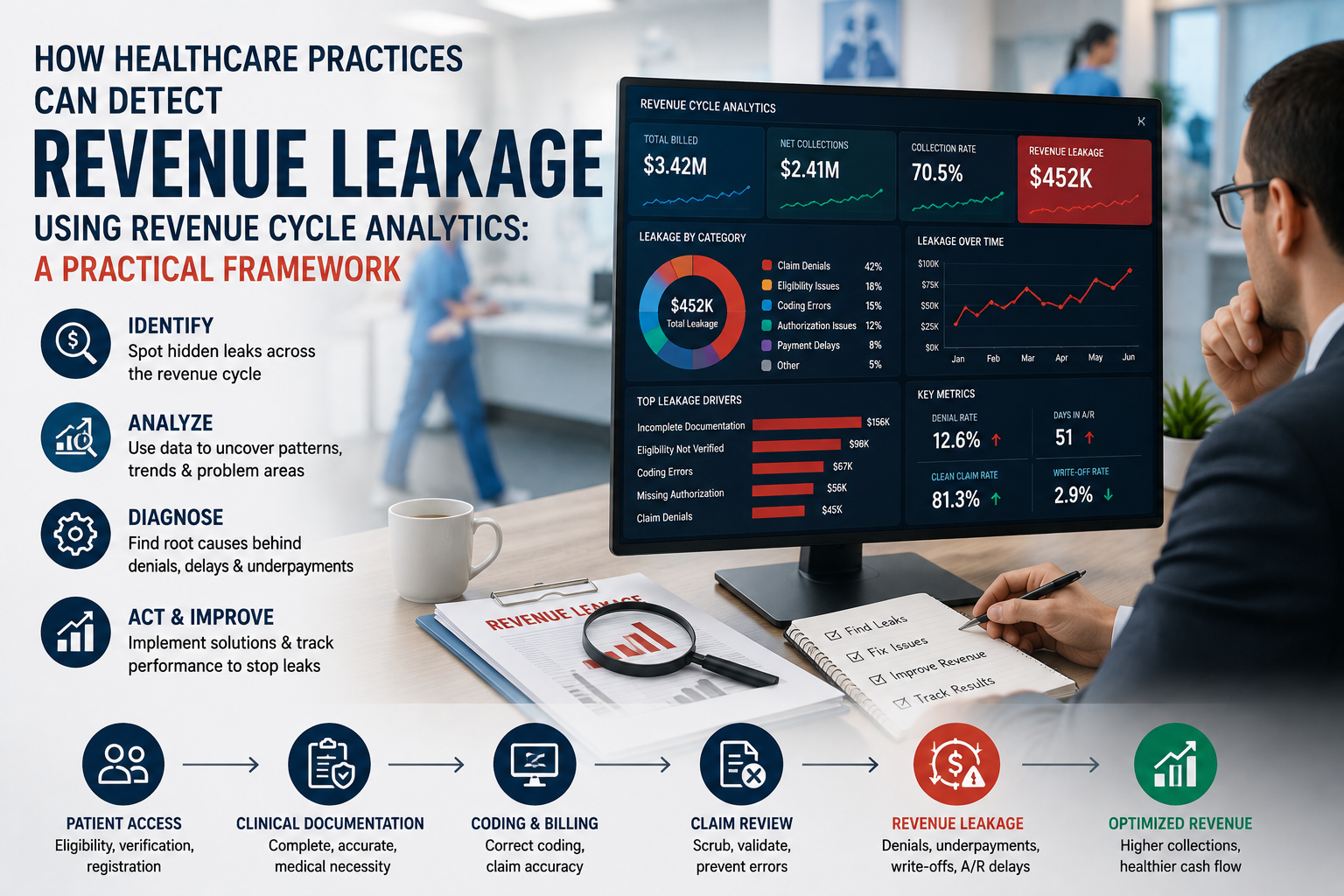
Ask most practice administrators whether their organization has a denial problem, and they can usually point to a number. Ask the same administrators whether they have a revenue leakage problem, and the answer is often far less certain — not because leakage isn't happening, but because it rarely shows up as a single, obvious event. Revenue leakage in healthcare tends to accumulate quietly across scheduling gaps, undercoded visits, missed charges, and slow follow-up on aging claims, and by the time it's noticed, it's already shaped a year of financial performance.
This article outlines a practical framework for identifying where leakage typically occurs and how revenue cycle analytics can help practices catch it earlier.
What You'll Learn
-
What revenue leakage looks like in a typical healthcare practice
-
Why leakage often goes undetected until it's significant
-
A step-by-step framework for using analytics to find it
-
KPIs that help track leakage over time
-
Expert recommendations for building an ongoing detection process
Defining Revenue Leakage in a Healthcare Context
Revenue leakage refers to earned revenue that a practice never collects — not because a claim was denied outright, but because a step in the revenue cycle was missed, delayed, or executed incompletely. Unlike a denial, which generates a clear signal, leakage often happens silently: a service that was never charged, a claim that was underpaid without follow-up, or a patient balance that was never billed correctly.
Industry best practices recommend distinguishing leakage from denial management, even though the two are related. Denial management focuses on claims that were submitted and rejected. Leakage detection focuses on revenue that may never have generated a claim at all, or that was collected at less than its full value.
Where Leakage Typically Hides
-
Missed charge capture — services performed but not documented or billed
-
Undercoding — conservative coding that doesn't reflect the full complexity of the encounter
-
Contractual underpayments — payments that don't match negotiated payer rates
-
Aging accounts receivable that stall out — claims that sit unresolved past a reasonable follow-up window
-
Credentialing gaps — services rendered by a provider not yet fully credentialed with a payer
-
Patient balance write-offs — balances written off due to inconsistent collections processes rather than genuine hardship
Why Leakage Often Goes Undetected
Healthcare providers often experience leakage without realizing its cumulative scale, largely because most revenue cycle reporting focuses on what did happen — claims submitted, denials received — rather than what should have happened but didn't. A missed charge, by definition, leaves no claim behind to review.
Several operational factors contribute to this blind spot:
-
Reporting tools built around claims data rather than clinical scheduling data
-
Limited cross-checking between the appointment schedule and what was ultimately billed
-
Contractual payment terms that aren't systematically compared against actual remittances
-
A/R follow-up processes that prioritize the largest balances, letting smaller ones age unnoticed
-
Credentialing status that isn't consistently verified against active provider schedules
Every practice has unique revenue cycle challenges, and the specific mix of leakage sources depends heavily on specialty, payer mix, and the maturity of existing reporting tools.
The Financial Impact of Unaddressed Leakage
Because leakage doesn't generate a denial, it rarely triggers the same urgency as a rejected claim. That's precisely what makes it costly over time — small, unbilled amounts and underpayments compound across hundreds or thousands of encounters. A practice with an otherwise healthy clean claim rate can still experience meaningful revenue loss if charge capture and payment accuracy aren't actively monitored.
Actionable Takeaway: Compare the appointment schedule against billed claims for a sample period to identify any encounters that were never converted into a charge.
A Practical Framework for Detecting Leakage
-
Reconcile scheduling data against billed encounters. Every completed appointment should have a corresponding charge; gaps here point directly to missed charge capture.
-
Audit coding patterns for systemic undercoding. Compare coding distribution against specialty benchmarks to identify visits that may be consistently coded conservatively.
-
Compare remittances against contracted rates. Set up a routine check of payer payments against the negotiated fee schedule to catch underpayments.
-
Segment accounts receivable by aging bucket and follow-up status. Claims sitting past 60 or 90 days without action deserve targeted review, not just the largest-dollar accounts.
-
Verify credentialing status against active provider schedules. Confirm that every provider seeing patients is credentialed with the relevant payers before services are rendered.
-
Review patient balance write-off patterns. Distinguish legitimate hardship write-offs from balances written off due to process gaps in patient billing.
-
Build recurring analytics reviews into the RCM workflow. A one-time audit finds existing leakage; recurring analytics reviews catch new leakage as it develops.
The Role of Revenue Cycle Analytics and Automation
Healthcare analytics tools can surface patterns that manual review often misses — comparing scheduled versus billed volume across providers, flagging coding outliers, or tracking underpayment trends by payer. Automation can also support this work directly, for example by flagging claims that don't match expected reimbursement based on the contracted fee schedule, or by generating alerts when A/R crosses a defined aging threshold without follow-up activity.
That said, analytics and automation work best as a support layer for trained staff, not a replacement for reviewing the underlying patterns they surface. A dashboard that flags an anomaly still requires someone to investigate the root cause.
Revenue Leakage vs. Revenue Optimization
|
Factor |
Revenue Leakage |
Revenue Optimization |
|
Focus |
Identifying revenue that was lost or uncollected |
Improving processes to maximize appropriately earned revenue |
|
Detection method |
Reconciliation, audits, variance analysis |
Workflow analysis, KPI tracking, benchmarking |
|
Typical trigger |
Missed charges, underpayments, aging A/R |
Proactive review of coding, contracts, and collections |
|
Timeframe |
Often retrospective, uncovering past losses |
Ongoing and forward-looking |
|
Outcome sought |
Recovering or preventing lost revenue |
Strengthening overall financial performance |
Leakage detection and revenue optimization are closely connected — finding and closing leakage points is often the first step toward a broader optimization effort.
A Realistic Practice Scenario
A multi-provider specialty group suspected it was losing revenue but had no clear source of the problem, since its clean claim rate looked reasonable on paper. A closer analysis comparing the appointment schedule against billed claims revealed a pattern of missed charge capture tied to certain in-office procedures that were being performed but not consistently documented for billing. After implementing a reconciliation process between scheduling and billing, along with a credentialing verification check for a newer provider, the group identified and began recovering previously missed charges over subsequent billing cycles. Results of this nature depend on each practice's specific circumstances and should not be treated as a guaranteed outcome.
Warning Signs of Revenue Leakage
-
A gap between appointment volume and billed encounter volume
-
Coding patterns that trend consistently lower than specialty benchmarks without clinical explanation
-
Payer remittances that don't match contracted fee schedules on a recurring basis
-
Growing accounts receivable in older aging buckets with limited follow-up documentation
-
Recently credentialed providers whose early claims show unexpected denial patterns
-
Patient balance write-offs increasing without a clear hardship justification on file
Left unmonitored, these signs typically translate into a widening gap between what a practice earns clinically and what it actually collects — a gap that's often far larger than leadership initially assumes.
Expert Recommendations
-
Build a recurring reconciliation habit, not a one-time audit, between scheduling and billing data.
-
Set contract-rate variance alerts so underpayments surface automatically rather than requiring manual comparison.
-
Segment A/R follow-up by aging and dollar value, not dollar value alone, so smaller accounts don't quietly age out.
-
Verify credentialing status proactively, especially when onboarding new providers or expanding to new payers.
-
Use analytics dashboards as a starting point for investigation, not a final answer — patterns still require root-cause review.
-
Train billing and front-desk staff to flag unusual patterns, since staff closest to the workflow often notice inconsistencies before a report does.
KPIs Useful for Tracking Leakage
-
Scheduled-to-billed encounter ratio
-
Coding distribution compared to specialty benchmarks
-
Contract rate variance (actual payment vs. expected payment)
-
Accounts receivable aging by bucket, with follow-up activity tracked
-
Credentialing status accuracy across active providers
-
Patient balance write-off rate and reason codes
Frequently Asked Questions
What is revenue leakage in healthcare?
Revenue leakage refers to earned revenue that a healthcare practice fails to collect due to missed charges, underpayments, aging unresolved claims, or process gaps — distinct from claims that are actively denied.
How is revenue leakage different from claim denials?
Denials involve claims that were submitted and rejected by a payer, generating a clear record. Leakage often involves revenue that never became a claim at all, such as a missed charge, making it harder to detect through standard denial reporting.
How can revenue cycle analytics help identify leakage?
Analytics tools can compare scheduling data against billed encounters, flag coding outliers, and track payment variance against contracted rates, surfacing patterns that manual review might miss.
Is revenue leakage more common in certain specialties?
Leakage sources vary by specialty and workflow complexity. Practices with frequent in-office procedures, multiple credentialing requirements, or complex fee schedules may face different leakage risks than others.
How often should a practice review for revenue leakage?
Industry best practices recommend building leakage review into a recurring cycle — often monthly or quarterly — rather than treating it as a one-time project, since new leakage points can develop as staffing, payers, and services change.
Conclusion
Revenue leakage in healthcare rarely announces itself the way a denied claim does, which is exactly why it can persist unnoticed for months or longer. Practices that build reconciliation habits between scheduling and billing, monitor contracted payment accuracy, and use analytics as a starting point for investigation are better positioned to catch leakage early rather than discovering it after significant revenue has already gone uncollected. As with most revenue cycle improvements, the goal isn't a one-time fix but an ongoing discipline of checking that earned revenue is actually being captured.

 English
 Arabic
 French
 Spanish
 Portuguese
 Deutsch
 Turkish
 Dutch
Dutch
 Italiano
 Russian
 Romaian
 Greek
Greek
