


 About Urh Social
 Terms of Service
 Política de privacidade
 Contact
The Importance of Xactimate Estimating in Modern Property Damage Assessments
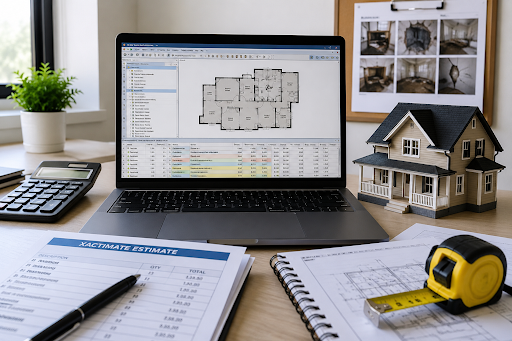
Property damage doesn't wait for a convenient time. A pipe bursts at 2 a.m., a storm rips through a neighborhood, and suddenly homeowners and contractors need a number they can trust. That's exactly where Xactimate Estimating earns its keep.
What Is Xactimate Estimating, Really?
Xactimate Estimating is the industry-standard software system used to calculate the true cost of repairing or rebuilding a damaged property. It's built by Xactware, a Verisk Analytics company, and it's been the go-to tool in insurance and restoration circles since 1986.
Instead of guessing at repair costs, adjusters and contractors use it to sketch the property, tag the damaged areas, and let the software pull real, location-specific pricing data. That data comes from actual material suppliers and millions of prior estimates, not random guesswork.
This matters because two contractors eyeballing the same water-damaged basement can land on wildly different numbers. Xactimate narrows that gap by giving everyone a shared, defensible starting point.
Why Has Xactimate Become the Industry Standard?
Around 75% to 80% of insurance adjusters use Xactimate for claim-related restoration work, according to industry estimates from restoration software comparisons. That's not a small majority — that's near-total market dominance.
A few reasons this happened:
-
It launched early and never let go. First released in 1986, it had decades to become the default before serious competitors showed up.
-
It's backed by real pricing data, pulled regionally so a roof repair in Miami isn't priced the same as one in Denver.
-
It works across devices. Field techs log data on mobile, then finish complex line items on desktop, with everything synced automatically.
When almost everyone on both sides of a claim — the insurer and the contractor — is speaking the same "software language," negotiations move faster and disputes shrink.
How Does Xactimate Actually Work on a Real Job?
Here's the short version: sketch, tag, calculate, report. Here's the longer one.
An adjuster or contractor walks the property and sketches out the affected rooms, often with photos and GPS data attached for verification. Each damaged item — flooring, drywall, cabinetry — gets tagged with a corresponding line item from Xactimate's cost database.
The software then does the heavy lifting: labor cost, material cost, equipment cost, applicable tax, and overhead and profit calculations all get pulled together into one itemized report. That report becomes the document both the insurance company and the property owner reference when settling the claim.
One detail worth knowing: overhead and profit (O&P) is often where disagreements start. It covers a general contractor's coordination fee on multi-trade jobs, and insurers sometimes leave it off estimates where they don't think a GC is needed. Contractors frequently argue the opposite. Knowing this upfront can save a lot of back-and-forth later.
Why Does This Matter More Than Ever in 2026?
Property damage isn't a rare event anymore — it's a growing, expensive reality. The United States has recorded 426 separate billion-dollar weather and climate disasters since 1980, according to Climate Central's ongoing database (which picked up this tracking after federal budget cuts ended a similar NOAA program in 2025).
In 2025 alone, the U.S. absorbed 23 billion-dollar disasters totaling $115 billion in damages — driven heavily by the January Los Angeles wildfires, which alone caused more than $61 billion in losses. Severe thunderstorms and tornado outbreaks made up 91% of last year's billion-dollar events.
That's the modern backdrop for property damage assessment: more frequent events, higher price tags, and more claims moving through the system at once. A consistent, data-backed estimating standard isn't a nice-to-have in that environment — it's the only thing keeping the claims process from turning into chaos.
Does Xactimate Favor Insurance Companies Over Homeowners?
This is a fair question, and the honest answer is: it depends on who's using it, and how.
Xactimate itself is a neutral pricing engine it reflects regional material and labor costs. But some critics, including public adjuster advocacy groups, have pointed out that the software was historically designed with tract homes in mind. That means custom-built, historic, or high-value properties can sometimes be underestimated if the person running the software doesn't adjust for those unique features.
The tool is only as fair as the person operating it. This is exactly why independent Xactimate Estimating Services exist to double-check that a homeowner's estimate reflects their actual property, not just a generic template.
Who Actually Benefits From Professional Xactimate Estimating Services?
Pretty much everyone touching a property claim benefits, but not equally.
Homeowners get a second opinion that can catch underestimated scope before signing off on a settlement. Contractors and restoration companies get faster turnaround on accurate scopes, which means faster payment cycles. Public adjusters get a standardized document that strengthens negotiation leverage with carriers.
Outsourcing this work to a specialized Xactimate Estimating provider also frees up contractors to focus on actual repair work instead of spending hours behind a screen building line-item reports — which, let's be honest, isn't why most people got into construction in the first place.
What Should You Look for in an Estimating Partner?
Not every estimating service is created equal, so a few things are worth checking before you commit:
-
Certification — Verisk offers official Xactimate certification, and a provider with certified estimators is less likely to make costly line-item errors.
-
Turnaround time — In active disaster seasons, speed matters almost as much as accuracy.
-
Familiarity with local pricing data — Regional cost accuracy is the whole point of using Xactimate in the first place.
The Bottom Line
Modern property damage assessments run on data, not guesswork, and Xactimate Estimating is the backbone of that shift. With disaster costs climbing and claim volumes rising, having an accurate, standardized estimate isn't just a technical formality — it's what determines whether a homeowner gets a fair settlement or leaves money on the table.If you're a contractor, adjuster, or homeowner trying to navigate a property damage claim, working with a professional Xactimate Estimating Services provider takes the guesswork — and a lot of the stress — out of the process.

 English
 Arabic
 French
 Spanish
 Portuguese
 Deutsch
 Turkish
 Dutch
Dutch
 Italiano
 Russian
 Romaian
 Greek
Greek
