


 About Urh Social
 Terms of Service
 Πολιτική Ιδιωτικότητας
 Contact
6 Warning Signs Your AC Coils Are Failing (Before You're Stuck With No Cooling in July)
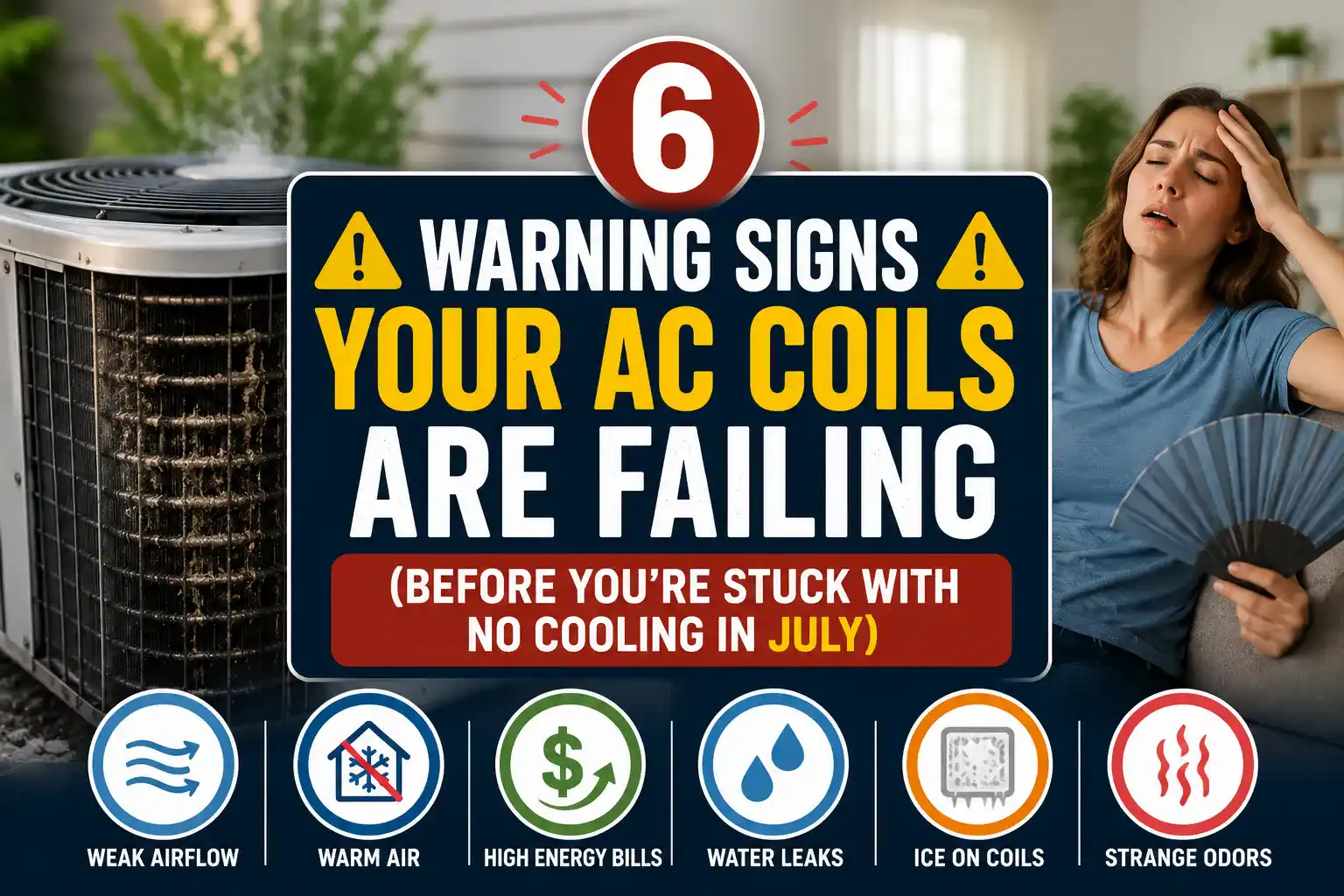
Most homeowners don't think about their air conditioner's coils until the system stops cooling properly usually on the hottest week of the year, right when every HVAC company in town is booked solid. The frustrating part is that coil problems rarely happen without warning. There are almost always signs beforehand, if you know what to look for.
Here's what tends to show up before a coil failure turns into a full system breakdown.
1. Warm Air Coming From the Vents
This is the most obvious sign, and often the first one people notice. If your system is running but the air coming out feels lukewarm instead of cold, it's often a sign the indoor coil isn't absorbing heat properly sometimes due to dirt buildup, sometimes due to a refrigerant issue. Either way, this isn't something that tends to fix itself by waiting.
2. Ice Forming on the Indoor Unit or Refrigerant Lines
Counterintuitively, a frozen coil is a cooling problem, not a cold-weather issue. Ice buildup on the indoor coil or the refrigerant lines usually points to restricted airflow (often a dirty filter or blocked vents) or low refrigerant, both of which prevent the coil from doing its job properly. Running the system with a frozen coil for an extended period can cause more serious damage, so this one's worth addressing quickly rather than waiting it out.
3. A Noticeable Jump in Energy Bills
Coils covered in dirt, dust, or grime have to work harder to transfer heat, which means the system runs longer and less efficiently to hit the same temperature. If your energy bill climbs noticeably without a clear reason, no unusual weather, no change in usage, dirty or failing coils are a common, often-overlooked cause worth ruling out.
4. Longer Cooling Cycles Than Usual
If your system seems to run constantly, or takes noticeably longer to bring a room down to temperature than it used to, that's often a sign the coils aren't transferring heat as efficiently as they should be. This tends to develop gradually, which is exactly why it's easy to miss most people who don't notice a slow decline the way they'd notice a sudden failure.
5. Water Pooling Around the Indoor Unit
Evaporator coils naturally produce condensation as part of the cooling process, and that moisture is supposed to drain away through a designated line. Water pooling around the unit can indicate a clogged drain line, but it can also point to a coil that's frosting over and then melting faster than the drain can handle, worth investigating either way before it leads to water damage nearby.
6. Unusual Odors When the System Runs
A musty smell often points to mold or mildew growth on a coil that's staying too wet, usually due to drainage issues. A different, more chemical or burnt smell can indicate an electrical issue near the unit rather than the coil itself. Neither is something to ignore, since both tend to get more serious (and more expensive) the longer they're left unaddressed.
Why Catching This Early Actually Saves Money
None of these signs, caught early, usually mean a full coil replacement. A dirty coil can often just be cleaned. A minor refrigerant leak can sometimes be sealed rather than requiring a completely new coil. It's only once a problem goes unnoticed for an extended period running the system inefficiently, freezing and thawing repeatedly, or continuing to operate with restricted airflow that the coil itself typically sustains enough damage to require full replacement.
If You're Already Looking at Replacement
If your coils have already reached the point of needing replacement rather than just cleaning or minor repair, it helps to understand what actually drives the cost before calling around for quoted coil type, system size, and whether you're dealing with the evaporator coil, the condenser coil, or both. This breakdown of evaporator coil vs. condenser coil functions, costs, and maintenance covers exactly that, including realistic cost ranges by system size and coil type, and what typically drives the price up or down.
The Takeaway
Coil problems rarely happen overnight. They build up gradually through reduced airflow, dirt accumulation, or a slow refrigerant leak and the warning signs above are your system's way of flagging the problem before it becomes a full breakdown. Catching any of these early is almost always cheaper and less disruptive than waiting for the system to fail completely, usually at the worst possible time.

 English
 Arabic
 French
 Spanish
 Portuguese
 Deutsch
 Turkish
 Dutch
Dutch
 Italiano
 Russian
 Romaian
 Portuguese (Brazil)
