


 About Urh Social
 Terms of Service
 Datenschutzbestimmungen
 Contact
Who Needs BIS Certification Across India and Why?
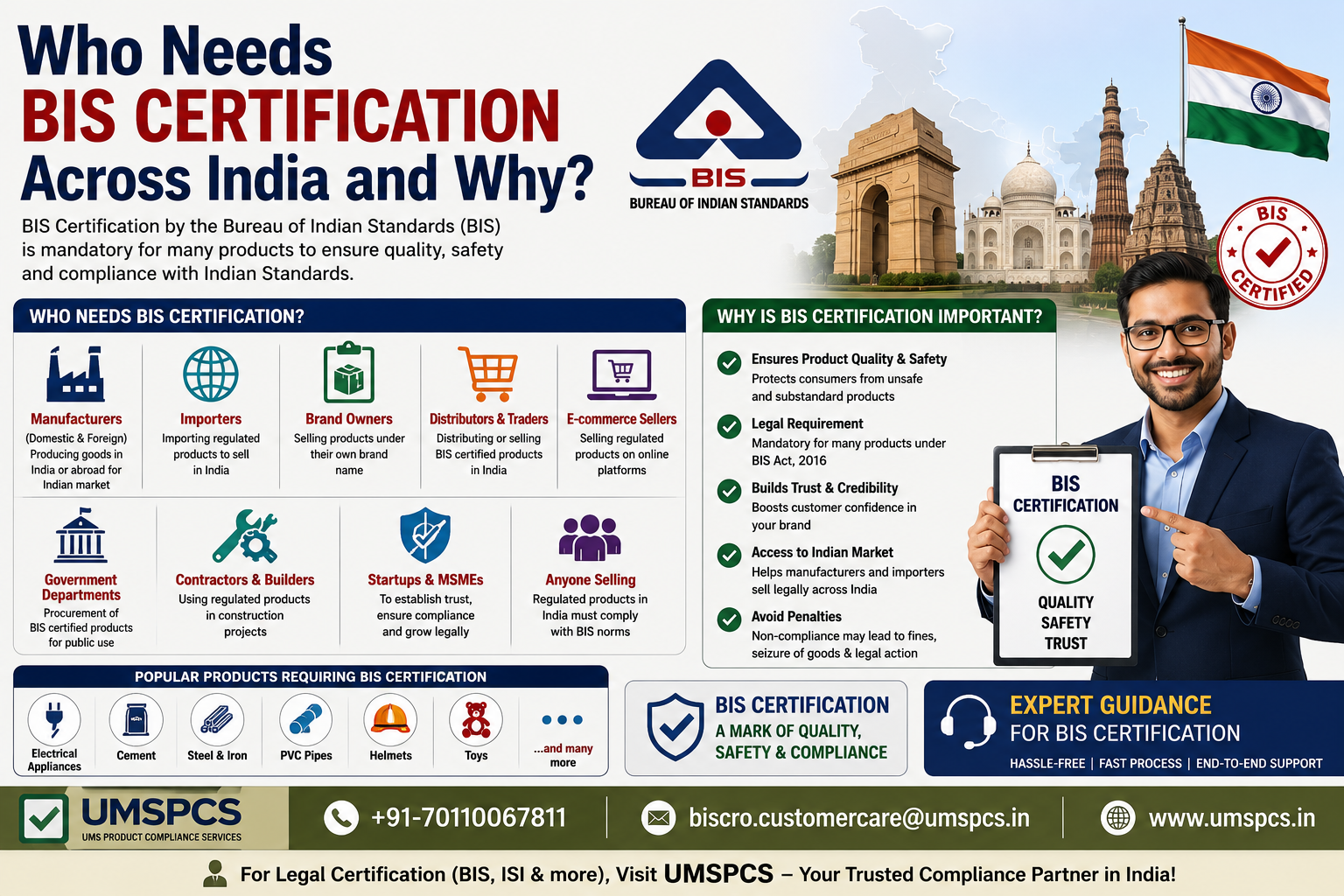
Every day, thousands of products move across Indian borders, warehouses, and retail shelves, from electronics and toys to cement and packaged food. Behind many of these products lies a quiet but powerful requirement: BIS Certification. Yet a surprising number of manufacturers, importers, and even retailers remain unclear on whether this certification applies to them.
If you've ever wondered whether your product needs BIS approval before it can legally enter the Indian market, you're not alone. This blog breaks down exactly who needs BIS Certification across India , why it exists, and what happens if businesses choose to ignore it.
What Is BIS Certification, In Simple Terms
The Bureau of Indian Standards (BIS) is India's national standards body, responsible for setting quality, safety, and performance benchmarks for products sold in the country. BIS Certification is essentially an official confirmation that a product meets these benchmarks.
It's not a one-size-fits-all certificate. Depending on the product category, certification falls under different schemes, most commonly:
-
ISI Mark Scheme – for items like cement, LPG cylinders, kitchen appliances, and helmets
-
Compulsory Registration Scheme (CRS) – mainly for electronics, IT hardware, and AV equipment
-
Foreign Manufacturers Certification Scheme (FMCS) – for overseas manufacturers exporting to India
-
Hallmarking Scheme – for gold and silver jewellery
Each scheme has its own testing requirements, documentation, and inspection process, which is why identifying the correct one is often the first challenge businesses face.
Who Actually Needs BIS Certification?
1. Domestic Manufacturers
Any Indian manufacturer producing goods under a category notified as mandatory by BIS must obtain certification before selling the product commercially. This applies whether you're a small-scale unit or a large industrial manufacturer.
2. Foreign Manufacturers Exporting to India
If you manufacture products overseas and want to sell them in India, whether it's electronics, machinery, or consumer goods, you'll likely need certification under the Foreign Manufacturers Certification Scheme. This includes an evaluation of your factory's quality control systems, often through a physical or virtual inspection.
3. Importers
Importers bringing in BIS-regulated products cannot simply rely on the manufacturer's certification from their home country. Products must carry valid BIS approval before they can clear Indian customs, especially for electronics falling under CRS.
4. E-commerce Sellers
Online marketplaces have tightened compliance checks significantly. Products sold on major e-commerce platforms in regulated categories, such as power banks, chargers, and household appliances, are increasingly required to display valid BIS registration numbers before listings go live.
5. Construction and Infrastructure Companies
Materials like cement, steel bars, and certain electrical fittings used in construction projects require ISI-marked certification. This isn't just a compliance formality; it directly affects structural safety and project approvals.
6. Toy Manufacturers and Importers
Since toy safety regulations were tightened, BIS Certification has become mandatory for most toys sold in India, covering everything from material safety to choking hazards and chemical composition.
7. Electronics and IT Hardware Companies
Laptops, mobile phone chargers, power adapters, and several categories of consumer electronics fall under CRS, making certification a non-negotiable step before market entry.
Read more about BIS CRS registration in Gujarat.
Why BIS Certification Exists in the First Place
It's easy to view certification as bureaucratic red tape, but the reasoning behind it is fairly practical:
-
Consumer Safety – Preventing substandard or hazardous products, especially electronics, toys, and construction materials, from reaching consumers.
-
Quality Assurance – Ensuring products perform as claimed and meet minimum durability and safety standards.
-
Market Trust – Giving buyers, whether individual consumers or B2B purchasers, confidence that a product has passed government-recognized quality checks.
-
Fair Competition – Preventing low-quality, uncertified products from undercutting compliant manufacturers on price.
-
Environmental and Health Standards – Certain schemes also account for chemical safety and environmental impact, particularly in electronics and packaging.
Read more about BIS consultant in Kolkata.
What Happens If You Skip BIS Certification?
Businesses that overlook this requirement often face consequences that are far more expensive than the certification process itself:
-
Customs seizure of imported goods lacking valid certification
-
Heavy penalties and legal action under the BIS Act
-
E-commerce delisting, with platforms removing non-compliant products from sale
-
Reputational damage, especially if a product recall becomes necessary
-
Lost business opportunities, since many B2B buyers and government tenders require BIS-certified suppliers
In short, skipping certification isn't a shortcut; it's a liability waiting to surface at the worst possible time, often during a shipment, an audit, or a compliance check.
How UMSPCS Helps Businesses Navigate BIS Requirements
Figuring out whether your product needs certification, and under which scheme, isn't always straightforward. Product categories are updated regularly, and overlapping regulations can confuse even experienced business owners.
As a dedicated BIS Consultant, UMSPCS helps manufacturers, importers, and e-commerce sellers determine exact certification requirements for their products, prepare accurate documentation, coordinate with testing labs, and manage the entire application process from start to finish. Instead of guessing which scheme applies or risking a rejected application, businesses get a clear roadmap and hands-on support at every stage.
Whether you're a first-time applicant or renewing an existing certificate, working with an experienced consultant significantly reduces delays and compliance risks.
Final Thoughts
BIS Certification isn't limited to a handful of niche industries; it touches manufacturers, importers, e-commerce sellers, and construction companies across the country. As regulations continue to expand into new product categories, understanding whether your business falls under a mandatory scheme is no longer optional, it's essential for staying compliant and competitive.
If you're unsure whether your product requires BIS certification consultancy with experts like UMSPCS early can save significant time, cost, and legal risk down the line.
FAQs
1. How do I know if my product needs BIS Certification? BIS periodically notifies product categories as mandatory. Checking the current list for your product type, or consulting a BIS expert, is the most reliable way to confirm.
2. Does BIS Certification apply only to manufacturers? No. Importers, foreign manufacturers, and even e-commerce sellers dealing in regulated product categories also need valid BIS certification or registration.
3. Is BIS Certification required for products sold only online? Yes, if the product falls under a mandatory scheme like CRS, it needs certification regardless of whether it's sold in physical stores or online marketplaces.
4. How long is a BIS Certificate valid? Validity periods vary by scheme, but most certificates require periodic renewal along with surveillance audits to ensure continued compliance.
5. Can small businesses and startups apply for BIS Certification? Yes, business size doesn't exempt a company from certification requirements if their product falls under a mandatory category. Many startups work with consultants to simplify the process.
6. What's the difference between ISI Mark and CRS certification? ISI Mark generally applies to categories like cement, appliances, and safety equipment, while CRS primarily covers electronics and IT hardware. Each has distinct testing and documentation requirements.
source: https://www.linkedin.com/pulse/who-needs-bis-certification-across-india-why-isimark-india-vfnsc/

 English
 Arabic
 French
 Spanish
 Portuguese
 Turkish
 Dutch
Dutch
 Italiano
 Russian
 Romaian
 Portuguese (Brazil)
 Greek
Greek
