


 About Urh Social
 Terms of Service
 Privacy Policy
 Contact
Best Computer Vision Services for Enterprise Process Optimization
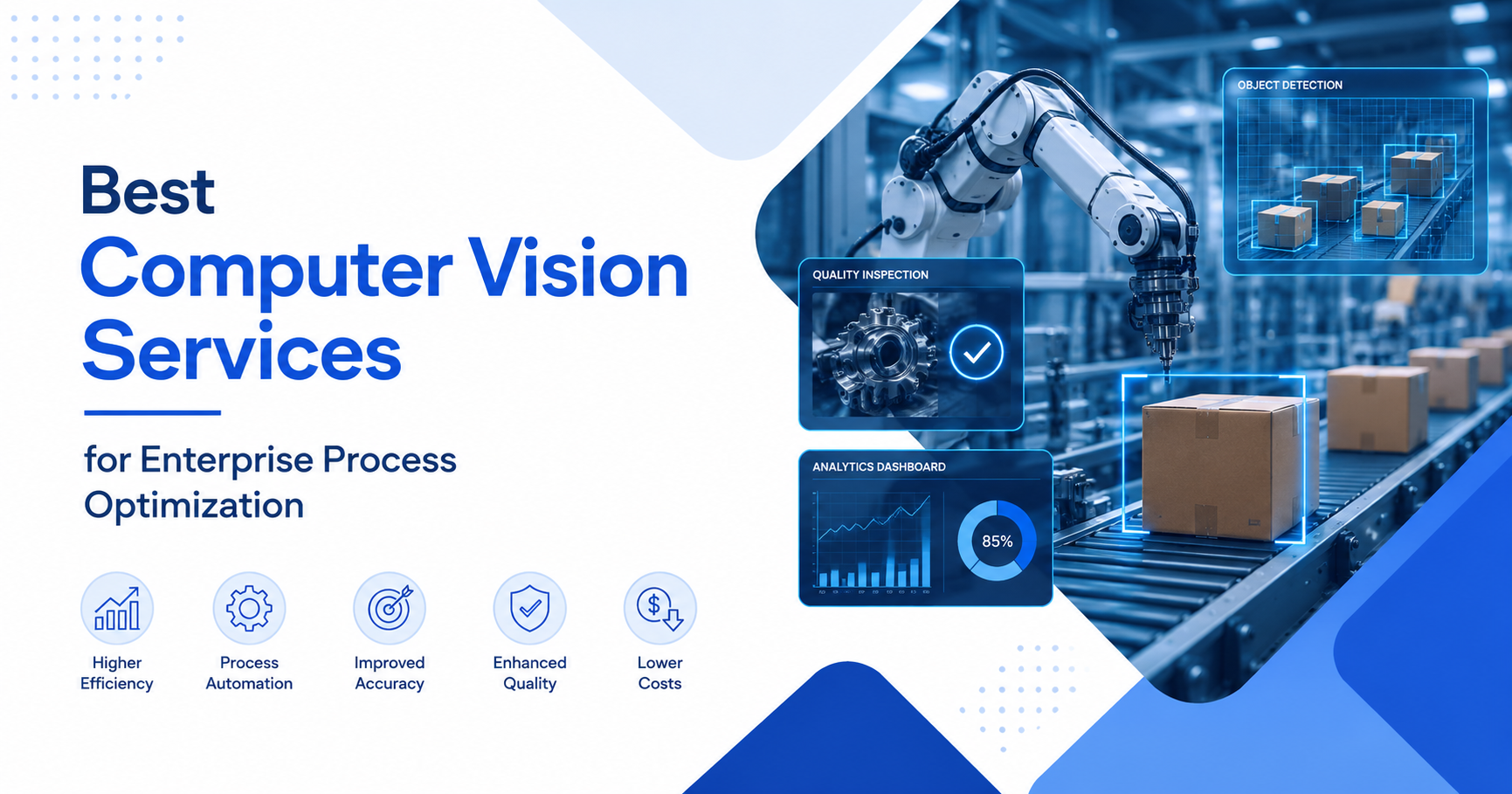
If you run a mid-size or large operation — manufacturing, retail, logistics, healthcare, or financial services — there's a very real chance that a significant portion of your process inefficiencies are hiding in plain sight. Literally. Your cameras are capturing footage 24/7. Your assembly lines are producing visual data at every shift. Your warehouses generate spatial information with every shelf movement. But without the right intelligence layer on top of all that visual input, it's just noise. Computer vision changes that equation entirely. It converts unstructured visual data into structured, actionable intelligence that directly feeds into better decisions, lower costs, and faster operations. The question for most enterprise leaders isn't whether computer vision makes sense — it's where to start and which services are actually worth investing in.
What Enterprise Computer Vision Actually Looks Like in Practice
Before jumping to vendor comparisons or technology stacks, it's worth grounding the conversation in what computer vision is actually doing inside enterprise environments today. This isn't about research labs or experimental AI demos. Mature organizations are deploying vision systems that inspect products at millisecond speed, track inventory without manual counts, monitor worker safety in real time, and even detect fraud through visual pattern recognition. Computer vision development services have matured significantly over the past three years, and the gap between pilot projects and production-grade deployments has narrowed considerably. What was once a six-month proof-of-concept exercise can now be architected, tested, and rolled out in weeks with the right partner and a clearly scoped problem.
The core value proposition for business owners is straightforward: human eyes fatigue, miss patterns, and can't scale. Computer vision systems don't. They apply the same detection logic at 2 AM on a Sunday as they do during peak production hours on a Monday morning. For enterprises dealing with high-volume, repetitive visual tasks — quality inspection, document verification, facility monitoring — this consistency translates directly into financial returns.
Key areas where enterprise computer vision delivers measurable ROI:
- Quality Control & Defect Detection — Vision systems scan products at speeds and resolutions impossible for human inspectors, catching micro-defects before they reach customers
- Inventory & Supply Chain Visibility — Real-time shelf monitoring, automated stock counts, and shipment verification without manual intervention
- Worker Safety Monitoring — PPE compliance detection, restricted zone alerts, and ergonomic risk identification on factory floors
- Document & ID Processing — Automated extraction and validation of information from forms, invoices, contracts, and identity documents
- Predictive Maintenance — Thermal and visual anomaly detection on equipment before failures occur
The Major Service Categories You Need to Know
Not all computer vision engagements are the same. Depending on where you are in your AI maturity curve, you might need a full build-from-scratch solution, a platform integration, or something in between. Understanding the landscape of what's available saves you from either overpaying for capabilities you don't need or underinvesting in infrastructure that will bottleneck you six months down the road.
Cloud-Native Vision APIs sit at one end of the spectrum. Providers like Google Cloud Vision, AWS Rekognition, and Azure Computer Vision offer pre-built models for common tasks — object detection, OCR, face detection, image classification. These work well for standard use cases and can be integrated quickly. The tradeoff is limited customization. If your manufacturing defect looks subtly different from anything in a general-purpose training dataset, pre-built models will underperform. This is where custom development becomes non-negotiable.
Custom Model Development is where enterprises with unique processes, proprietary visual data, or high-precision requirements need to invest. A qualified computer vision development company will collect or curate your domain-specific training data, architect the right model type (object detection, segmentation, classification, anomaly detection), train and validate it against your actual operational conditions, and deploy it in a way that integrates with your existing infrastructure. The investment is higher upfront, but the accuracy and business fit are substantially better.
Edge Deployment Solutions address latency-sensitive environments. If you're doing real-time inspection on a fast-moving assembly line, cloud round-trips introduce unacceptable delay. Edge-deployed models run inference directly on hardware at the point of capture — on-premise servers, industrial PCs, or smart cameras. Designing systems that work reliably at the edge requires specialized expertise in model optimization, hardware selection, and deployment pipeline design.
MLOps and Continuous Improvement Pipelines are the often-overlooked component that separates one-time projects from sustainable enterprise systems. Production vision models degrade as environments change — lighting shifts, product designs update, new defect types emerge. A proper computer vision software development engagement includes the infrastructure to monitor model performance, flag degradation, retrain on new data, and redeploy without operational disruption. This is what keeps your system accurate eighteen months after go-live.
Top Computer Vision Services Worth Evaluating
1. Custom End-to-End Development Partners
For enterprises with complex, proprietary, or high-stakes visual processes, partnering with a specialized development firm remains the highest-value option. These partners handle everything from data annotation strategy to model architecture to production deployment and ongoing maintenance. When evaluating firms, look for demonstrated experience in your industry vertical, a clear MLOps practice, and references from clients who have run systems in production for at least a year (not just pilot projects). The ability to hire computer vision developers who understand both the technical stack and your domain context is often what separates a successful deployment from one that stalls after the demo.
2. AWS Rekognition + SageMaker
Amazon's combination of managed vision APIs and a full ML platform gives enterprise teams flexibility. Rekognition handles standard tasks out of the box; SageMaker supports custom model training with strong managed infrastructure for training, hosting, and monitoring. It's a strong choice for organizations already deep in the AWS ecosystem who want to minimize infrastructure overhead while retaining customization flexibility.
3. Google Cloud Vision AI + Vertex AI
Google's vision offerings benefit from the depth of research behind Google's own vision systems. AutoML Vision lowers the barrier to custom model training significantly, while Vertex AI provides enterprise-grade MLOps tooling. For organizations that deal heavily with document processing, retail image analysis, or large-scale media content, Google's pre-trained models tend to perform strongly out of the box.
4. Microsoft Azure Computer Vision + Custom Vision
Azure Custom Vision stands out for its accessible fine-tuning interface — teams with limited ML expertise can retrain models on custom datasets without deep data science involvement. This makes it valuable for pilot projects or departments that want to move fast. Azure's enterprise security and compliance posture also makes it a natural fit for regulated industries like healthcare and financial services.
5. NVIDIA Metropolis & DeepStream
For video-intensive applications — surveillance, traffic analysis, industrial line monitoring — NVIDIA's Metropolis platform provides purpose-built infrastructure for video analytics at scale. DeepStream handles the pipeline from video ingestion through inference and output, optimized for NVIDIA hardware. If your use case involves continuous video streams rather than batch image processing, this platform deserves serious consideration.
6. Specialized Vertical Platforms
A growing category of computer vision providers focuses on specific industries — Cognex and Keyence in industrial inspection, Viscovery in retail analytics, Aeye and Mobileye in autonomous vehicle perception. If your use case aligns tightly with one of these verticals, a specialized platform often delivers faster time-to-value than a general-purpose solution, because the training data, model architectures, and integration patterns are already optimized for your context.
How to Choose the Right Fit for Your Business
The technology decision is secondary to the strategic one. Before you evaluate platforms, you need to answer a few questions honestly about your organization.
Your current data situation matters enormously. Do you have labeled training data, or would you need to build that from scratch? Custom model development requires substantial annotated datasets — if you're starting from zero, budget accordingly. The time and cost of data preparation often exceeds the model development itself for first-time deployments.
Your infrastructure environment shapes your architecture options. Are your critical processes in the cloud, on-premise, or hybrid? Do you have edge hardware deployed already, or would that require capital expenditure? The best model in the world doesn't help if it can't integrate with your operational environment.
Your internal technical capacity determines what kind of partnership you need. If you have a capable data science team, you might want a platform partner rather than a full-service firm. If you're light on ML expertise internally, you'll benefit more from a computer vision development company that can own the full lifecycle, including knowledge transfer so your team can maintain the system post-deployment.
Your accuracy and latency requirements set the floor for what's acceptable. A vision system that's 95% accurate might be excellent for some applications and completely unacceptable for others. Define your tolerance for false positives and false negatives before any development begins — it will shape every technical decision downstream.
Building for the Long Term
The enterprises that extract the most value from computer vision aren't the ones that ran the most impressive pilot project — they're the ones that treated it as infrastructure rather than a one-time initiative. That means investing in data governance so training datasets grow and improve over time. It means building feedback loops so operational teams can flag model errors and contribute to retraining. It means selecting computer vision software development partners who will still be engaged six months after go-live, not just at the demo.
It also means thinking about scale from the beginning. A system designed for one facility needs to be architected differently than one meant to roll out across thirty. The decisions you make in year one — model architecture, deployment approach, data pipeline design — will either accelerate or constrain your expansion. Work with partners who have navigated that transition before.
When you're ready to move from evaluation to execution, the most practical first step is a well-scoped proof of value — not a full-scale deployment, but a focused engagement on one high-impact process where the business case is clear and the success criteria are measurable. Get that right, document the results rigorously, and you'll have both the internal buy-in and the technical foundation to scale confidently.
The competitive advantage in enterprise operations is increasingly visual. The organizations that learn to see their processes more clearly — literally — are the ones that will optimize faster, waste less, and deliver more consistently. Computer vision isn't a future capability. For many of your competitors, it's already live on the floor.

 English
 Arabic
 French
 Portuguese
 Deutsch
 Turkish
 Dutch
Dutch
 Italiano
 Russian
 Romaian
 Portuguese (Brazil)
 Greek
Greek
