


 About Urh Social
 Terms of Service
 Privacy Policy
 Contact
How Regression Testing Strategies Change as Applications Scale?
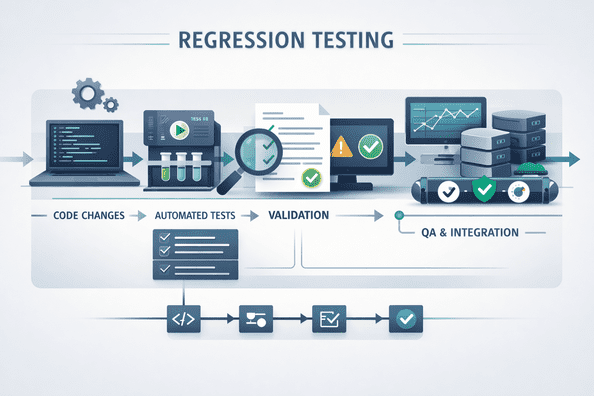
As applications grow in size and complexity, testing strategies must evolve to keep up with increasing demands. What works for a small application with limited features often becomes ineffective as the system expands. This is especially true for regression testing, which plays a critical role in ensuring that new changes do not break existing functionality.
In early stages, regression testing is relatively simple. However, as applications scale across multiple modules, teams, and environments, the approach to regression testing must become more structured, efficient, and adaptable.
Early Stage: Simple and Manual Regression Testing
In smaller applications, regression testing is often performed manually or with minimal automation. The scope is limited, and the number of test cases is manageable.
At this stage, teams typically:
- Execute a small set of test cases after changes
- Focus on core functionality
- Rely heavily on manual validation
This approach works because the system is not complex, and changes are easier to track. However, as the application grows, manual regression testing quickly becomes inefficient and error-prone.
Growth Stage: Introduction of Automation
As features increase and release cycles become more frequent, manual efforts are no longer sufficient. Teams begin introducing automation to handle repetitive regression tasks.
During this phase, regression testing evolves to include:
- Automated test cases for critical workflows
- Integration with CI pipelines for continuous validation
- Improved test coverage across different modules
Automation helps teams keep up with faster development cycles while reducing manual effort. It also ensures consistent execution of test cases across releases.
Scaling Stage: Managing Complexity Across Modules
In large applications, multiple teams often work on different modules simultaneously. This increases the risk of cross-module defects and integration issues.
At this stage, regression testing strategies focus on:
- Dividing test suites based on modules or services
- Running targeted regression tests for specific changes
- Maintaining a balance between full and selective regression
Teams also start leveraging different types of regression testing to ensure comprehensive validation across layers, including unit, integration, and system testing.
Maturity Stage: Optimization and Prioritization
As applications reach a mature state, regression test suites can become large and time-consuming. Running all tests for every change is no longer practical.
Teams optimize their approach by:
- Prioritizing high-risk and high-impact test cases
- Removing redundant or low-value tests
- Using data and past defect trends to guide test selection
This ensures that regression testing remains efficient while still providing meaningful coverage.
Continuous Integration and Faster Feedback
In scaled environments, regression testing is closely integrated with CI and CD pipelines. Tests are executed automatically at different stages of the development lifecycle.
This enables:
- Immediate feedback on code changes
- Early detection of defects
- Faster decision-making for releases
By distributing tests across pipeline stages, teams can maintain both speed and reliability.
Common Challenges at Scale
As regression testing evolves, teams encounter several challenges:
- Rapid growth of test suites leading to longer execution times
- Flaky tests reducing confidence in results
- Difficulty maintaining test data and environments
- Coordination issues across multiple teams
Addressing these challenges requires continuous monitoring and improvement of testing strategies.
Real-World Observation
In one large-scale application, the regression suite grew significantly as new features were added. Initially, the team attempted to run the entire suite for every release, which led to long execution times and delayed deployments.
To improve efficiency, they:
- Categorized tests based on priority and impact
- Introduced selective regression for smaller changes
- Integrated automated tests into their CI pipeline
- Regularly reviewed and removed outdated test cases
As a result, they achieved:
- Faster execution of regression cycles
- Improved defect detection in critical areas
- Better alignment with release timelines
This shift allowed the team to maintain quality while scaling their application.
Key Takeaways
- Regression testing strategies must evolve as applications grow
- Manual approaches work in early stages but do not scale
- Automation is essential for handling increased complexity
- Test prioritization helps manage large test suites efficiently
- Integration with CI and CD pipelines improves feedback speed
- Continuous optimization is necessary for long-term success
Regression testing is not a static process. As applications scale, teams must adapt their strategies to balance coverage, speed, and maintainability. By evolving their approach over time, teams can ensure consistent software quality while supporting rapid growth and frequent releases.

 English
 Arabic
 French
 Portuguese
 Deutsch
 Turkish
 Dutch
Dutch
 Italiano
 Russian
 Romaian
 Portuguese (Brazil)
 Greek
Greek
