


 About Urh Social
 Terms of Service
 Politique de confidentialité
 Contact
Boat and Ship Telematics Market Size, Share and Industry Outlook
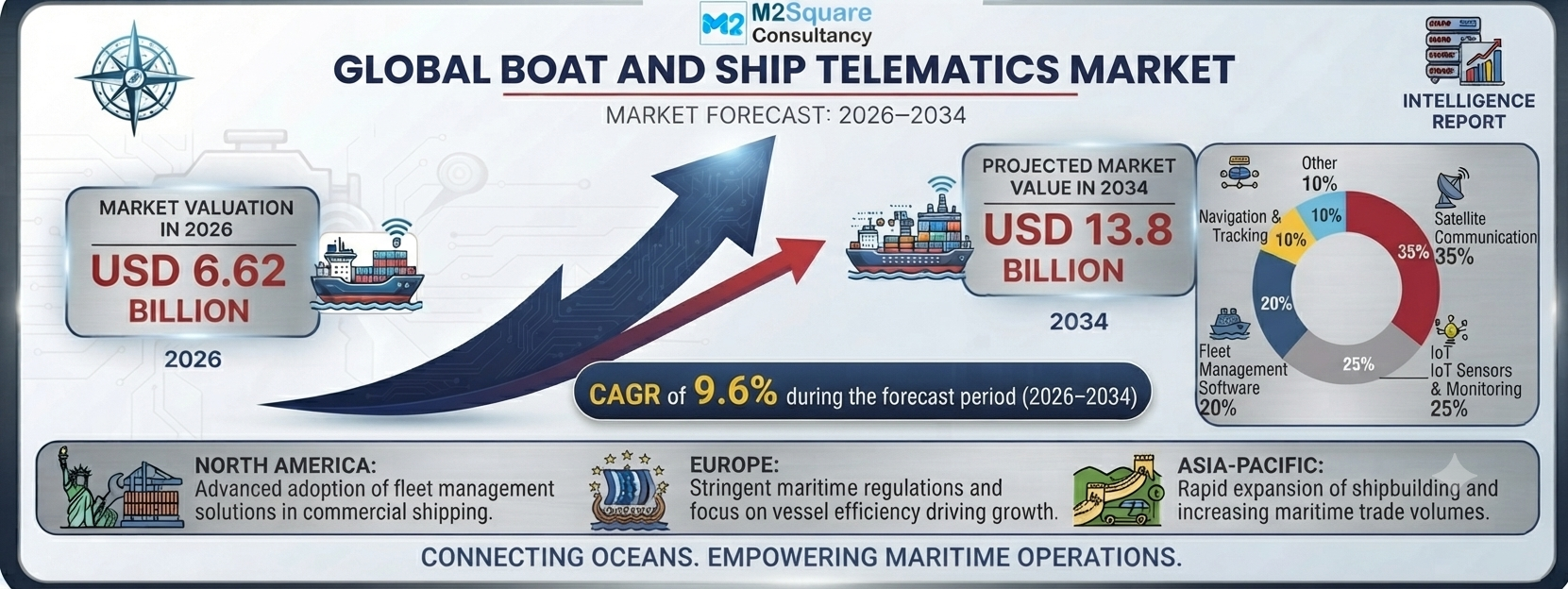
How Digital Connectivity and Smart Navigation Are Transforming the Boat and Ship Telematics Market
Overview
The global Boat and Ship Telematics Market is gaining momentum as the maritime industry increasingly adopts digital technologies to improve vessel monitoring, navigation, operational efficiency, and fleet management. Telematics solutions combine telecommunications, GPS, sensors, onboard systems, and data analytics to collect and transmit real-time information about vessel location, performance, fuel consumption, engine health, and operating conditions.
These technologies are becoming important across commercial shipping, fishing vessels, recreational boats, offshore operations, and passenger transportation. Shipowners and fleet operators are investing in connected maritime platforms to improve visibility, strengthen safety management, reduce operating costs, and support better operational decisions.
The global Boat and Ship Telematics Market was valued at USD 6.62 billion in 2026 and is projected to reach USD 13.8 billion by 2034, expanding at a CAGR of 9.6% during the forecast period.
As maritime operations become more connected and data-driven, telematics providers have opportunities to deliver advanced vessel tracking, predictive maintenance, remote monitoring, and intelligent fleet management solutions. The Boat and Ship Telematics Market research report provides insights into industry developments, emerging technologies, competitive dynamics, and future business opportunities.
Market Snapshot
| Market Parameter | Details |
|---|---|
| Market | Boat and Ship Telematics |
| Market Size (2026) | USD 6.62 Billion |
| Projected Market Size (2034) | USD 13.8 Billion |
| CAGR (2026–2034) | 9.6% |
| Industry | Maritime Technology and Marine Electronics |
| Key Growth Factors | Fleet digitization, vessel tracking, maritime safety, operational efficiency |
Request Sample PDF:
https://m2squareconsultancy.com/request-sample/boat-and-ship-telematics-market/991
Key Factors Driving Boat and Ship Telematics Market Growth
1. Increasing Adoption of Smart Vessel Monitoring
Vessel operators are increasingly using connected monitoring systems to track vessel location, speed, operating conditions, and equipment performance. Real-time monitoring provides better operational visibility and helps fleet managers make informed decisions.
GPS-enabled tracking and onboard communication systems also support route monitoring and vessel coordination across commercial and recreational marine applications.
2. Growing Focus on Maritime Safety and Security
Safety remains a major priority across the maritime industry. Telematics solutions help operators monitor vessel movements, receive operational alerts, and maintain communication between vessels and shore-based teams.
Advanced monitoring capabilities can also support incident response, navigation awareness, and security management.
3. Demand for Fuel Efficiency and Cost Optimization
Fuel represents a significant operating expense for many commercial vessels. Telematics platforms can collect information about fuel consumption, engine performance, speed, and operating patterns.
Fleet operators can use these insights to identify inefficient operations, optimize routes, monitor engine conditions, and improve resource utilization.
4. Expansion of Commercial Shipping and Maritime Trade
Global maritime transportation depends on efficient vessel operations and fleet coordination. Increasing demand for shipping services is encouraging operators to invest in digital technologies that improve fleet visibility and operational planning.
Telematics solutions help shipping companies monitor vessels across routes, coordinate operations, and access valuable performance data.
Emerging Trends in the Boat and Ship Telematics Market
Artificial Intelligence and Predictive Analytics
Artificial intelligence and data analytics are increasingly being integrated into maritime monitoring platforms. These technologies can analyze vessel performance data, identify unusual operating patterns, and support predictive maintenance planning.
Satellite-Based Vessel Connectivity
Satellite communication plays an important role in connecting vessels operating beyond coastal network coverage. Improved connectivity supports remote monitoring, navigation information, operational communication, and data transmission across long-distance maritime routes.
Internet of Things in Maritime Operations
IoT-enabled sensors collect information from engines, navigation equipment, fuel systems, and other onboard components. Connected platforms can bring this information together to provide a more comprehensive view of vessel operations.
Cloud-Based Fleet Management
Cloud-based telematics platforms allow fleet managers to access vessel data remotely and monitor multiple vessels through centralized dashboards. These systems can improve information sharing, reporting, and operational coordination.
Integration with Advanced Navigation Systems
Telematics solutions are increasingly working alongside electronic navigation, vessel identification, and monitoring technologies. Integration can improve situational awareness and provide operators with more comprehensive operational information.
Market Segmentation
The Boat and Ship Telematics Market can be analyzed across several segments:
| Segmentation | Key Categories |
|---|---|
| By Component | Hardware, software, services |
| By Application | Vessel tracking, fleet management, navigation, fuel monitoring, predictive maintenance, safety and security |
| By Connectivity | Satellite, cellular, radio and other communication technologies |
| By Vessel Type | Commercial vessels, fishing vessels, recreational boats, passenger vessels, offshore vessels |
| By End User | Shipping companies, fleet operators, fishing operators, recreational boat owners, marine service providers |
Regional Market Outlook
North America: The region benefits from established marine transportation networks, recreational boating activity, and growing adoption of connected vessel monitoring technologies.
Europe: Strong maritime trade, advanced marine technology capabilities, and increasing focus on operational efficiency support demand for telematics solutions.
Asia-Pacific: Expanding shipping activities, shipbuilding capabilities, fishing operations, and maritime trade across China, Japan, South Korea, India, and Southeast Asia create significant opportunities.
Latin America: Commercial shipping, fishing activities, and growing investment in maritime infrastructure are supporting regional demand.
Middle East and Africa: Port development, offshore operations, and maritime transportation investments are creating opportunities for connected vessel monitoring and fleet management technologies.
Key Companies in the Boat and Ship Telematics Market
The competitive landscape includes marine electronics manufacturers, satellite communication providers, navigation technology companies, and maritime software developers. Notable industry participants include:
-
Garmin Ltd.
-
Wärtsilä Corporation
-
Kongsberg Maritime
-
Furuno Electric Co., Ltd.
-
Raymarine
-
Navico Group
-
Inmarsat
-
Iridium Communications Inc.
-
ORBCOMM Inc.
-
KVH Industries, Inc.
These companies participate in different areas of the maritime technology ecosystem, including navigation, satellite connectivity, vessel monitoring, marine electronics, and fleet management. This is an illustrative list of industry participants, not a verified market-share ranking.
Challenges Facing the Boat and Ship Telematics Market
Despite strong growth opportunities, the market faces several challenges:
-
High installation costs: Advanced telematics hardware, satellite communication equipment, and integration systems can require substantial investment.
-
Connectivity limitations: Vessels operating in remote maritime areas may experience communication constraints depending on available network coverage.
-
Cybersecurity risks: Connected vessels and digital fleet platforms require strong protection against unauthorized access and cyber threats.
-
System integration complexity: Integrating telematics solutions with existing navigation, communication, and vessel management systems can be challenging.
-
Data management requirements: Continuous data collection requires reliable storage, processing, monitoring, and analytics capabilities.
Future Opportunities
The future of the Boat and Ship Telematics Market will be influenced by increasing maritime digitalization and demand for intelligent vessel management.
Opportunities are emerging in AI-powered predictive maintenance, satellite-based connectivity, cloud fleet management, real-time vessel tracking, and integrated maritime safety platforms.
Technology providers that develop scalable, secure, and interoperable solutions may benefit from growing demand among shipping companies, commercial fleet operators, fishing businesses, and recreational boat owners.
The increasing use of data-driven decision-making across maritime operations is also expected to create opportunities for software providers, marine electronics manufacturers, and connectivity service companies.
Frequently Asked Questions
1. What is the projected size of the Boat and Ship Telematics Market by 2034?
The market is projected to reach USD 13.8 billion by 2034.
2. What is the expected CAGR of the market during 2026–2034?
The market is expected to expand at a CAGR of 9.6% during the forecast period.
3. What are boat and ship telematics systems?
Boat and ship telematics systems use GPS, communication networks, sensors, and software to monitor vessel location, performance, operating conditions, and fleet activities.
4. What are the major factors driving market growth?
Increasing maritime digitalization, demand for vessel tracking, fuel efficiency requirements, fleet management needs, and improvements in satellite connectivity are major growth factors.
5. Which technologies are shaping the market?
Artificial intelligence, IoT sensors, satellite communication, cloud computing, GPS tracking, and predictive analytics are important technologies shaping the market.
Read the Full Report:
https://m2squareconsultancy.com/reports/boat-and-ship-telematics-market
Conclusion
The Boat and Ship Telematics Market is becoming an important part of the maritime industry's digital transformation. Increasing demand for real-time vessel tracking, connected navigation, fleet monitoring, and operational efficiency is encouraging shipping companies and boat operators to adopt advanced telematics solutions.
The integration of AI, IoT, satellite connectivity, and cloud-based fleet management is creating new opportunities for maritime technology providers. As vessel operations become more data-driven, telematics solutions are expected to play an increasingly important role in improving maritime visibility, safety, and performance.
With the market projected to increase from USD 6.62 billion in 2026 to USD 13.8 billion by 2034, companies across the maritime technology ecosystem can explore opportunities through product innovation, digital integration, and strategic expansion.
Read In-Depth Market Analysis
Explore the Boat and Ship Telematics Market in depth to understand market size, growth drivers, emerging technologies, regional developments, competitive landscape, and future opportunities through 2034.
About M2Square Consultancy
M2Square Consultancy is a market research and business intelligence company delivering industry analysis, market forecasts, competitive intelligence, and strategic insights across automotive, healthcare, ICT, energy, chemicals, consumer goods, and other industries.
Author: Shubham
Senior Market Research Analyst | M2Square Consultancy
Contact:
Email: [email protected]
Phone (India): +91 80978 74280
Phone (US): +1 929 447 0100
Related More Topics:
Small Molecule Drug Discovery Market

 English
 Arabic
 Spanish
 Portuguese
 Deutsch
 Turkish
 Dutch
 Italiano
 Russian
 Romaian
 Portuguese (Brazil)
 Greek
