


 About Urh Social
 Terms of Service
 Privacy Policy
 Contact
Cold Form Blister Packaging Market Growth, Industry & Landscape Outlook, Revenue Analysis By Fact.MR
Japan Leads Country Growth at 7.1% CAGR, While Coated Aluminum and Pharmaceutical Applications Maintain Dominant Market Positions, According to Fact.MR
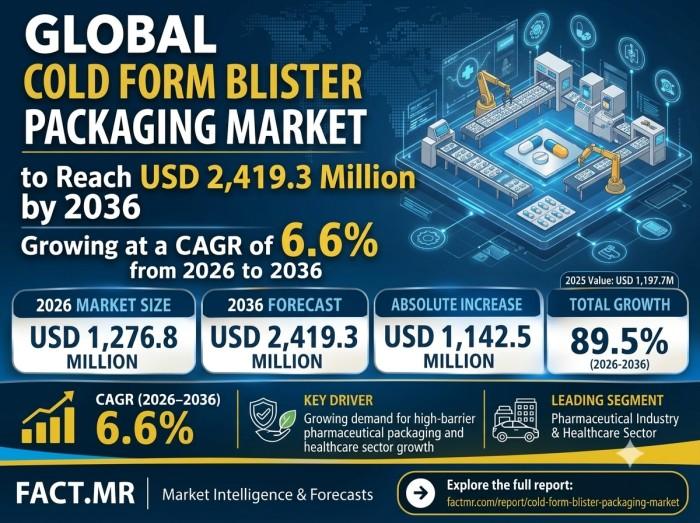
ROCKVILLE, MARYLAND — November 24, 2026 — According to Fact.MR analysis, the global market for cold form blister packaging is estimated at US$ 1,276.8 million in 2026 and is forecast to expand at a CAGR of 6.6% to reach US$ 2,419.3 million by 2036.Rising pharmaceutical demand for high-barrier packaging, increasing requirements for moisture-sensitive medicine protection, and expanding contract packaging activities are supporting market expansion. Japan is expected to record the fastest country-level growth at 7.1% CAGR, followed by the United States at 7.0%, Germany at 6.8%, and India at 6.7%.
Request for PDF Report Sample Pages:https://www.factmr.com/connectus/sample?flag=S&rep_id=7824
Pharmaceutical Packaging Requirements Strengthen Market Demand
Cold form blister packaging is gaining importance across pharmaceutical and medical product supply chains because of its ability to provide strong protection against moisture, oxygen, and light. The packaging format uses cold-forming processes to shape aluminum-based laminate structures without heat, creating protective cavities for products that require controlled storage and distribution conditions.
According to Fact.MR, pharmaceutical manufacturers increasingly use cold form blister packaging for tablets, capsules, and specialty medicines that require stronger barrier protection than standard plastic blister formats. The need to preserve product quality throughout storage and distribution is strengthening demand for packaging materials that provide reliable barrier performance and consistent cavity formation.
Several industry developments are contributing to this demand:
- Moisture-sensitive pharmaceutical products: Drug manufacturers are increasingly selecting high-barrier blister formats for medicines that require protection against humidity and environmental exposure.
- Export-oriented pharmaceutical production: Contract packaging organizations are expanding blister packaging capabilities to support pharmaceutical products moving through longer supply chains.
- Unit-dose packaging requirements: Medical product suppliers are using blister formats where dose security, tamper evidence, and individual product protection are important.
- Specialty medicine packaging: Products requiring stronger protection during storage and distribution are supporting the adoption of high-barrier cold form solutions.
However, the market also faces cost and operational challenges. Aluminum price volatility and raw material instability remain important restraints for manufacturers. Cold form blister packs generally require more material than standard thermoformed blister packaging because aluminum does not stretch as efficiently. This can increase packaging size and affect production line speed.
Sustainability considerations may also influence purchasing decisions as buyers assess material consumption and packaging performance. Suppliers therefore need to demonstrate the value of stronger product protection, reduced rejection risks, and improved shelf-life security.
Coated Aluminum and Pharmaceutical Applications Lead Segment Demand
Fact.MR's segment analysis identifies coated aluminum as the leading material category in the cold form blister packaging market, accounting for approximately 48.0% of total market share in 2026.
Its position is supported by its barrier strength and forming characteristics. Coated aluminum helps protect pharmaceutical products from moisture, oxygen, and light while supporting the formation of protective cavities without cracking during cold forming. Pharmaceutical manufacturers use coated aluminum laminates particularly for tablets and capsules that are sensitive to humidity and extended storage cycles.
PVC and polyamide also remain important materials in laminate structures, alongside polypropylene and other materials included in the report's market assessment.
By product type, high-barrier blisters are expected to account for approximately 36.0% of market share in 2026. Demand is supported by the need to protect moisture-sensitive medicines and specialty pharmaceutical products. Standard cold form blisters, child-resistant blisters, unit-dose blisters, and customized blister formats also form part of the market.
Pharmaceuticals represent the largest application segment, with an estimated 72.0% share in 2026. Tablets, capsules, and specialty oral solid medicines account for the central demand base. Consumer products, electronics and semiconductors, food and confectionery, and other applications are also covered in the market assessment.
From an end-use perspective, pharmaceutical companies account for nearly 54.0% of market share in 2026. Their purchasing requirements extend beyond material availability to include barrier strength, forming performance, print compatibility, quality documentation, and packaging validation.
Direct institutional sales are projected to represent approximately 43.0% of the market in 2026. Large pharmaceutical manufacturers and contract packaging buyers often prefer direct supplier relationships because they require specification-based material supply, technical assistance, forming trials, and quality documentation.
Japan, United States, Germany, and India Present Regional Growth Opportunities
Regional demand is influenced by pharmaceutical manufacturing activity, contract packaging capacity, drug exports, aluminum laminate supply, quality expectations, and packaging requirements.
Japan is projected to lead country-level growth, registering a CAGR of 7.1% through 2036. Its outlook is supported by precision manufacturing, high-quality pharmaceutical production, and export-oriented medicine packaging. Demand is particularly associated with reliable cavity formation, consistent laminate quality, and strong barrier protection.
The United States is forecast to expand at a CAGR of 7.0% through 2036. Prescription drug packaging, specialty medicines, and compliance-oriented blister formats support demand. Pharmaceutical manufacturing and contract packaging activities also contribute to the country's market outlook.
Germany is expected to record a CAGR of 6.8% during the forecast period. Pharmaceutical manufacturing, research activity, and established quality expectations support the adoption of high-barrier packaging. Buyers place importance on validated materials, reliable forming support, and regulatory documentation.
India is projected to grow at a CAGR of 6.7% from 2026 to 2036. Generic drug exports and contract packaging expansion are important demand contributors. Pharmaceutical manufacturers require cold form blister formats for moisture-sensitive tablets and export-ready oral solid medicines. Suppliers combining competitive pricing with reliable barrier performance and quality documentation may benefit from this demand.
China is expected to register a CAGR of 6.6%, supported by pharmaceutical manufacturing scale and increasing adoption of high-barrier packaging. Italy is forecast to grow at 6.1%, with medicine packaging and regional pharmaceutical production supporting market development.
Analyst Perspective: Barrier Performance and Material Consistency Shape Competition
Shambhu Nath Jha, Senior Analyst at Fact.MR, highlights the changing priorities of pharmaceutical packaging buyers:
"Cold form blister packaging demand is no longer defined only by drug pack volume. The stronger shift is toward barrier assurance, material consistency, and packaging formats that protect sensitive formulations through long supply chains. Suppliers that can support regulatory documentation, cavity design, and line performance will hold a better position than companies competing only on laminate price."
These findings indicate that competitive positioning increasingly depends on the ability to combine material performance with technical support and consistent supply.
For material suppliers, improving aluminum laminate consistency is an important strategic consideration because pharmaceutical buyers assess barrier performance and forming reliability. Contract packaging organizations need stronger cold form production capabilities to serve specialty medicine and export-oriented pharmaceutical requirements.
Packaging converters can also strengthen their market position by supporting cavity design, validation, and machine-line compatibility. These capabilities influence material consumption, packaging dimensions, and production speed.
Fact.MR identifies Amcor plc, Constantia Flexibles Group GmbH, Bilcare Limited, UFlex Limited, Tekni-Plex, Inc., ACG Pharmapack Pvt. Ltd., Essentra plc, Svam Packaging Industries Pvt. Ltd., Ningbo Dragon Packaging Technology Co., Ltd., Rollprint Packaging Products, Inc., R-Pharm Germany GmbH, and Shanghai Haishun New Pharmaceutical Packaging Co., Ltd. among the key companies operating in the market.
Market Outlook and Research Methodology Through 2036
Fact.MR forecasts the global cold form blister packaging market to increase from USD 1,276.8 million in 2026 to USD 2,419.3 million by 2036, representing a 6.6% CAGR. The projected USD 1,142.5 million absolute opportunity reflects expanding requirements for pharmaceutical product protection, specialty drug packaging, and export-oriented medicine supply.
The research evaluates market performance across material type, product type, application, end use, sales channel, and geography. Its forecasting framework combines pharmaceutical blister demand, coated aluminum laminate consumption, contract packaging activity, drug export requirements, product-level barrier needs, and average selling prices by material type.
The methodology incorporates primary interviews with pharmaceutical packaging heads, contract packaging managers, aluminum laminate suppliers, blister line engineers, quality assurance heads, packaging converters, and medical packaging distributors across major regions.
Desk research incorporates pharmaceutical packaging references, FDA packaging guidance, USP packaging standards, company product information, medical packaging safety resources, and aluminum industry documentation. Forecast validation considers converter inputs, pharmaceutical purchasing patterns, material availability, supplier catalogues, and regional pharmaceutical manufacturing indicators.
The report covers the 2026–2036 forecast period, with 2025 serving as the historical reference year. Its geographical assessment includes North America, Europe, Asia Pacific, Latin America, and the Middle East and Africa, covering more than 40 countries.
Gain Full Access to Market Forecasts and Key Drivers:https://www.factmr.com/report/cold-form-blister-packaging-market
Access the Complete Fact.MR Cold Form Blister Packaging Market Report
For pharmaceutical manufacturers, packaging converters, aluminum laminate suppliers, contract packaging organizations, and industry investors, understanding the relationship between barrier performance, material selection, and regional pharmaceutical demand is essential to evaluating market opportunities.
The complete Fact.MR Cold Form Blister Packaging Market Analysis and Forecast, 2026–2036 provides detailed market sizing, segment-level assessments, country-specific growth projections, competitive analysis, and research methodology.
The study includes 170 pages of analysis, 48 tables, and 141 figures. It examines material categories such as coated aluminum, PVC, polyamide, and polypropylene; product formats including high-barrier and child-resistant blisters; and demand across pharmaceutical, nutraceutical, medical device, consumer product, and other applications.
Industry participants can use the findings to evaluate regional growth prospects, assess supplier positioning, understand material-related challenges, and identify opportunities associated with pharmaceutical packaging requirements through 2036.
Explore Top Trending Reports & Related Report:
Men’s Social Wellness Clubs Market: https://www.factmr.com/report/mens-social-wellness-clubs-market
Watering and Water Hose Timers Market: https://www.factmr.com/report/watering-and-water-hose-timers-market
Longevity Residential Design Market: https://www.factmr.com/report/longevity-residential-design-market
About Fact.MR
Fact.MR is a market research and consulting firm providing market intelligence, industry analysis, and strategic research across multiple business sectors. Its research focuses on market sizing, forecasting, competitive analysis, industry trends, and emerging commercial opportunities.
Through its research reports, Fact.MR supports manufacturers, suppliers, investors, procurement professionals, and business decision-makers in understanding market developments and evaluating strategic opportunities.
Media Contact
Fact.MR Media Relations Team
Organization: Fact.MR
Email: [email protected]
Website: https://www.factmr.com
Media Kit: Contact Fact.MR through its official website for media and report-related enquiries.

 English
 Arabic
 French
 Spanish
 Portuguese
 Deutsch
 Turkish
 Dutch
 Russian
 Romaian
 Portuguese (Brazil)
 Greek
